

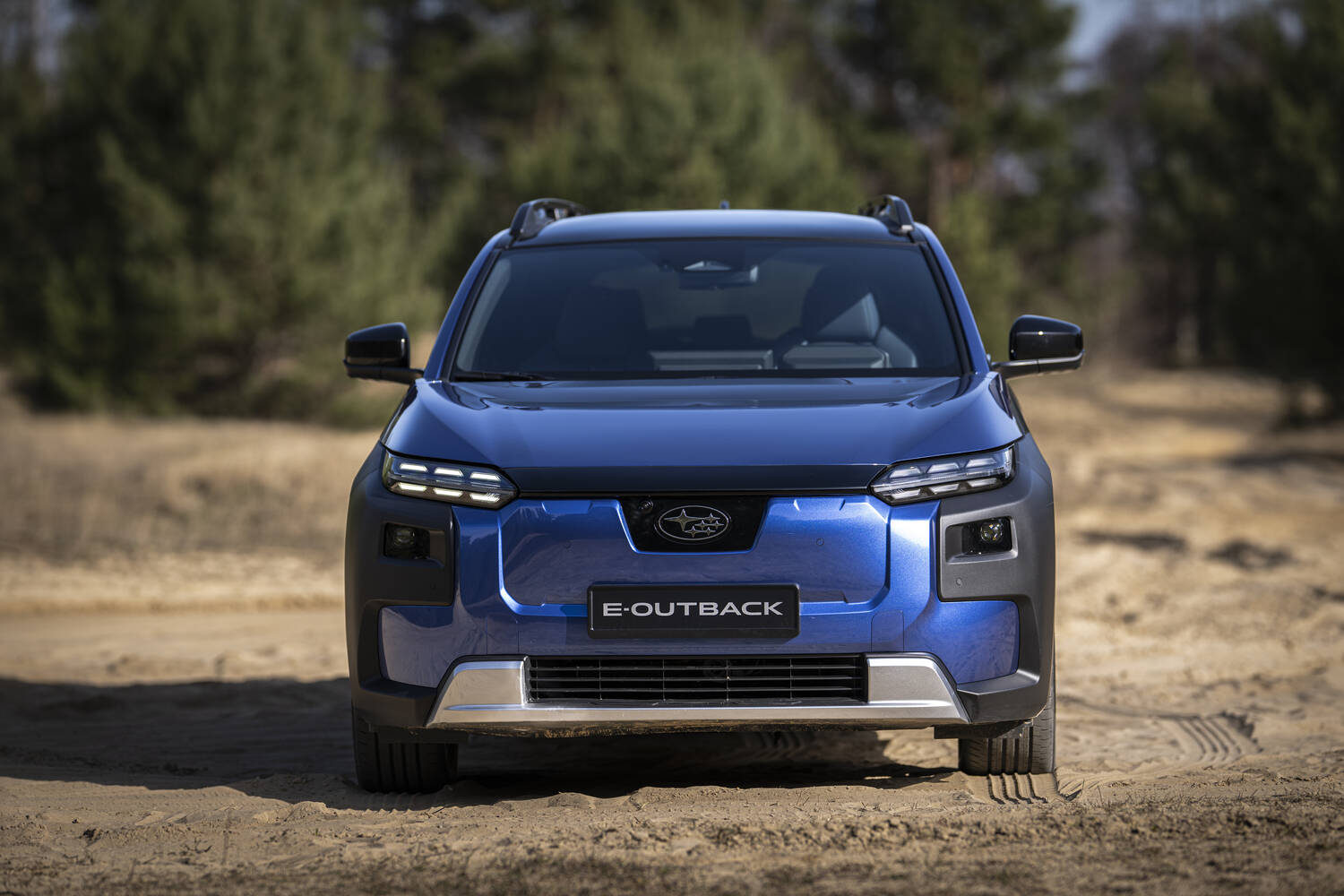
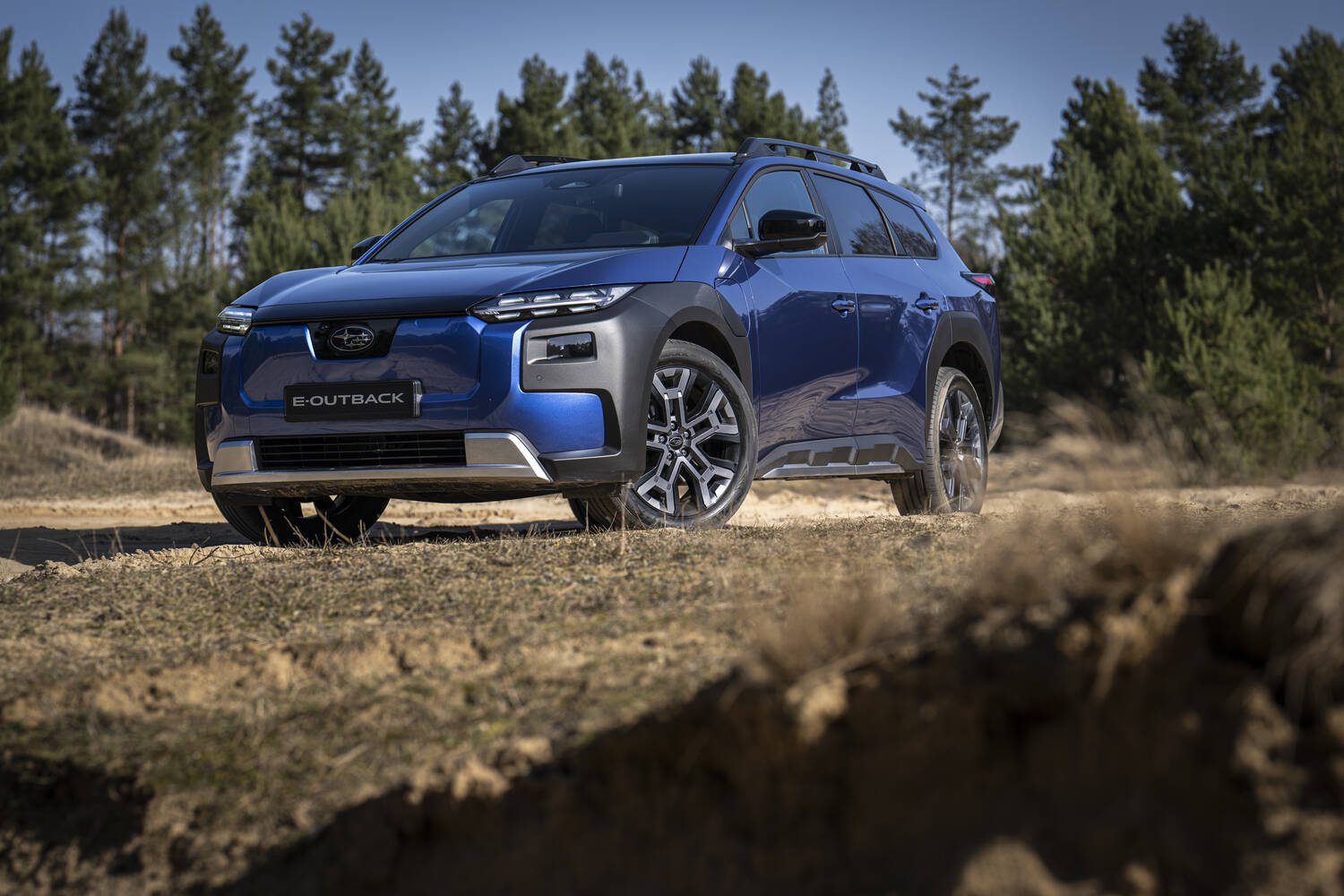
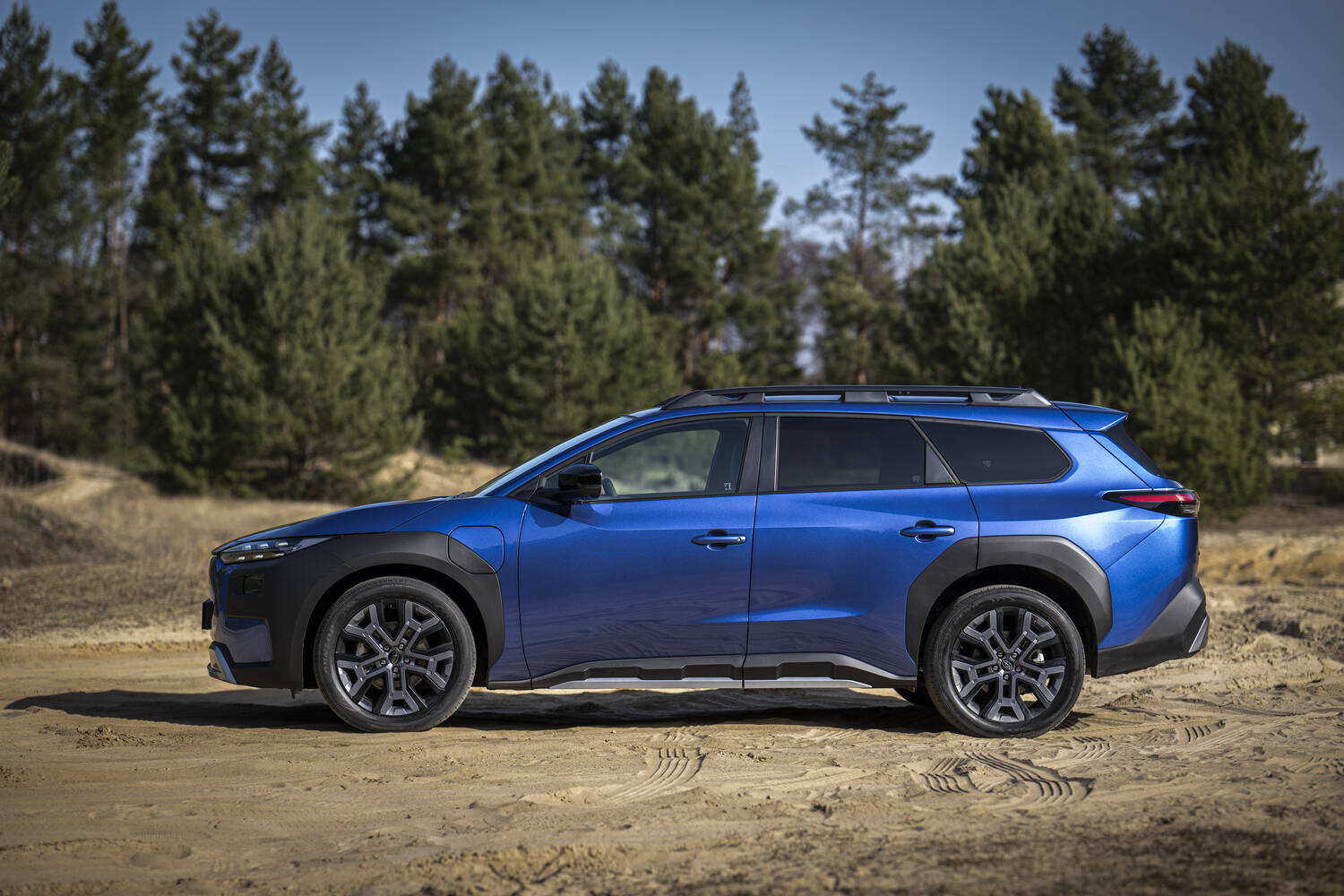
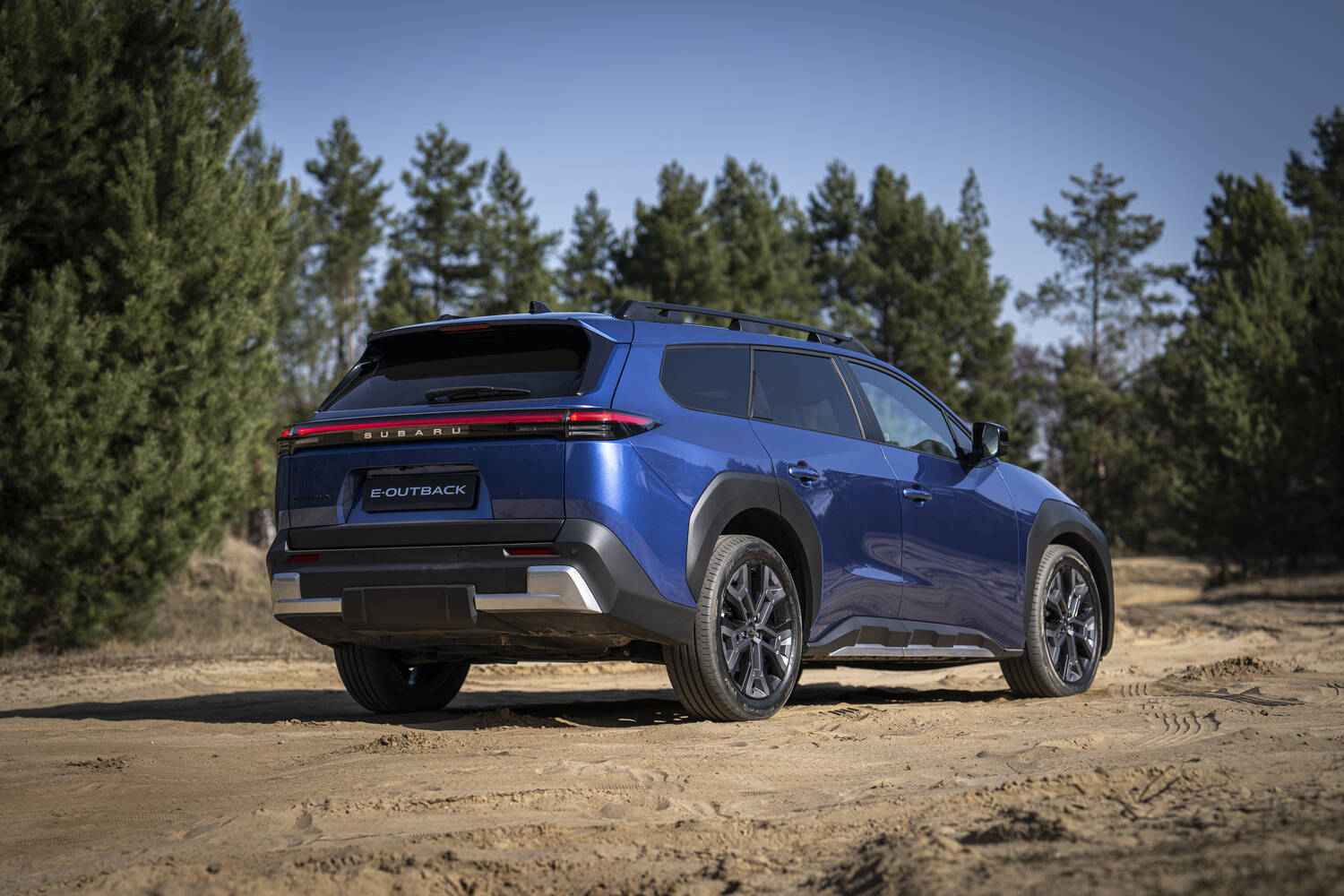
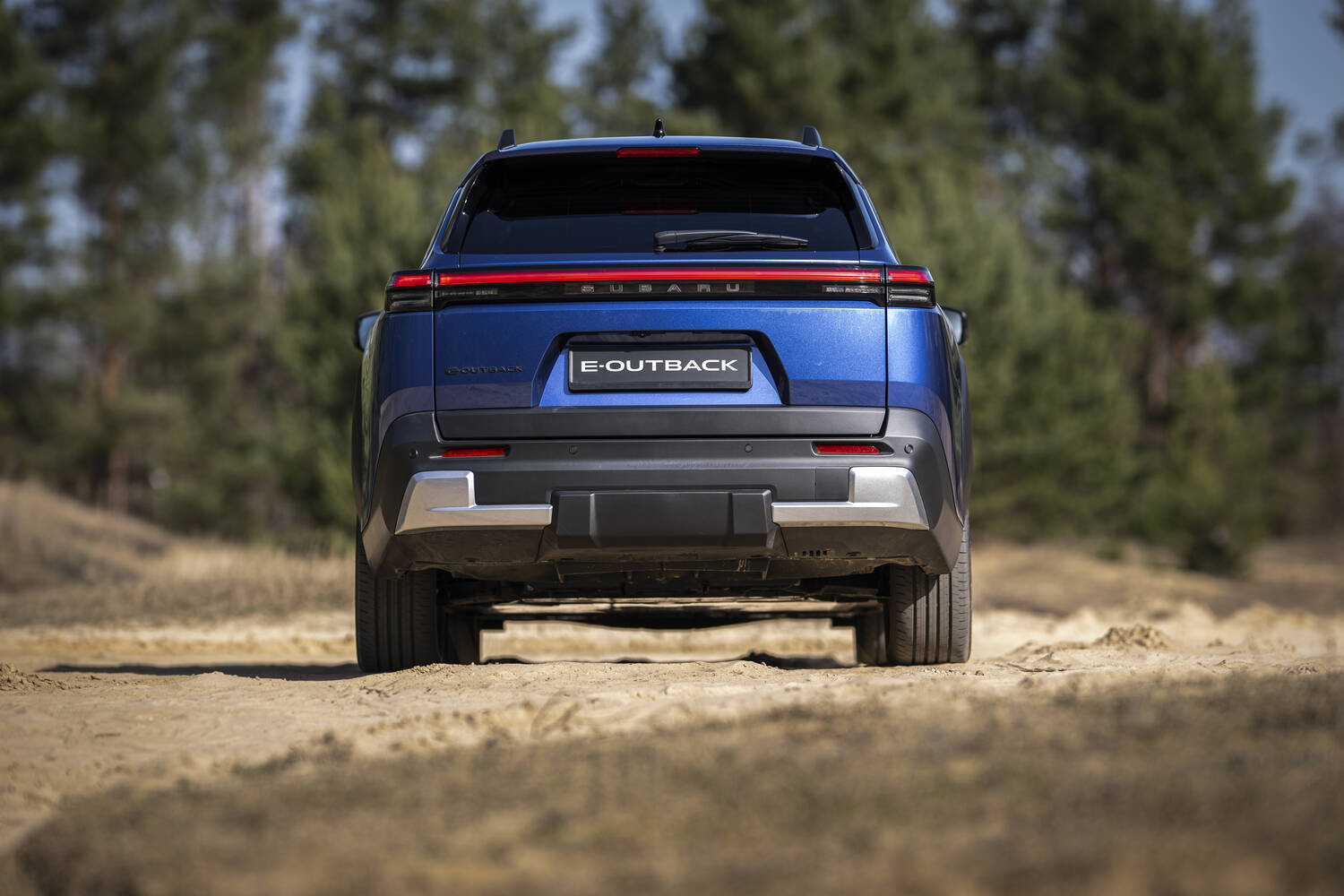

Exterior & design of the 2026 Subaru E-Outback
- Rare wagon form to bodywork
- Lots of plastic body cladding
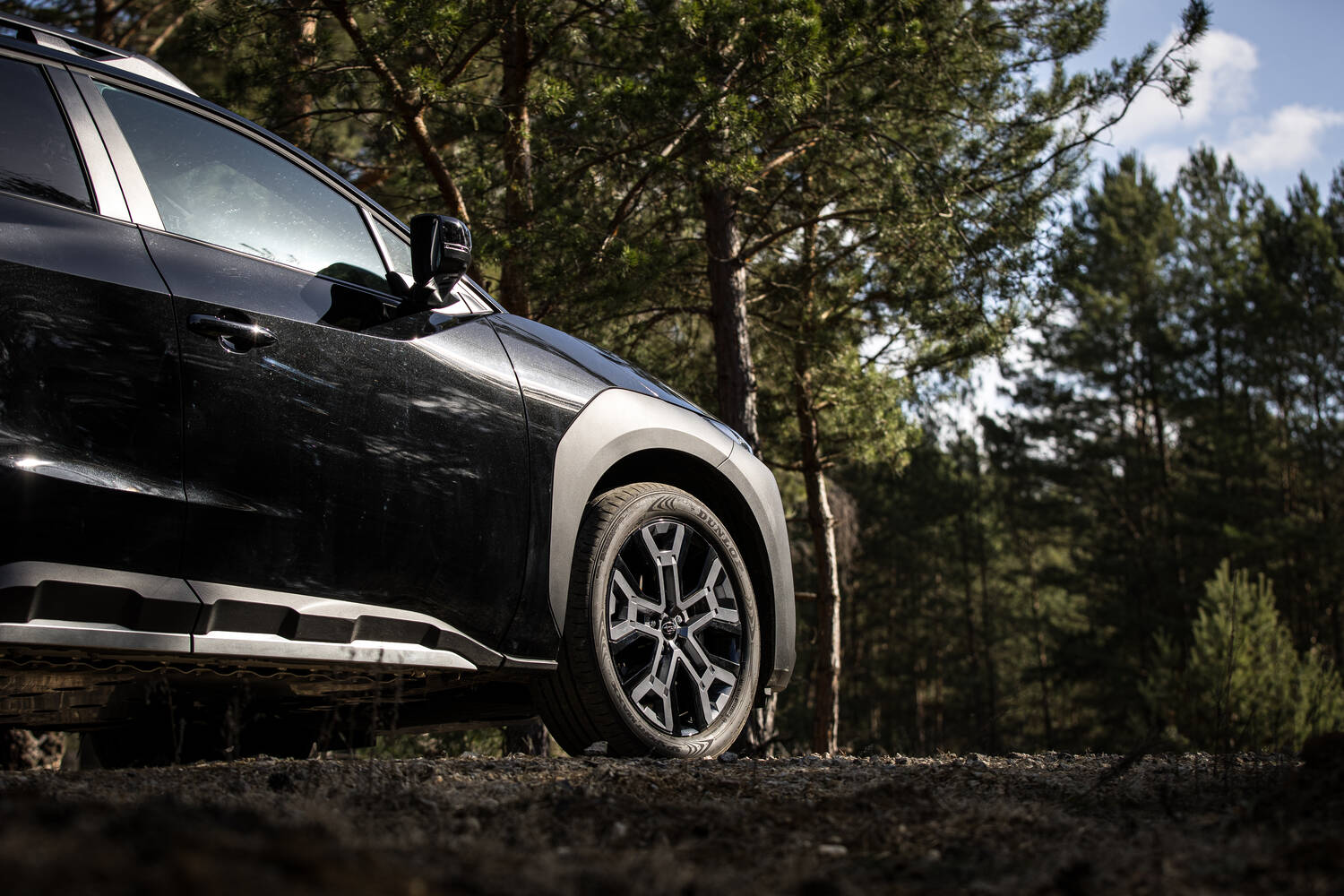
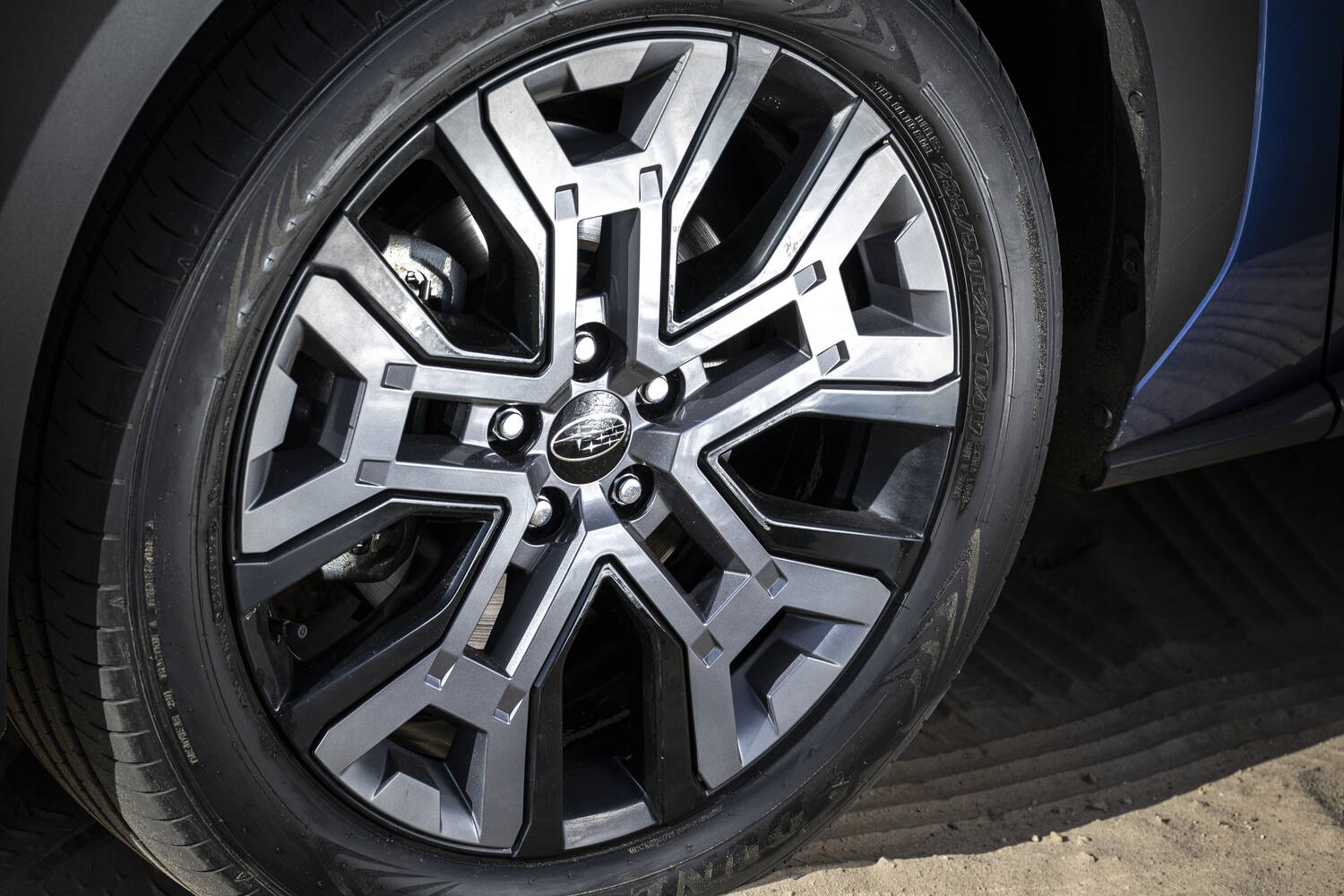
- 18- or 20-inch alloy wheels

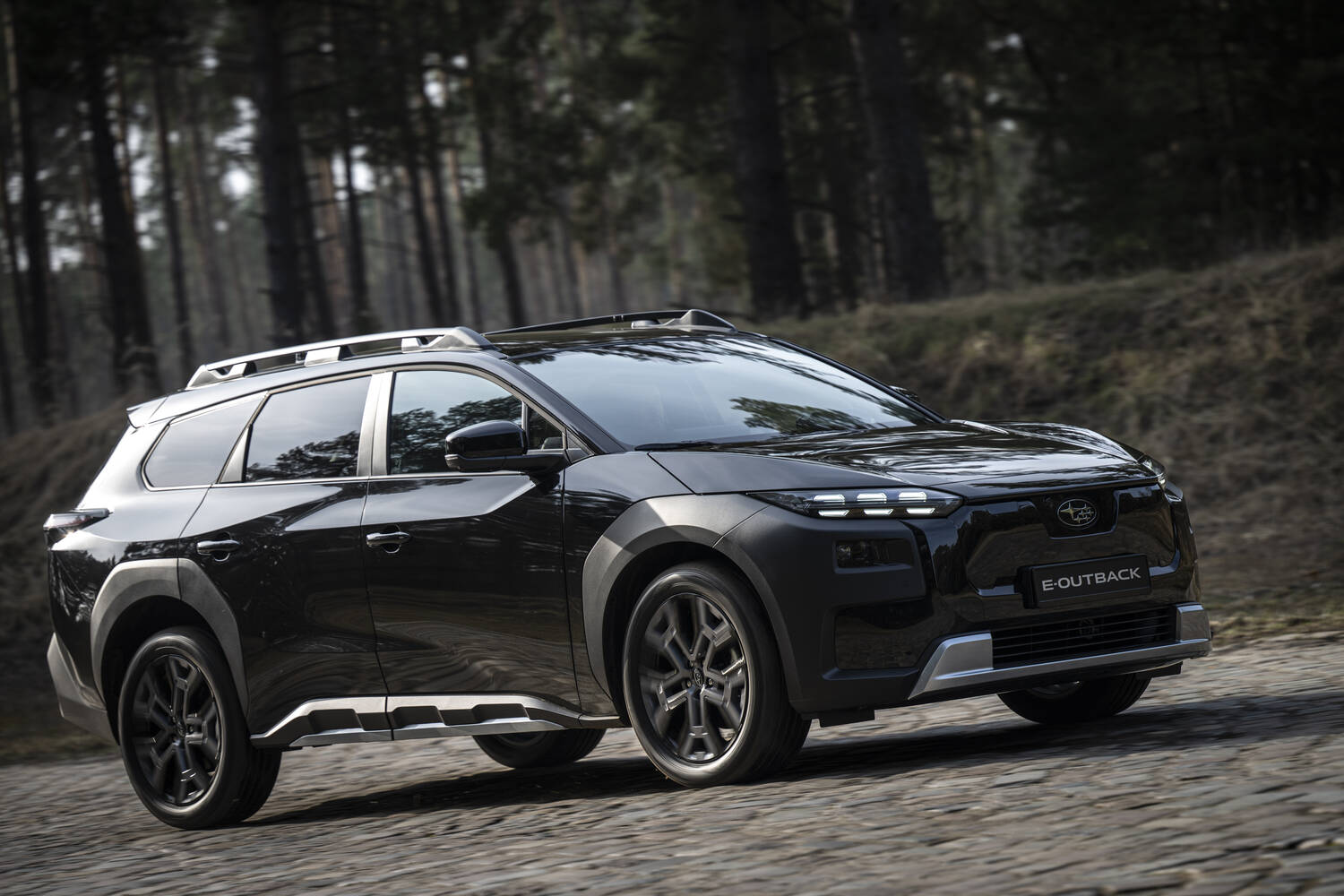
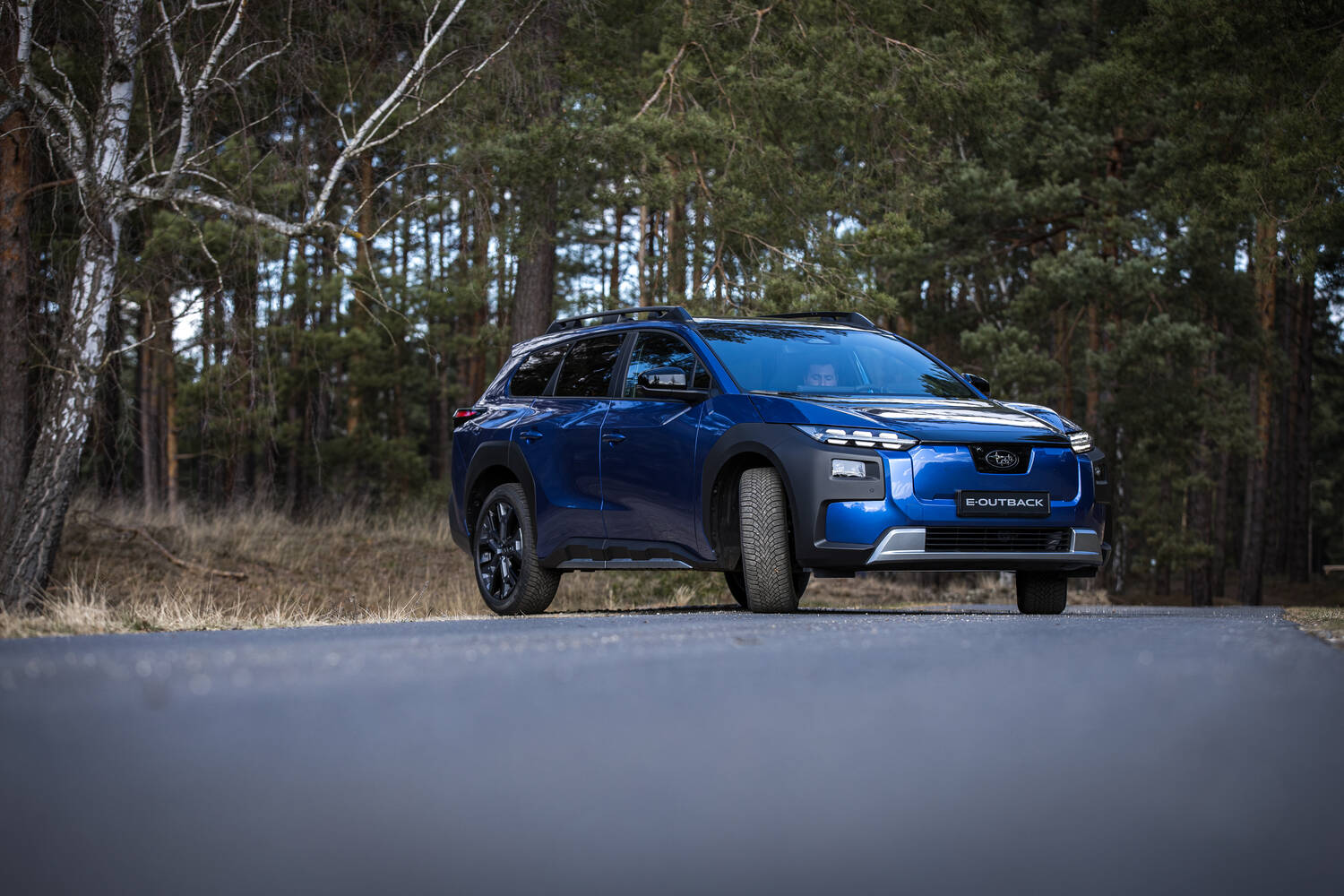
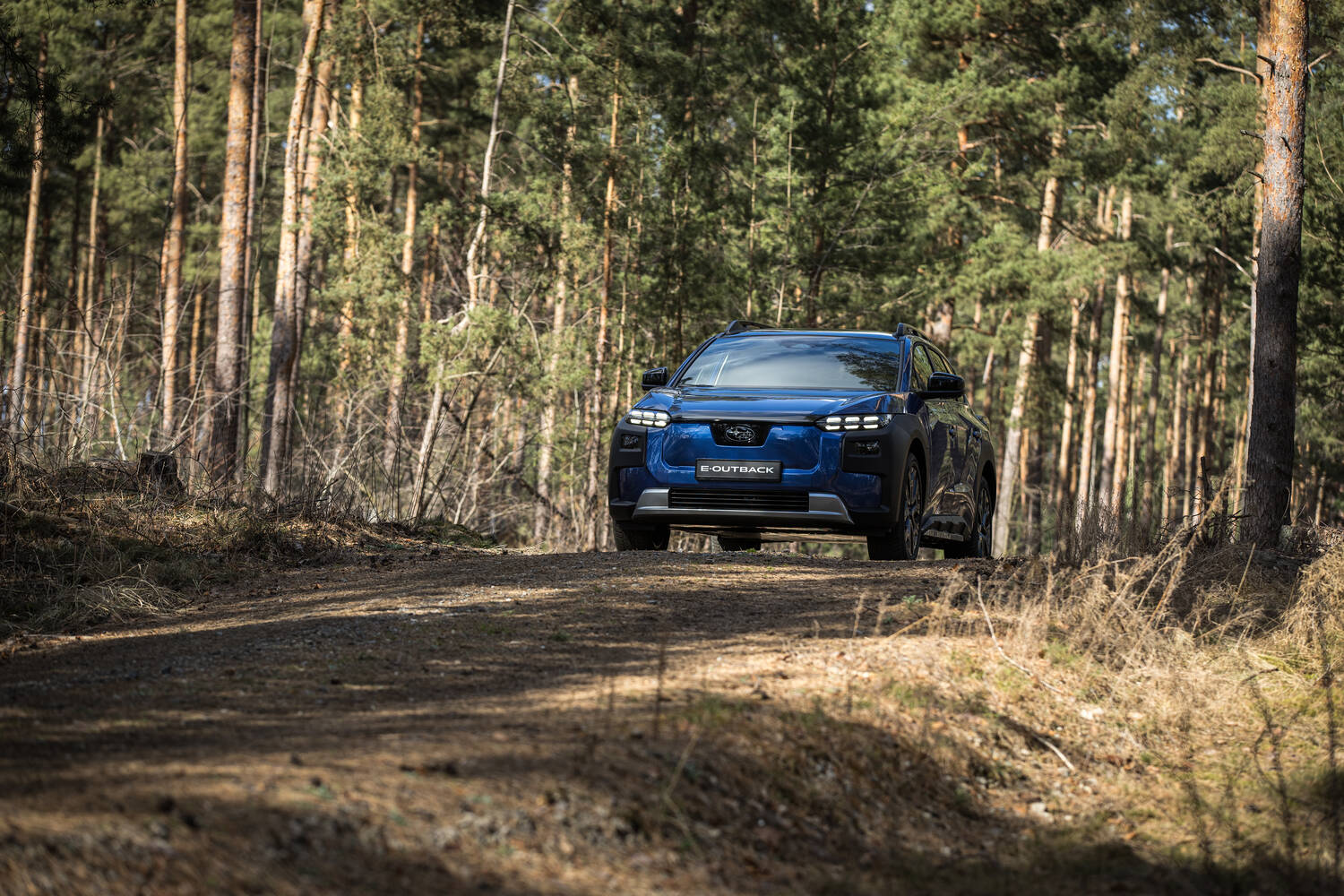
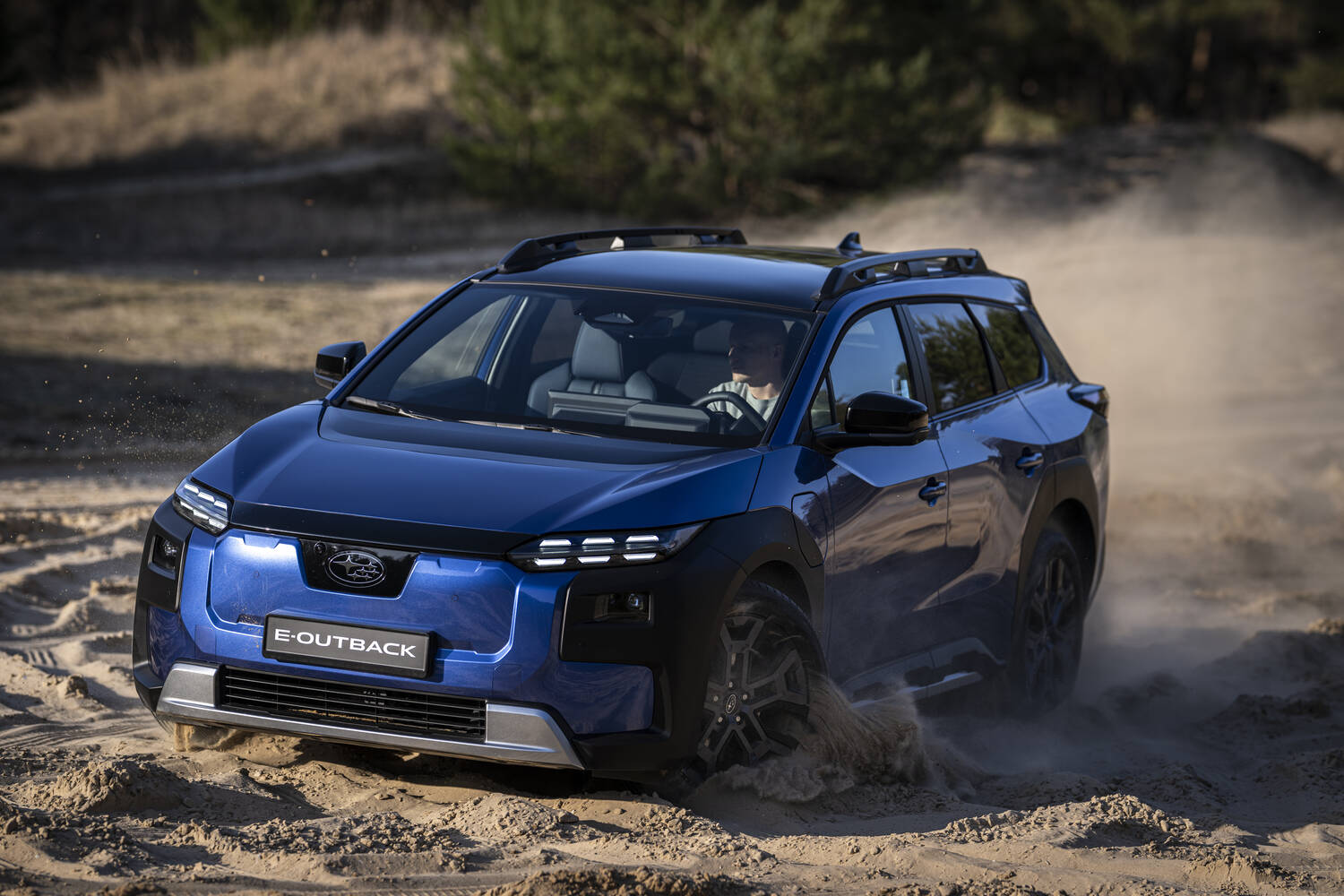
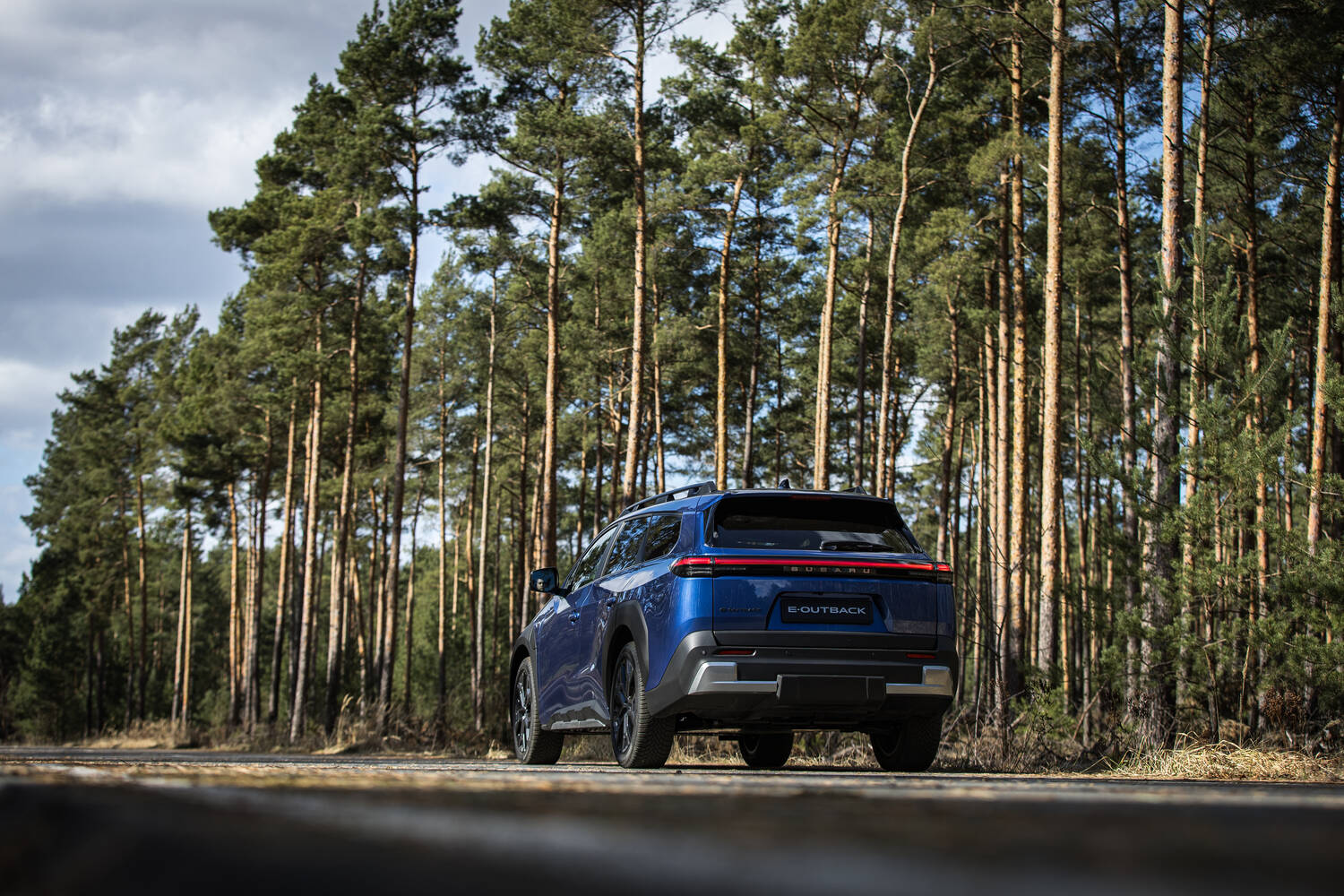
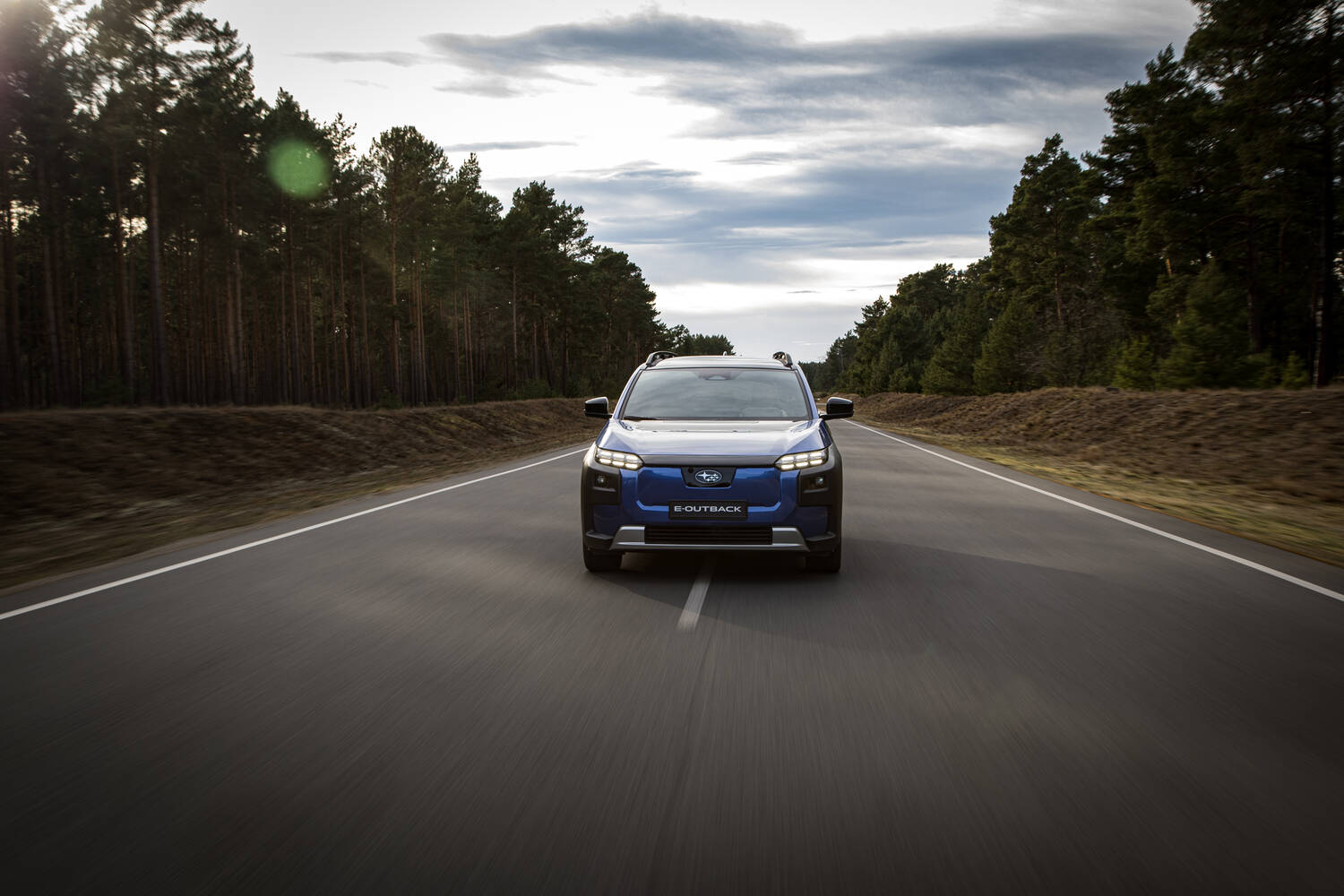
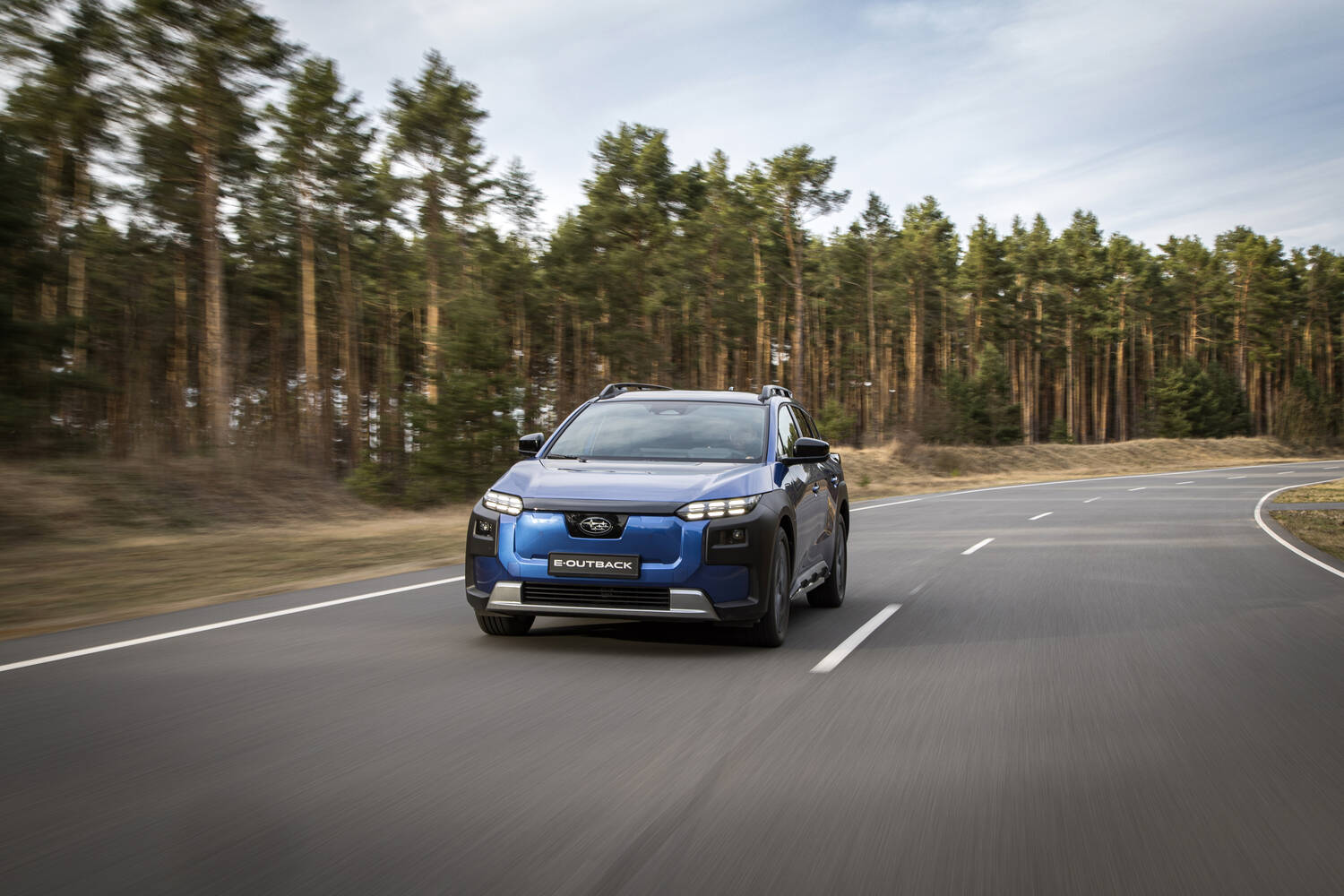
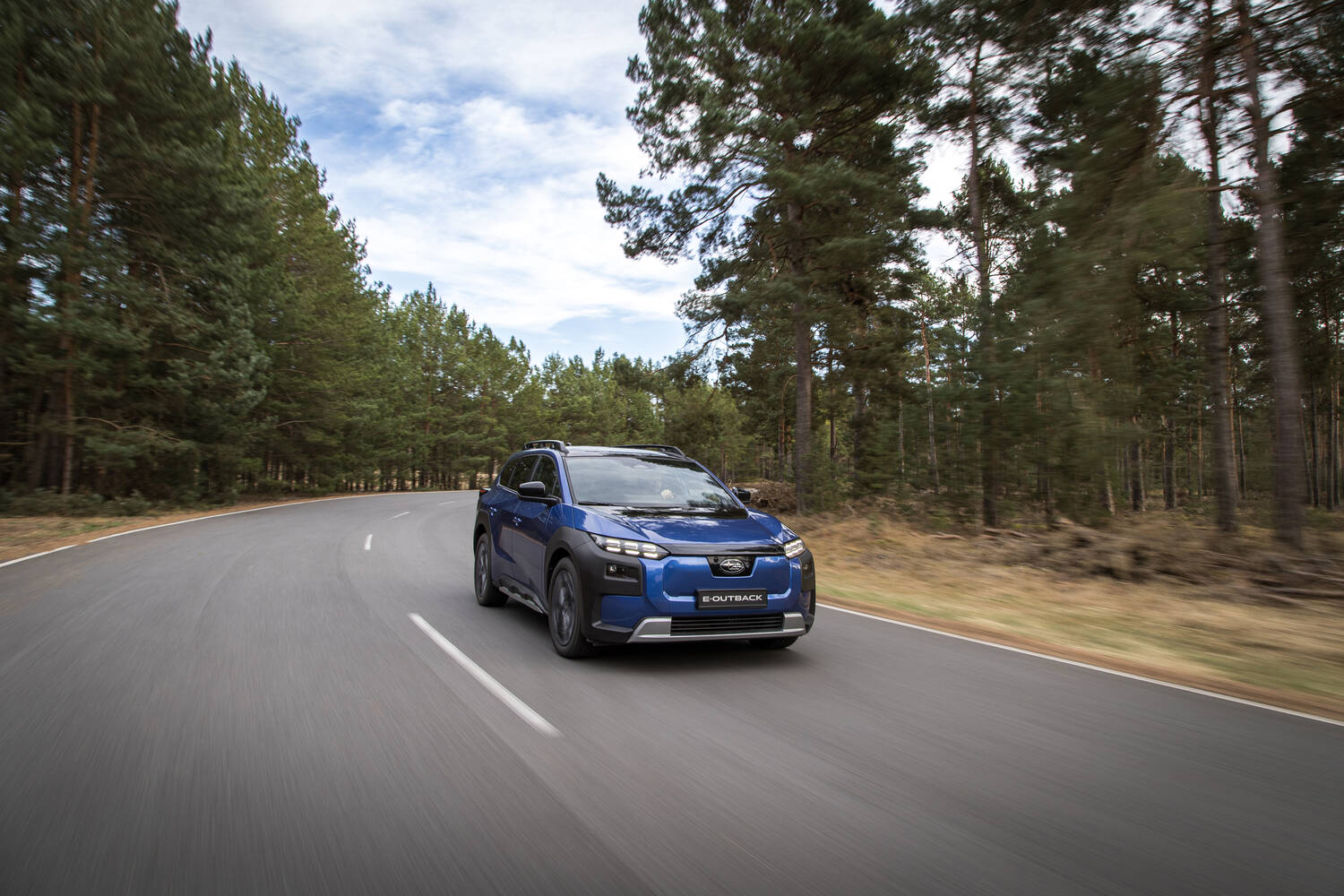
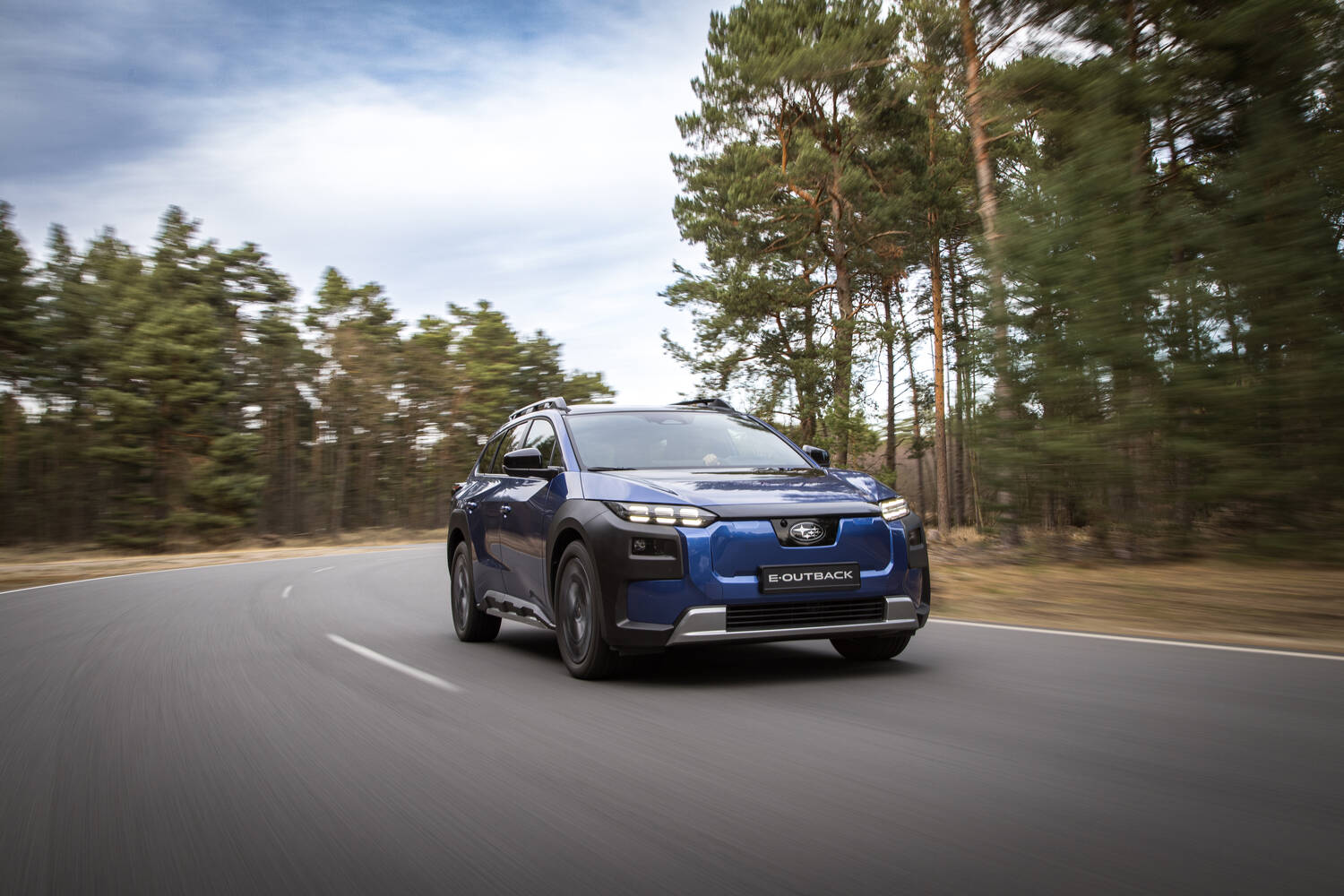
There have been six generations of the Subaru Outback since 1995, with the car's formula of a jacked-up estate all swathed in protective body extrusions inspiring early rival machines from premium European brands, such as the Volvo XC70 and Audi A6 allroad quattro - so it's perhaps no surprise that the electric E-Outback is quite clearly cut from the same stylistic cloth, despite its different form of propulsion.
Indeed, it's dimensionally almost the same as the outgoing version of Subaru's off-road wagon (the E-Outback is 25mm shorter, 15mm narrower and 5mm lower), but it's better to think of it as an estate version of the Solterra - the two electric Subarus have the same 2.85-metre wheelbase, front overhang and basic shape until you get to the bodywork behind the back doors.

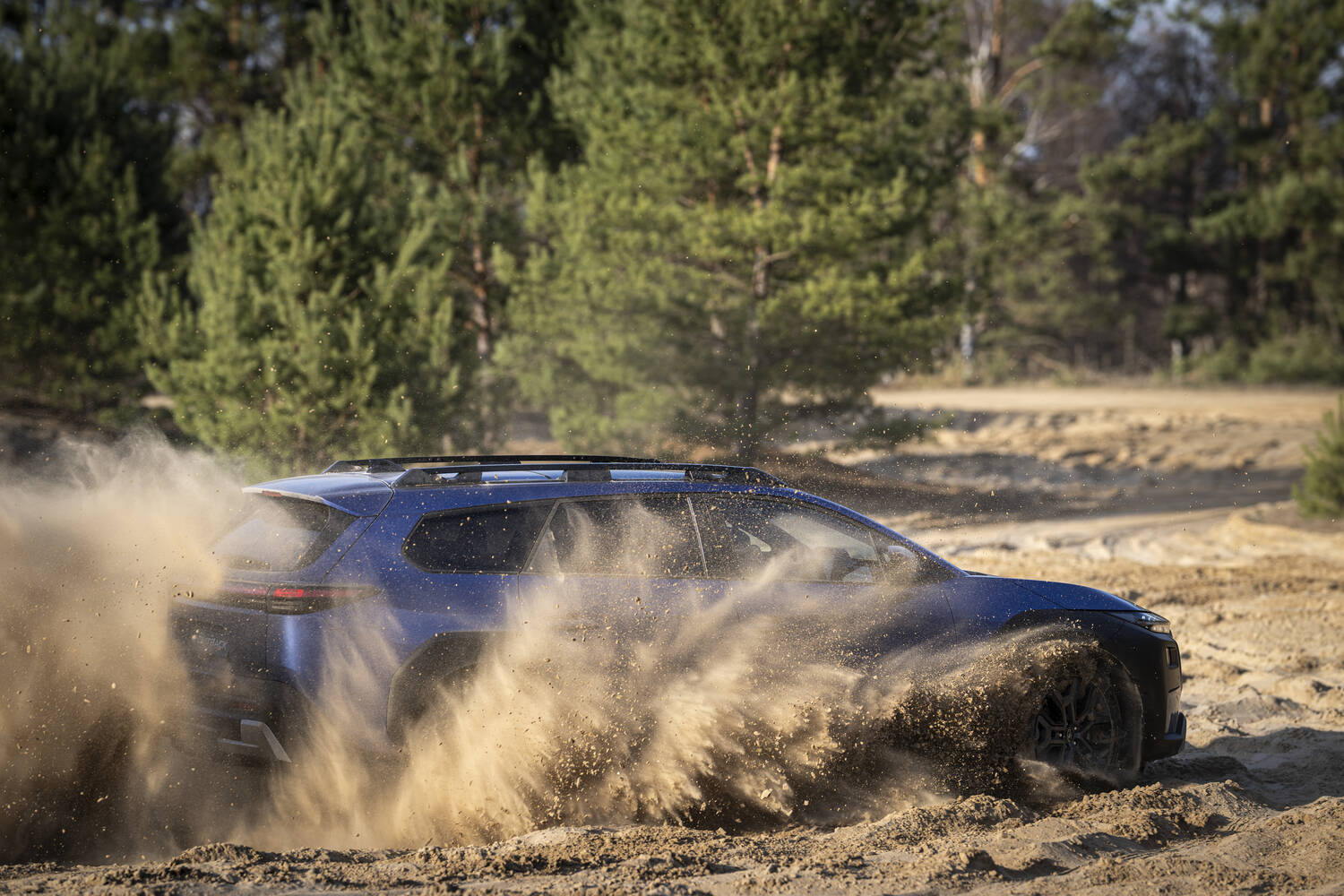
It's only here that the E-Outback's roof stays higher and the rear overhang becomes longer, making it 155mm larger than the Solterra when measured from tip to tail.
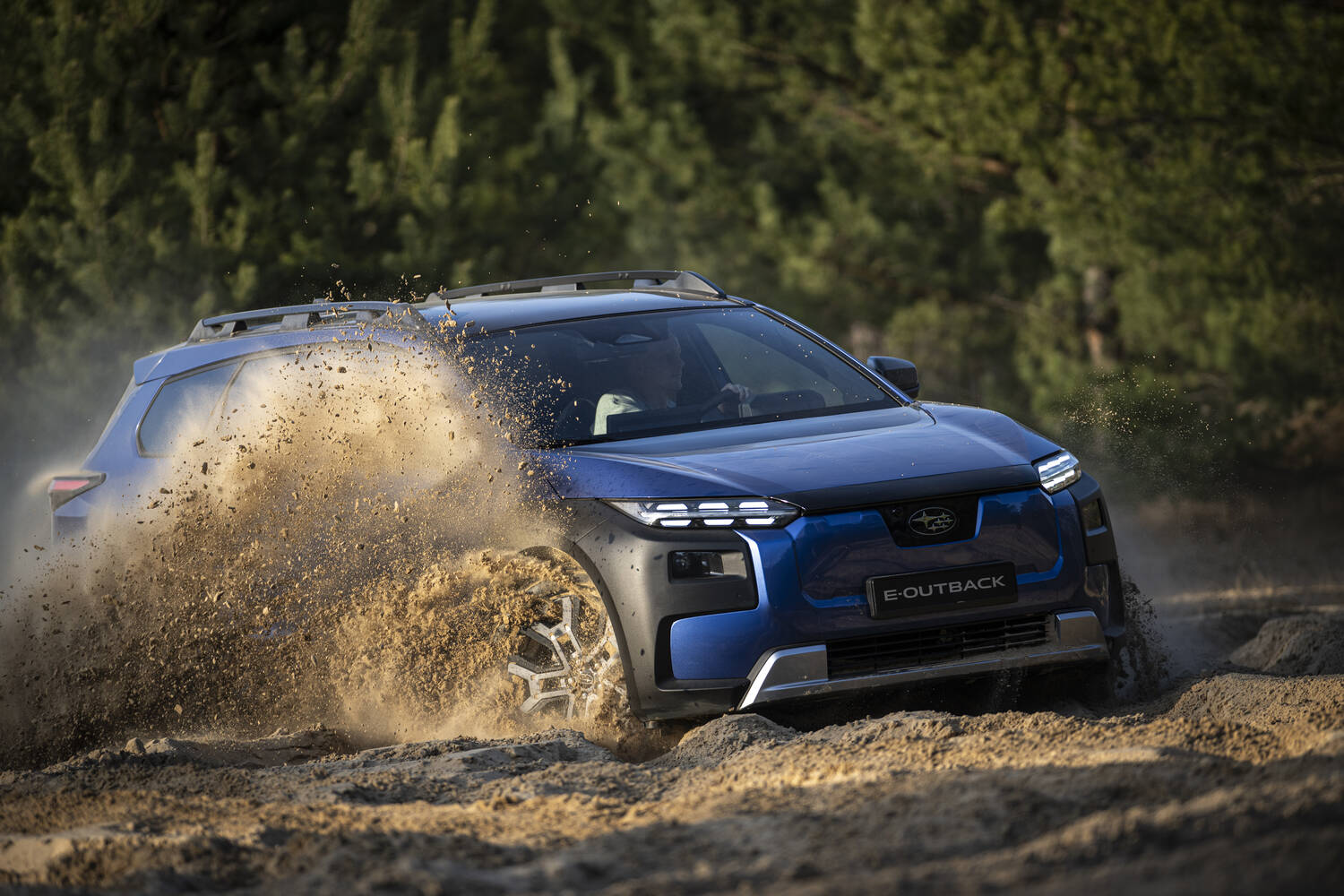
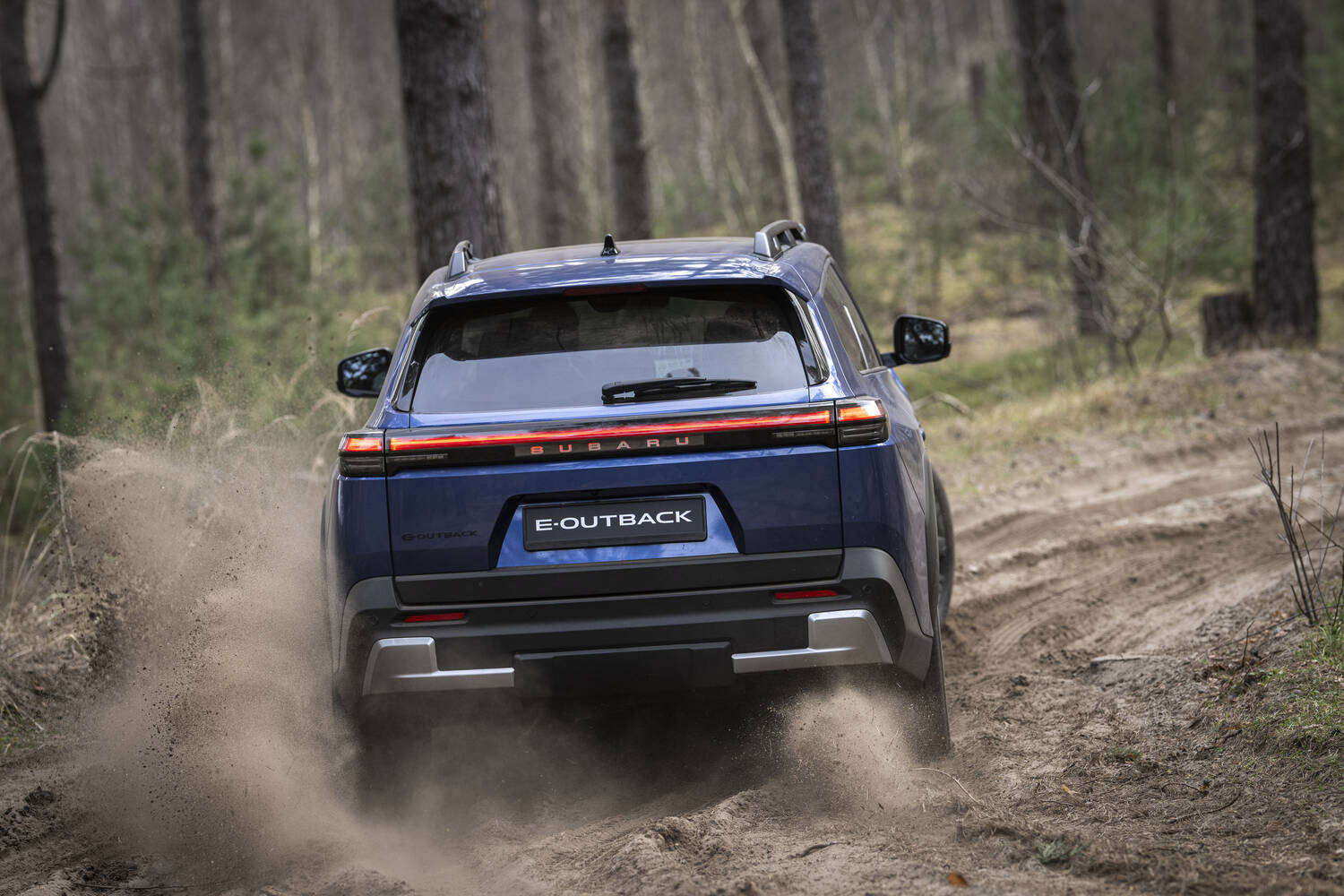
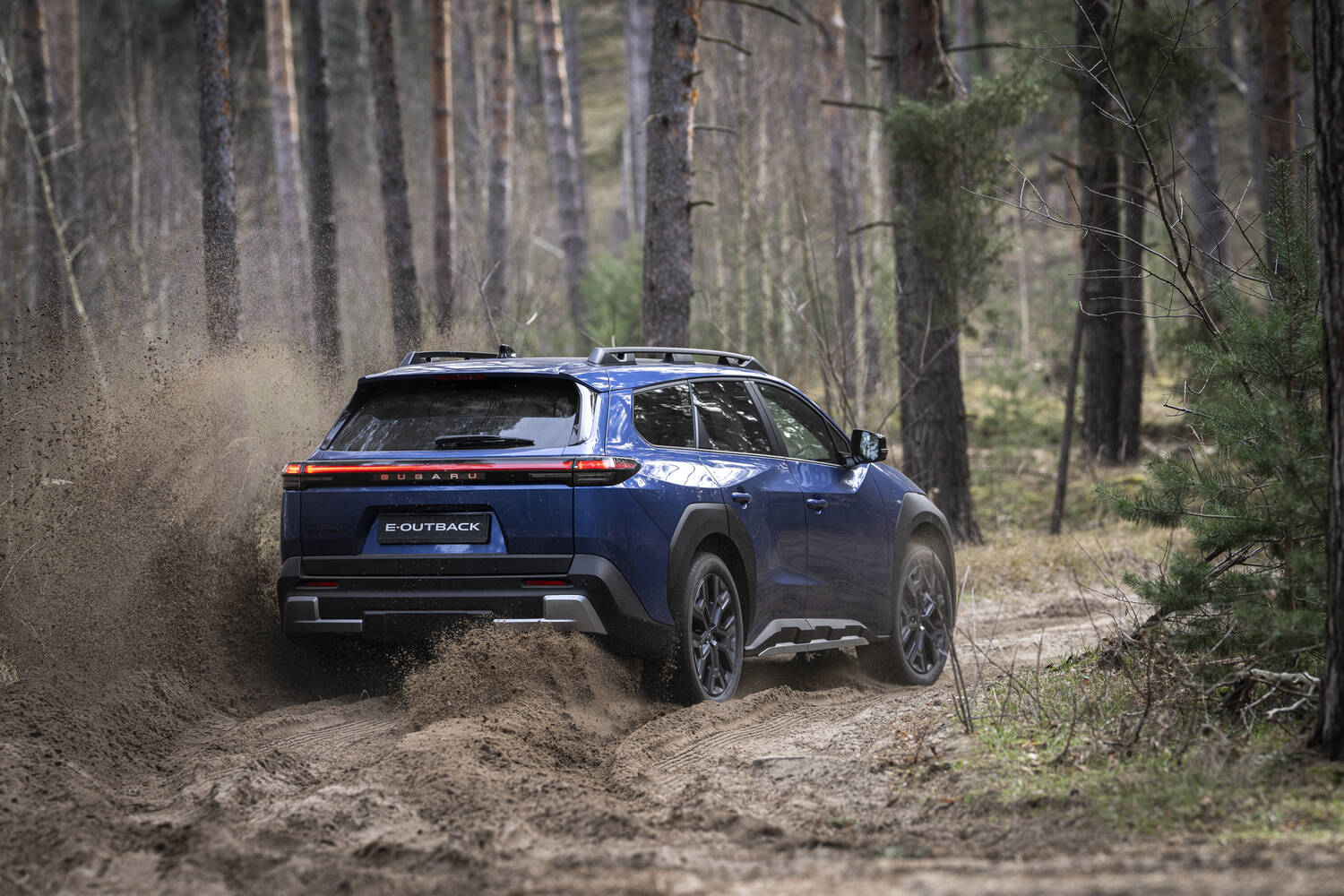
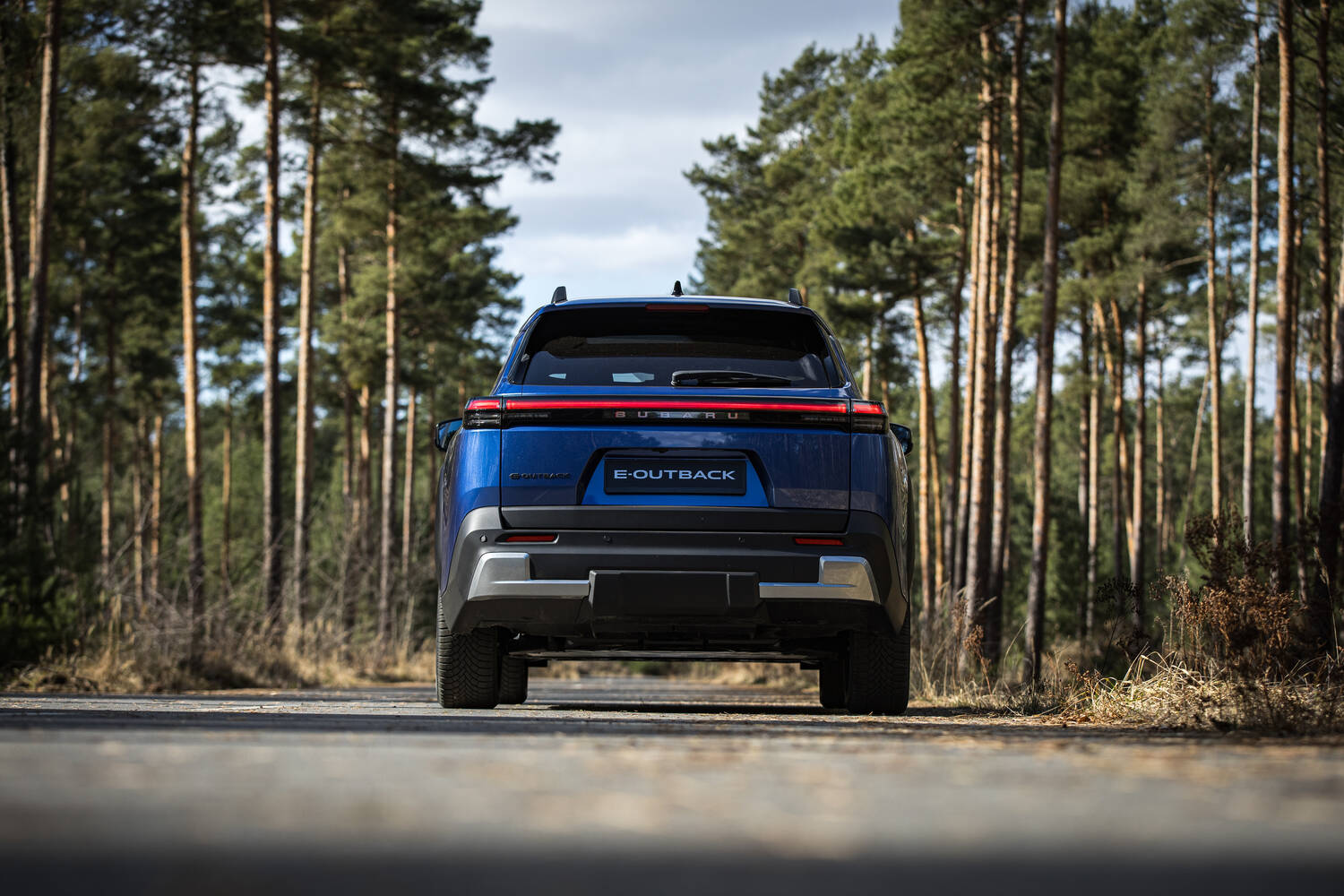
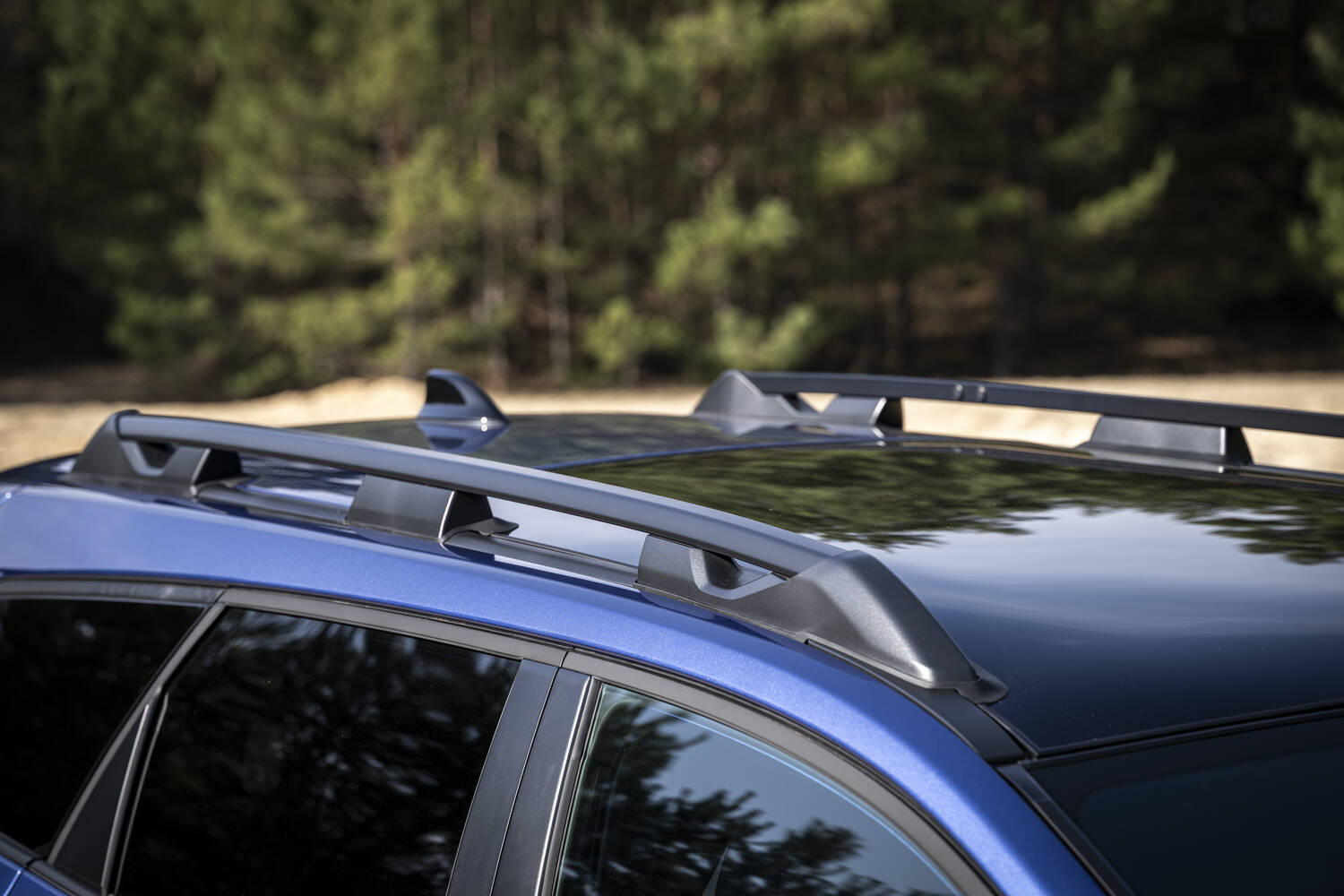
From thereon in, it's the usual lifestyle-estate signifiers we've seen over the years: rugged plastic body cladding, roof rails up top, big chunky alloys in the arches.

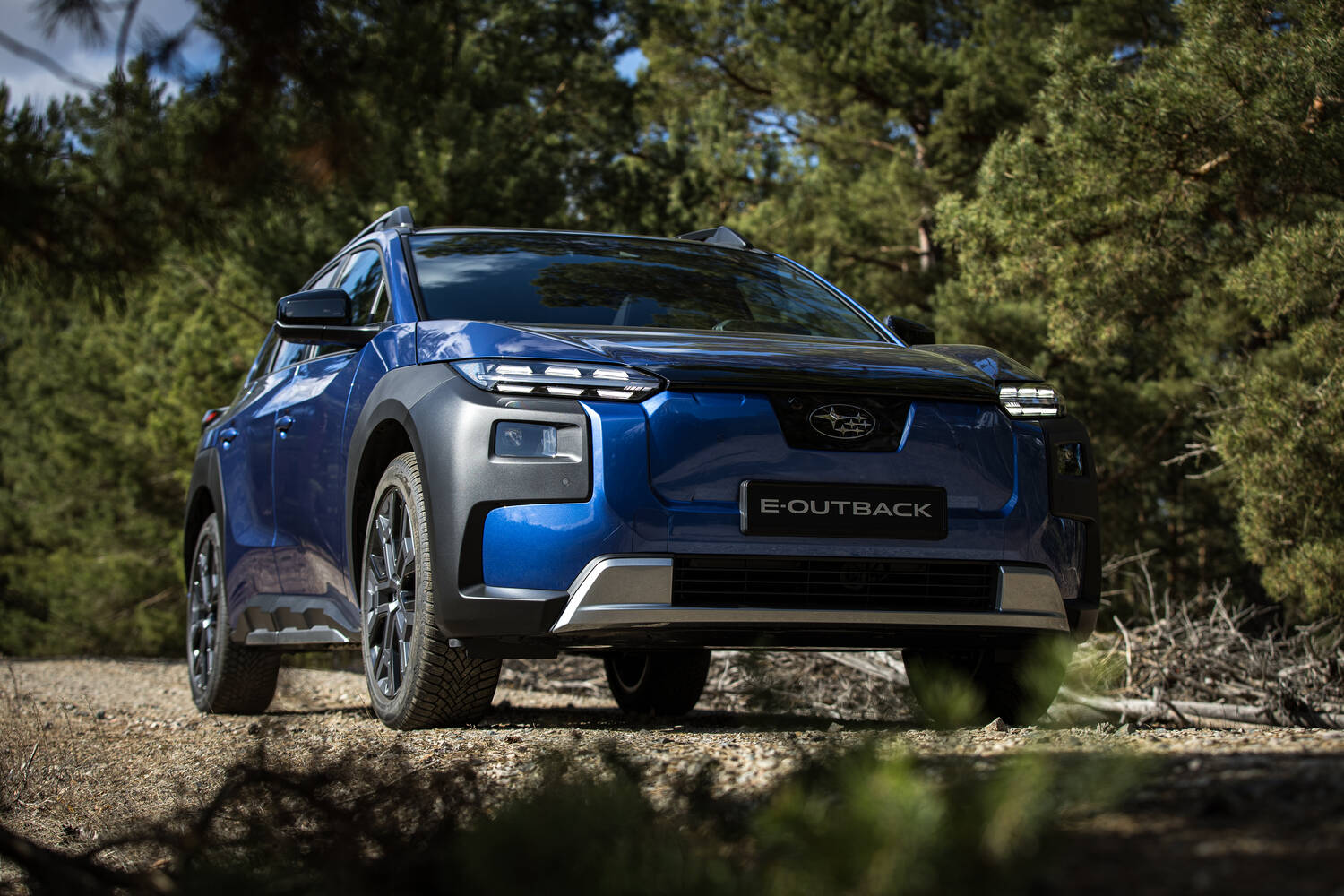
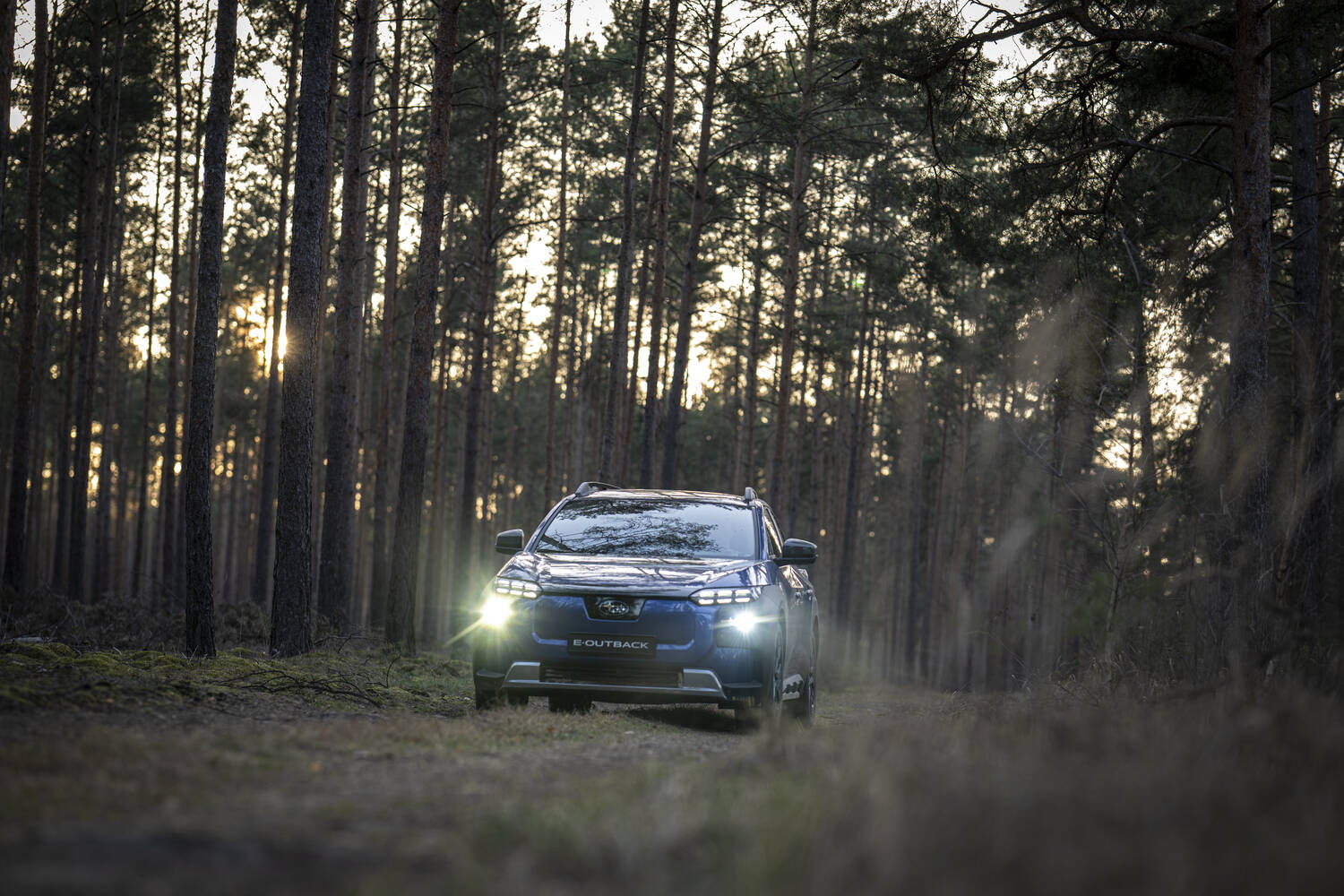
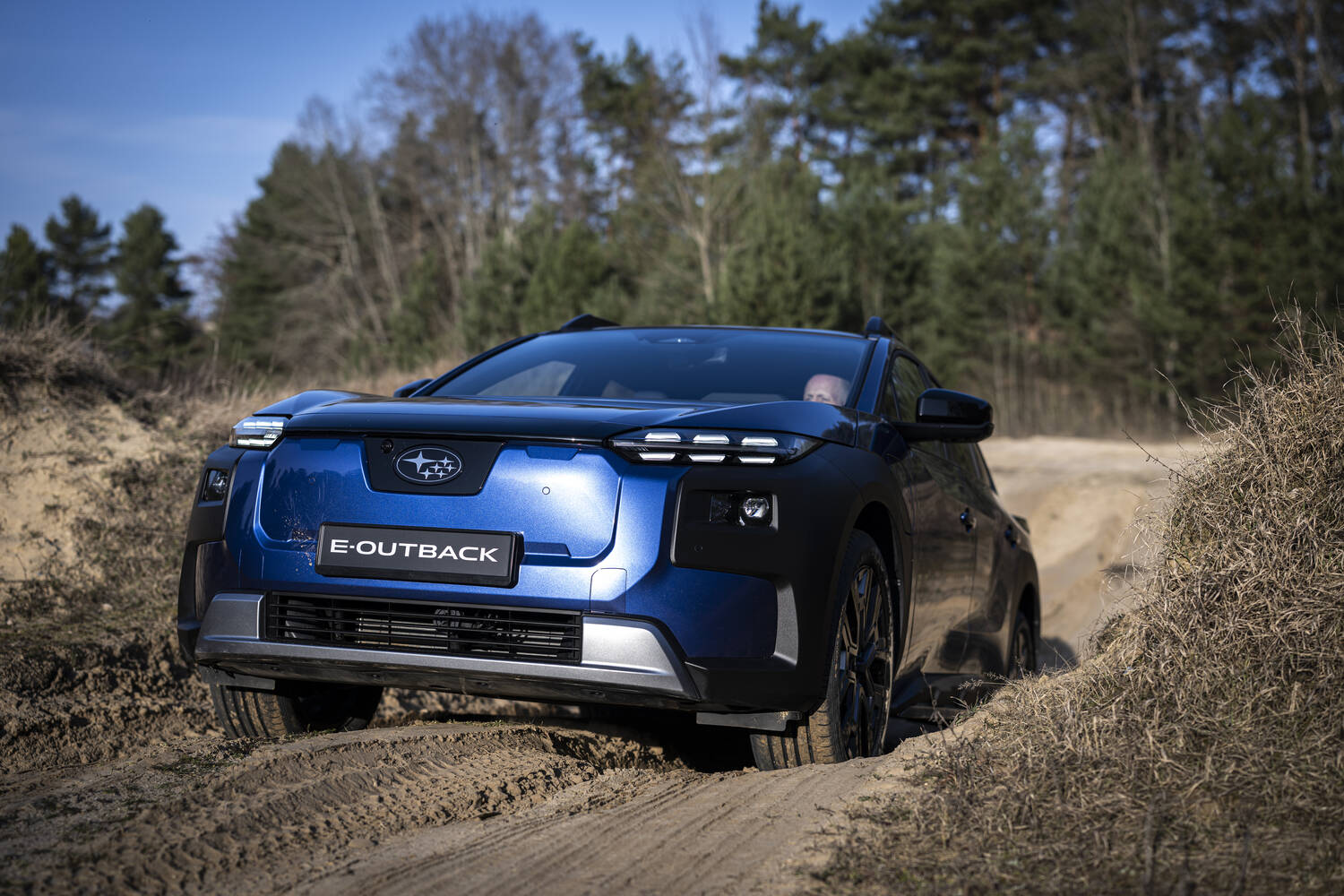
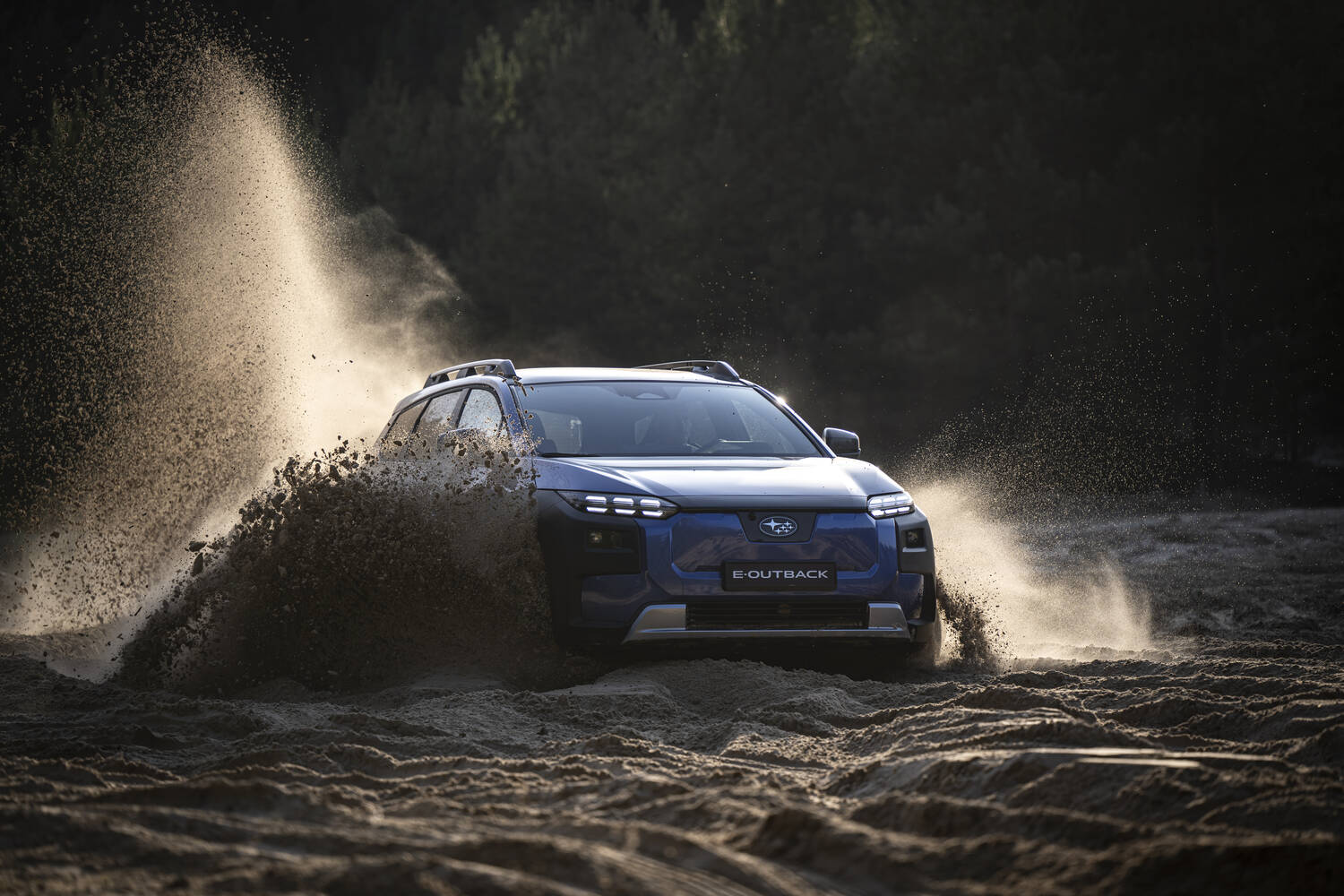
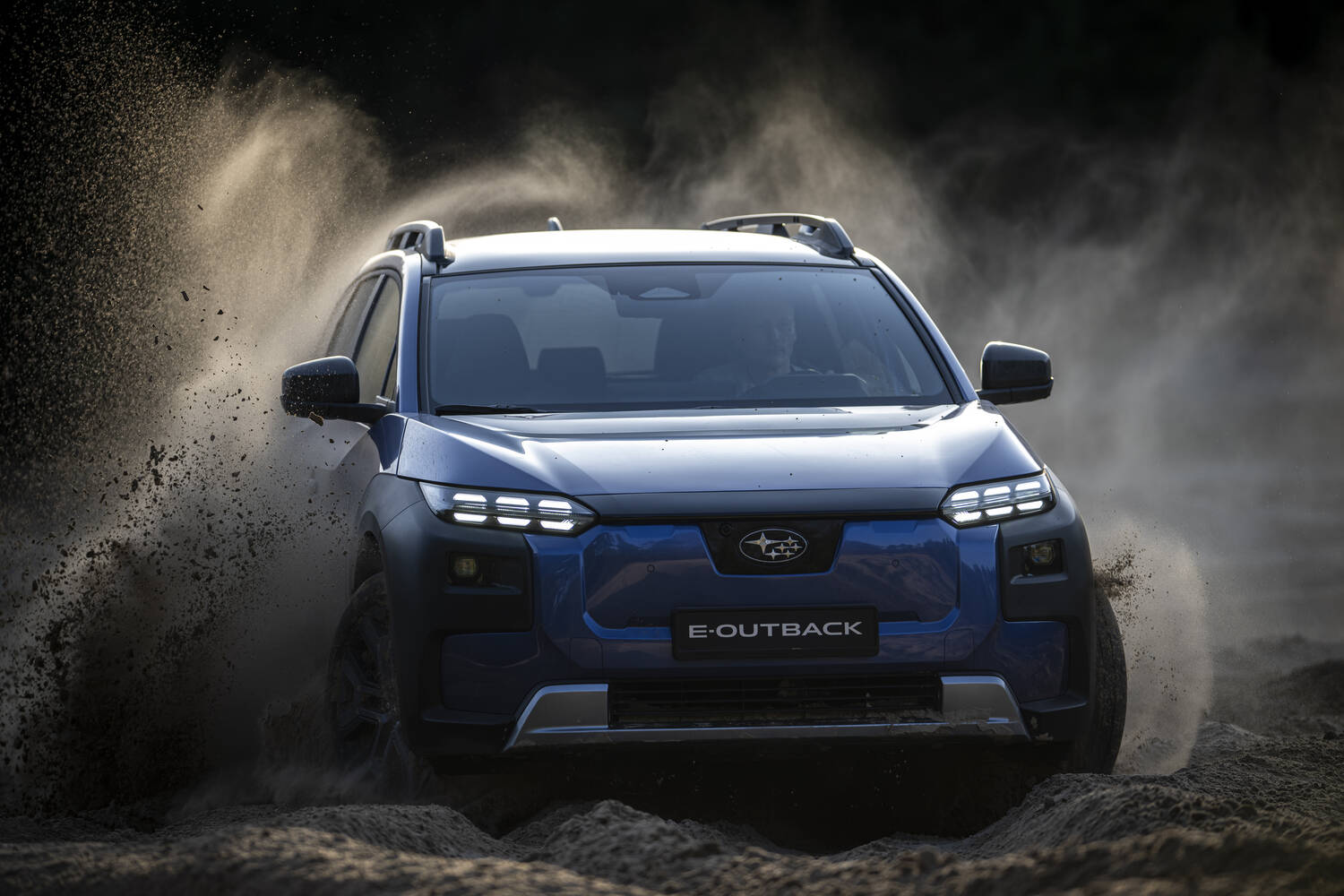
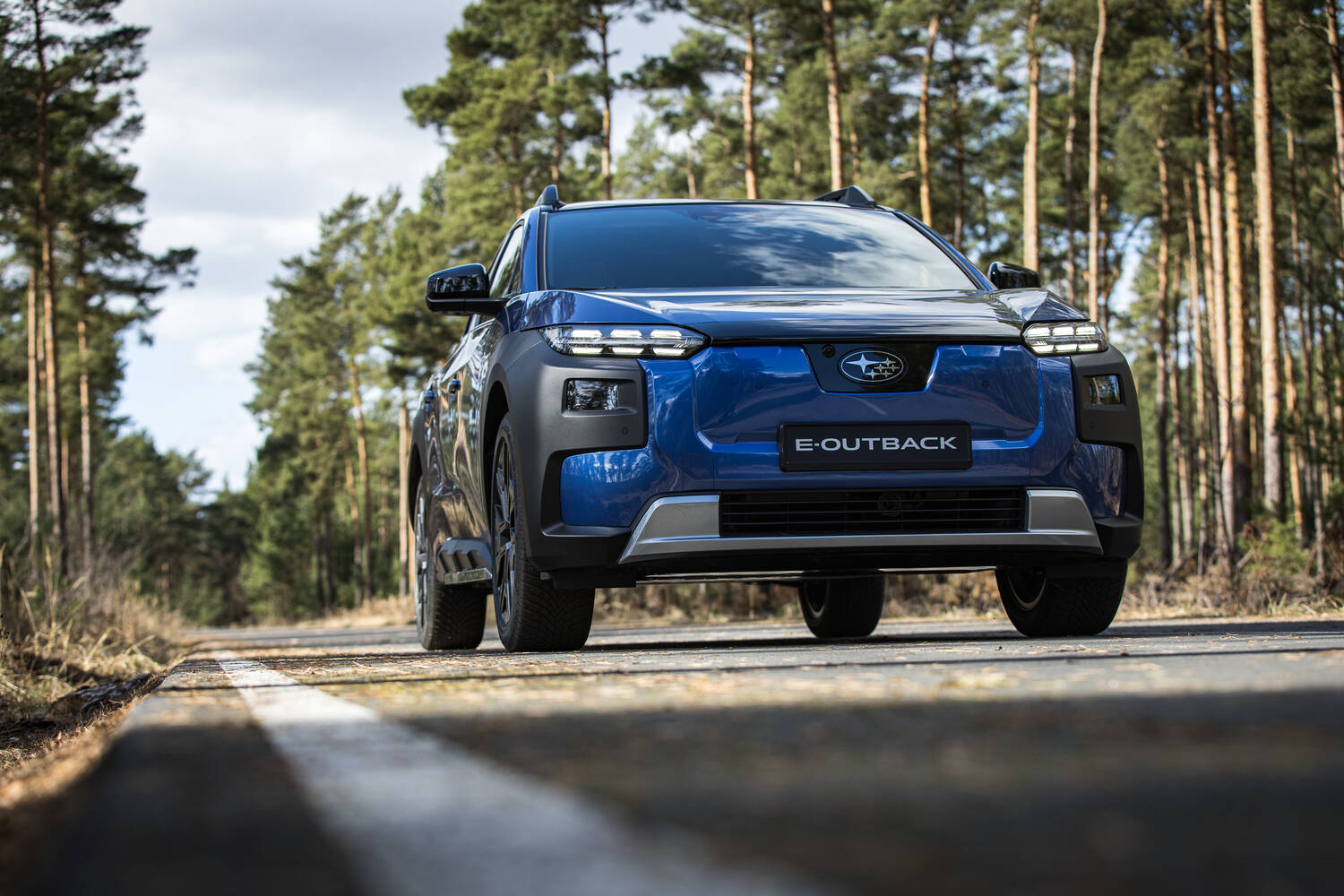
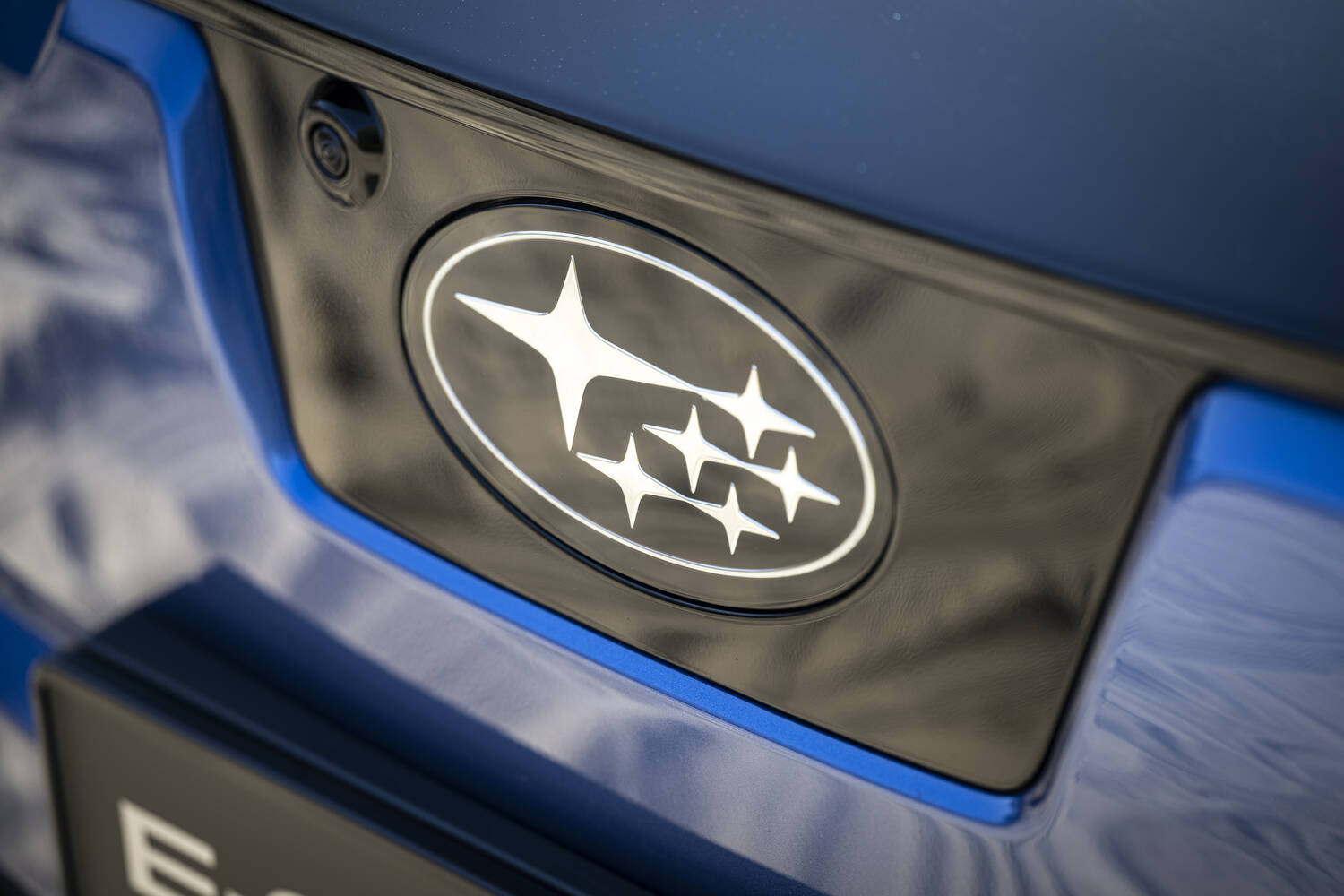
The overall effect, though, is quite pleasing and the E-Outback immediately becomes Subaru's most attractive model going. It also has some of the styling quirks seen on the two preceding EVs from this manufacturer, most notably the six-point daytime running lamps in the headlight clusters - this is a direct nod to the six stars in Subaru's corporate emblem.
Dimensions of the 2026 Subaru E-Outback
- Length:
- 4,845mm
- Width:
- 1,860mm (excluding mirrors)
- Height:
- 1,675mm
- Wheelbase:
- 2,850mm
Paint colours for the 2026 Subaru E-Outback
On the assumption the Irish range follows Subaru Europe's convention, there should be six colours for the E-Outback range, all designed to show off the contrast of the black plastic body cladding, and then a couple of these paints can be optioned with a black roof too, providing eight total colour schemes.

The body paints are Crystal White Pearl, Brilliant Bronze Metallic, Sapphire Blue Pearl, Magnetite Grey Metallic, Crystal Black Silica (this hides the E-Outback's most distinctive features) and Daybreak Blue Pearl.
Of these, both Crystal White and Brilliant Bronze can be optionally teamed with both the roof and A-pillars of the car finished in Crystal Black Silica.
Interior, practicality, tech & comfort of the 2026 Subaru E-Outback
- Large infotainment screen works well
- Lots of space within
- Biggest boot of any Subaru

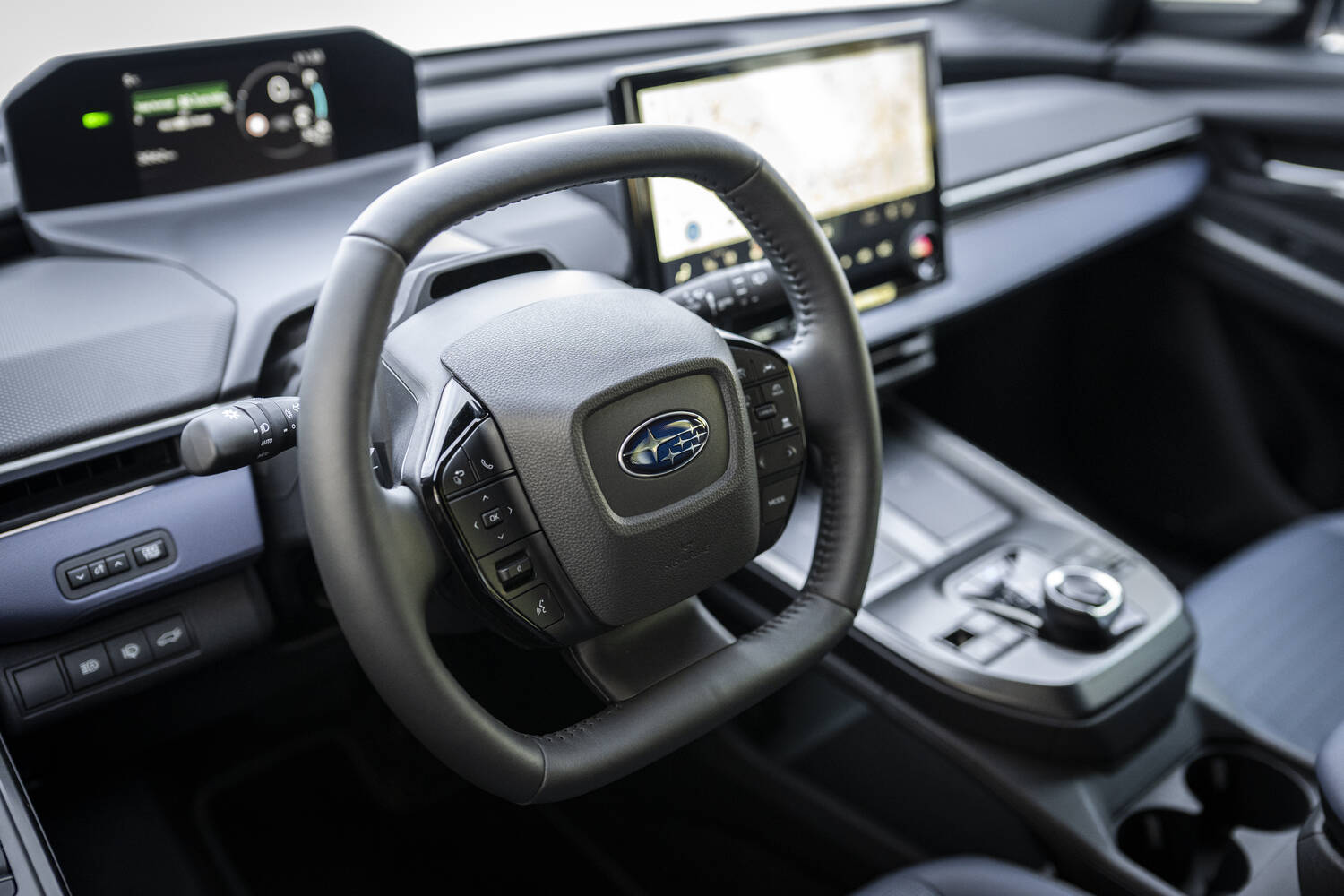
The material quality and general ergonomic layout of the Subaru E-Outback's interior are both fine, although there's obviously a lot of similarity between this cockpit and those of the Solterra and Uncharted relations, not to mention the interiors found in the connected Toyotas.
However, the E-Outback's main strengths are loads of passenger room, a huge boot and some neatly integrated technology.
Getting comfortable in the driver's seat
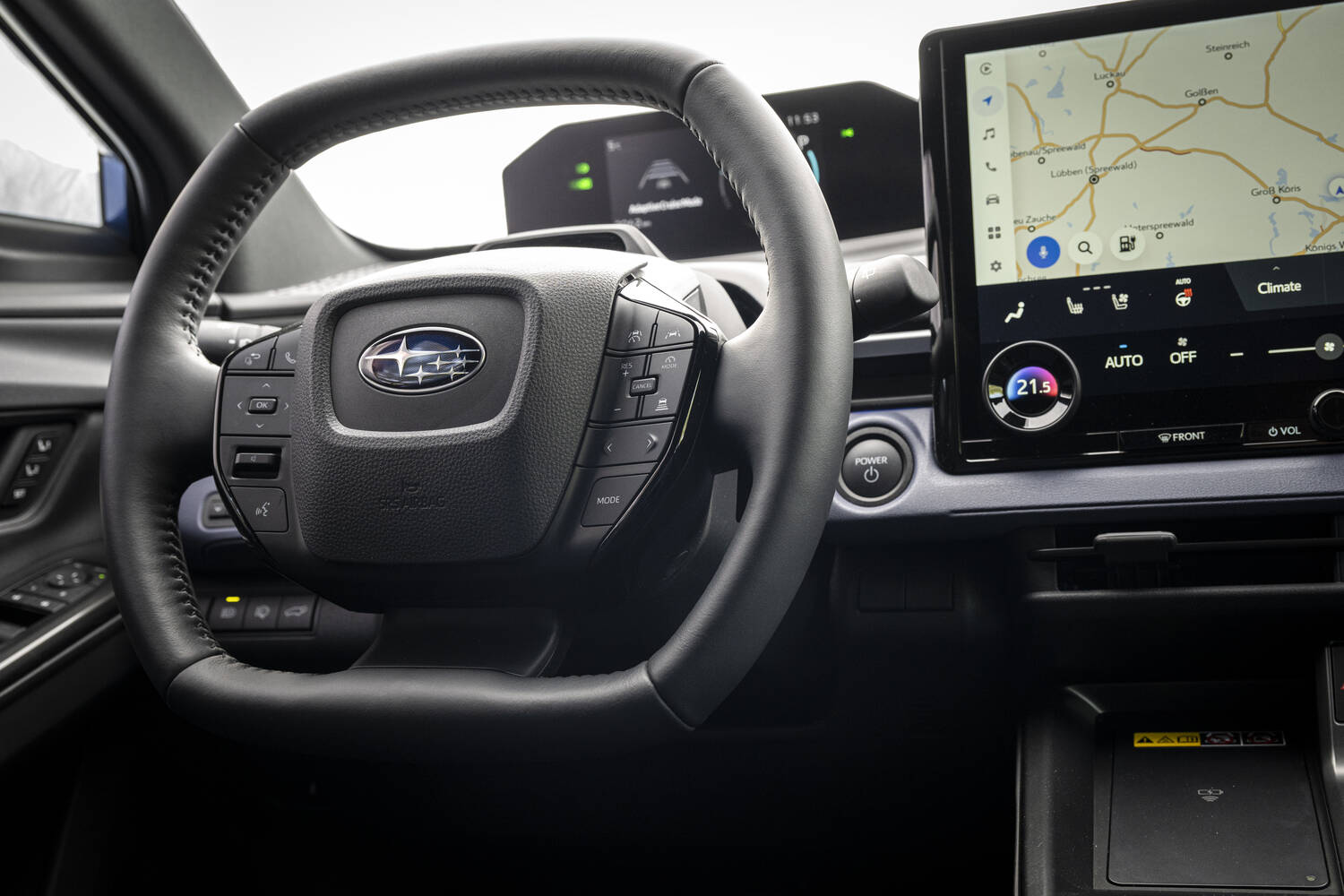
With electrically controlled front seats and reach-and-rake adjustment of the steering column, attaining a good driving position in the Subaru E-Outback turns out to be a breeze.

You do end up sitting a little high in relation to the vehicle's body, although plenty of folk will like this position, and as a consequence visibility out in all directions is super-clear.
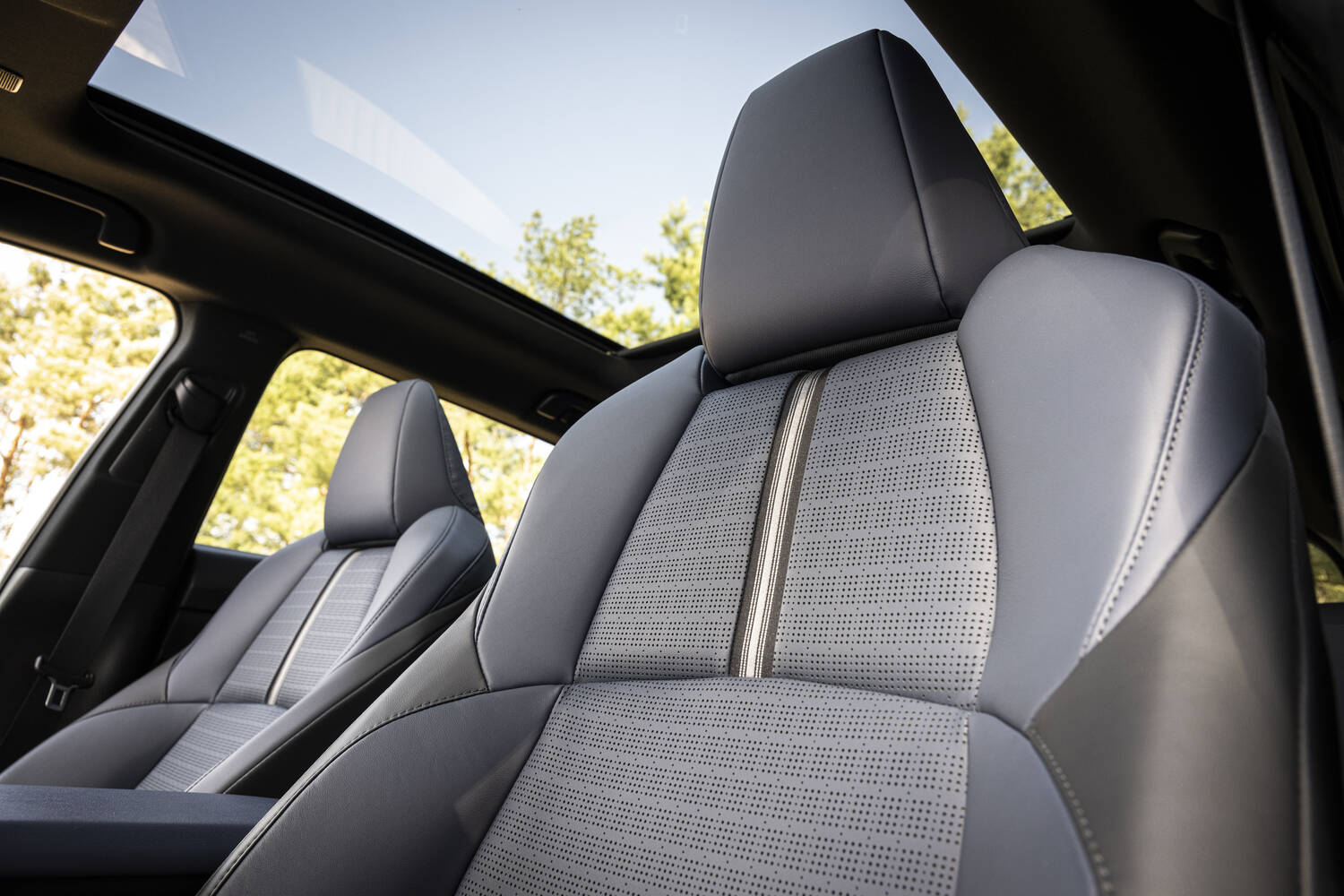
Vegans might want to avoid the blue interior finish, though. It looks nice, but this colourway uses true cow-hide leather, whereas the black cabin option is synthetic material instead.
Infotainment and technology
The main infotainment in the Subaru E-Outback is presented on a 14-inch touchscreen which runs Apple CarPlay and Android Auto wirelessly if you prefer to use them to the proprietary systems for navigation and apps.

Accompanying it is another digital unit, mounted on high for the driver, which doubles up as both an instrument cluster and a head-up display, so lofty is its perch.
We didn't give either screen an extensive usability workout, though, due to the way we were driving the car on this test (see driving impressions below).
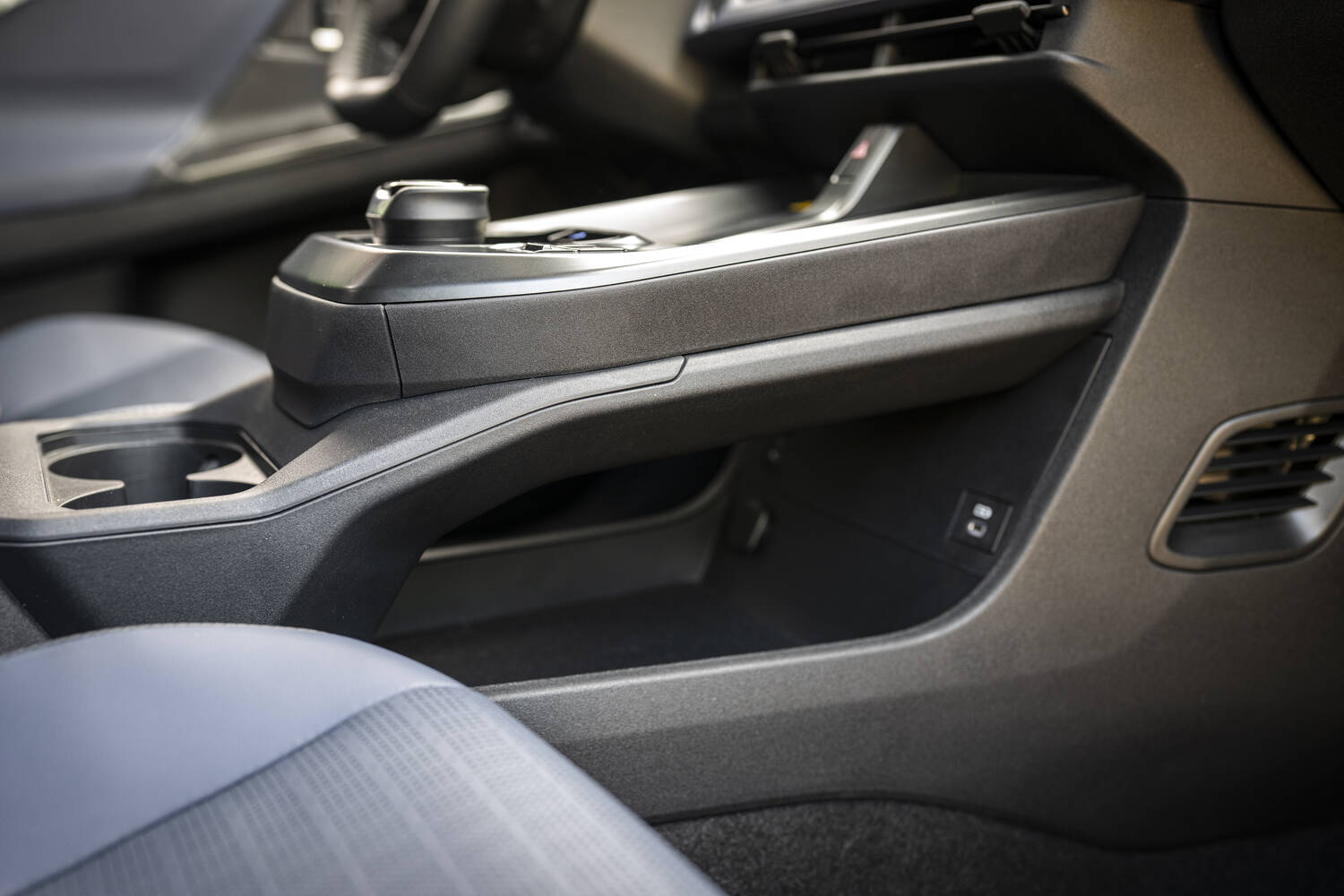
Beyond that, there are two 15-watt wireless smartphone charging pads sitting side-by-side up front and also two USB-C sockets plus a 12-volt port, but these latter three items are all in the lower-level stowage area beneath the drive selector plateau and so they're not in the easiest location to access.

Practicality around the cabin
There are sizeable door bins in the Subaru E-Outback, as well as an under-dash storage zone, a couple of cupholders in the transmission tunnel up front and a large, lidded cubby beneath the central armrest, so there are plenty of useful touches within this estate for the stowage of assorted items. But there is no glovebox at all, which is a strange omission.

Rear-seat passenger space

The floor isn't quite completely flat in the rear, but the elevation of the middle portion is so small that it won't really affect where an occupant of the middle pew in the second row would put their feet.
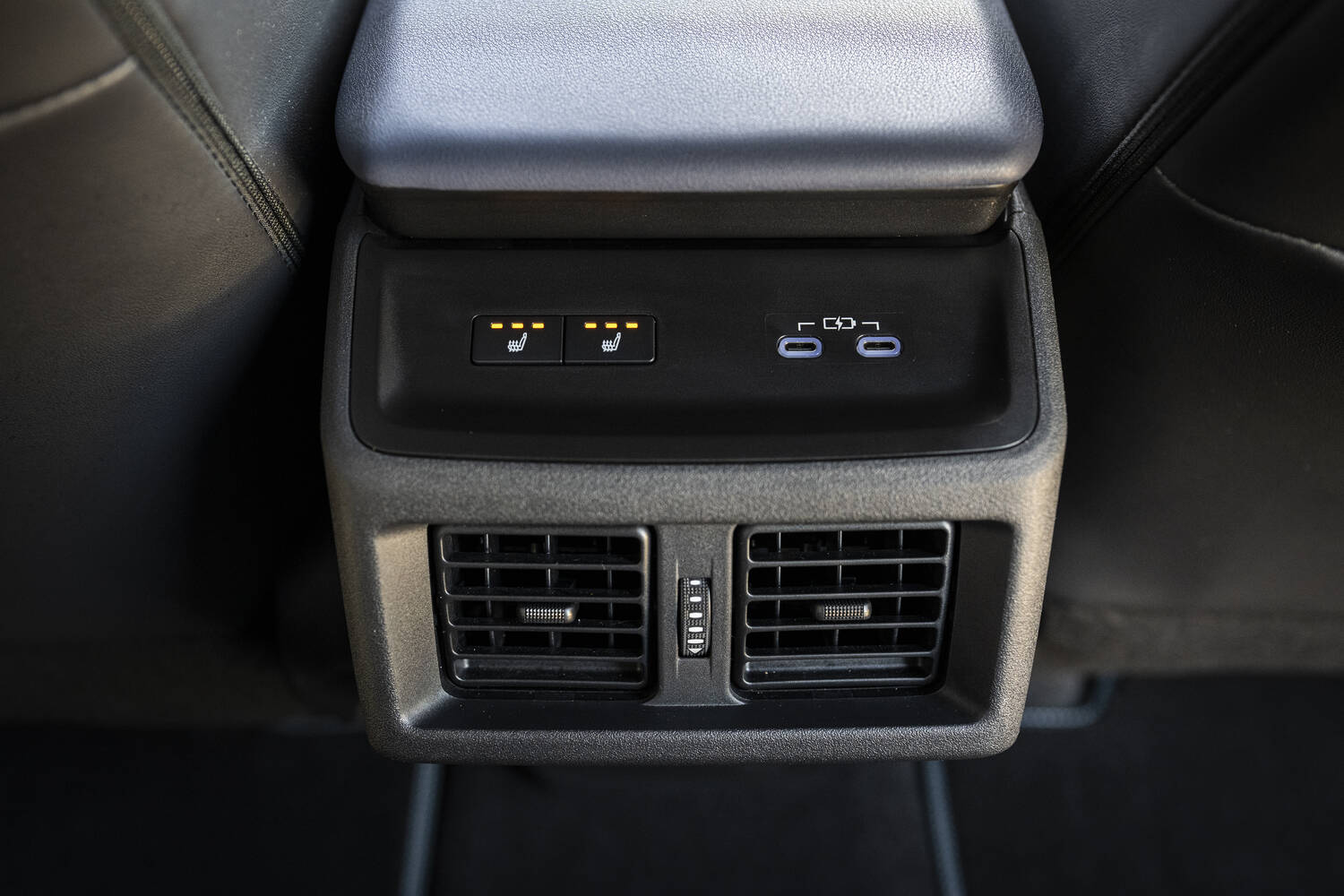
What does cut into legroom there is the extrusion on the back of the front-centre armrest, although this houses two air vents, two USB-C sockets and the two buttons for the heated seats in the outer positions.
Otherwise, though, leg- and headroom in the back is sufficiently generous that the idea of four tall adults travelling in a commendable amount of comfort in the E-Outback doesn't seem far-fetched.
Fitting child seats to the Subaru E-Outback
There are just the two ISOFIX positions in the Subaru E-Outback and they're both on the outer chairs of the second-row seating, with top-tether points accordingly.
The rear doors of the car are large enough and swing open quite wide, so that loading in bulky child seats ought to be fairly easy, while the generous legroom should see younger occupants sitting comfortably back there.
Boot space in the Subaru E-Outback
This is, says Subaru, the biggest boot on any of its products, and it's hard to argue with that when there's 633 litres of capacity with all seats in use.
This figure is made up of a little bit of underfloor storage, granted, but in the main the boot area of the Subaru is a belter - mainly because it's not just vast, it's versatile too.
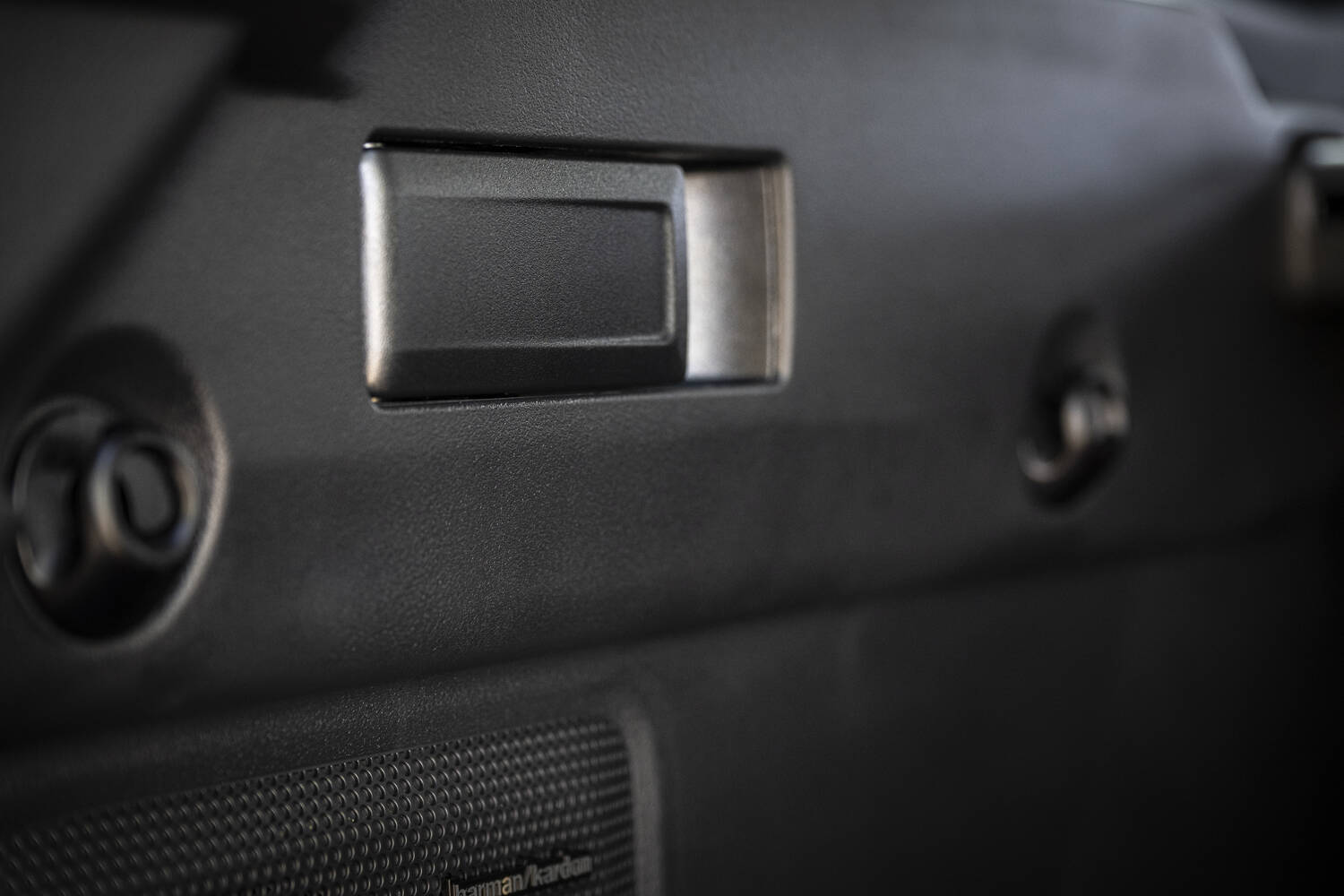
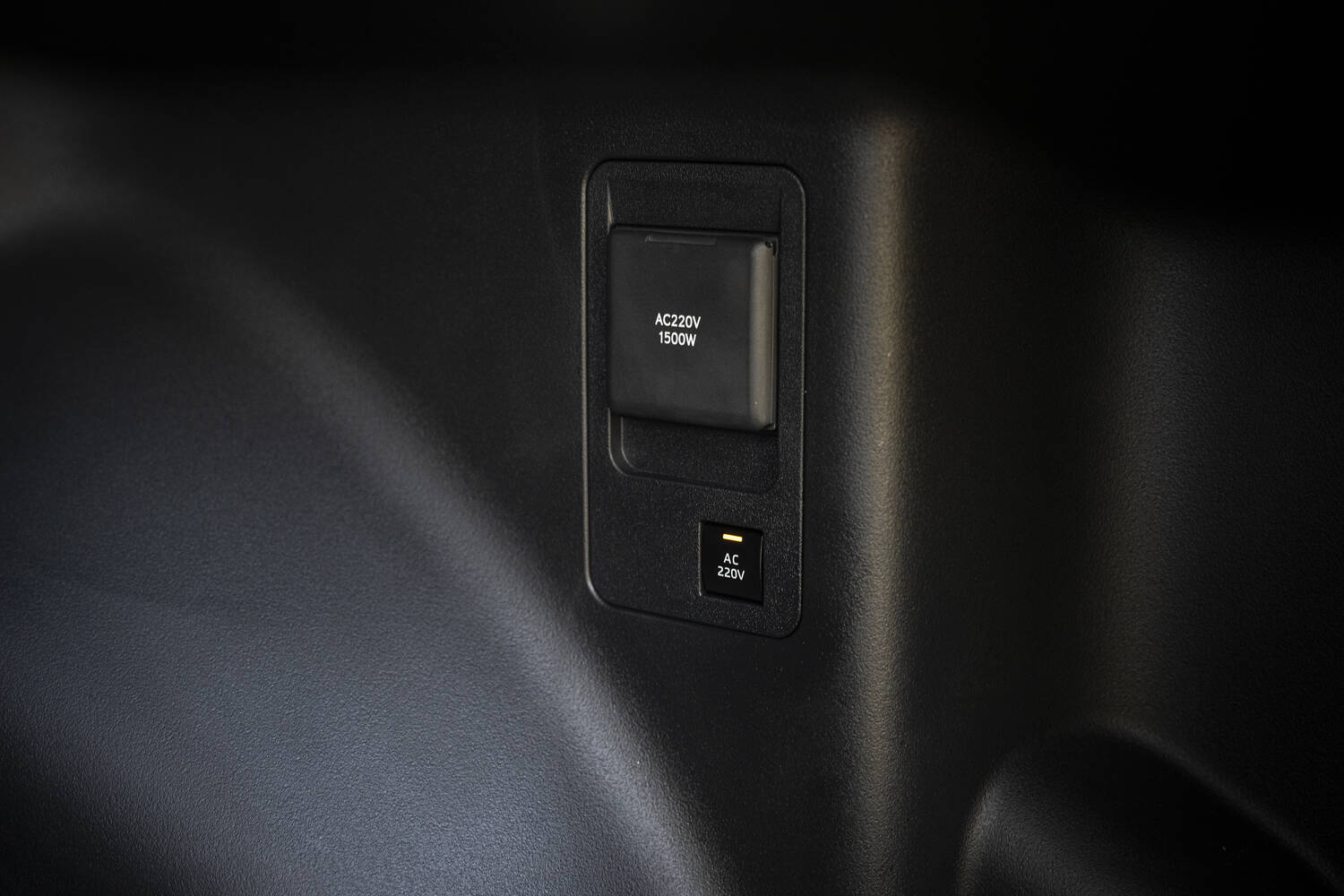
There are four hooks moulded into the sides of the boot of the E-Outback, as well as two handles to easily drop the rear seats when you're standing at the tailgate area, lashing eyes cleverly built into the plastic trim, a light on one flank of the load bay, an underfloor stowage solution for the retractable luggage cover when it's not in use and a vehicle-to-load socket.

As if that wasn't enough, there's another downlighter built into the tailgate to shine on the floor at night when the boot's lid is open, plus another two sturdy hooks mounted in the headlining of the roof - so you can hang wet coats and outdoor gear there when you return to the car after some sodden lifestyle activity, perhaps.
About the only gripe in this department is that those folding seatbacks are only split 60:40, rather than the more useful 40:20:40 arrangement, and there also isn't a ski hatch built into the back bench of the Subaru. However, with the rear seats of the E-Outback tucked away, the boot volume rises to a healthy 1,718 litres.
Safety in the Subaru E-Outback
Neither the Subaru E-Outback itself nor the Toyota alternative, the bZ(4X) Touring, have been tested by Euro NCAP as yet, but both the Solterra and bZ from the same two companies have - and the duo each picked up full five-star safety ratings in 2025.

As the E-Outback is based on the same architecture, chassis and hardware as the Solterra, we'd be confident in predicting it too would garner full marks when put under the safety microscope.
Performance of the 2026 Subaru E-Outback
- Just one powertrain
- But it's a strong one
- All-wheel drive as standard

The Subaru E-Outback is only sold with a dual-motor arrangement. This all-wheel-drive set-up for the electric estate has a more powerful rear motor fitted than either of the all-wheel-drive variants of the Solterra or Uncharted, as befits the E-Outback's flagship status in Subaru's electric portfolio.
Thus, it has two 167kW/269Nm motors, one on each axle, delivering a system max of 381hp, making the E-Outback the most potent vehicle in Subaru's range. Peak system torque isn't quoted by the manufacturer but should be the 538Nm combined force of the propulsion units, given Subaru quotes a 4.5-second 0-100km/h time for the E-Outback in this format.
Driving the E-Outback at a German test facility
Words by Matt Robinson on 23 March 2026
Subaru is keen to emphasise that its E-Outback is not the same as the Toyota equivalent, only with slightly different headlights and exterior badging. Subaru's engineers say they have done their own specific tuning of the suspension and electric power steering for this platform, to better reflect the E-Outback's off-road brief, while it has three drive modes to the Toyota's two - the additional setting here being 'Power'.
The E-Outback also has five settings for regenerative braking to its relation's four.
Regardless, from an initial showing the E-Outback is impressive to drive. We should couch this precis of its dynamics in terms of the fact we didn't actually drive the Subaru on public roads - our entire time with the car, off-road and 'on' it, was conducted at a German test facility in the forests just outside of Berlin.

There was tarmac to simulate public streets, though (as well as some cobbled 'pavé' surfacing), and the opportunity to drive the EV at up to 120-130km/h through one big sweeping bend, as well as various slalom runs and tests of its traction and acceleration, both in the dry and the wet.
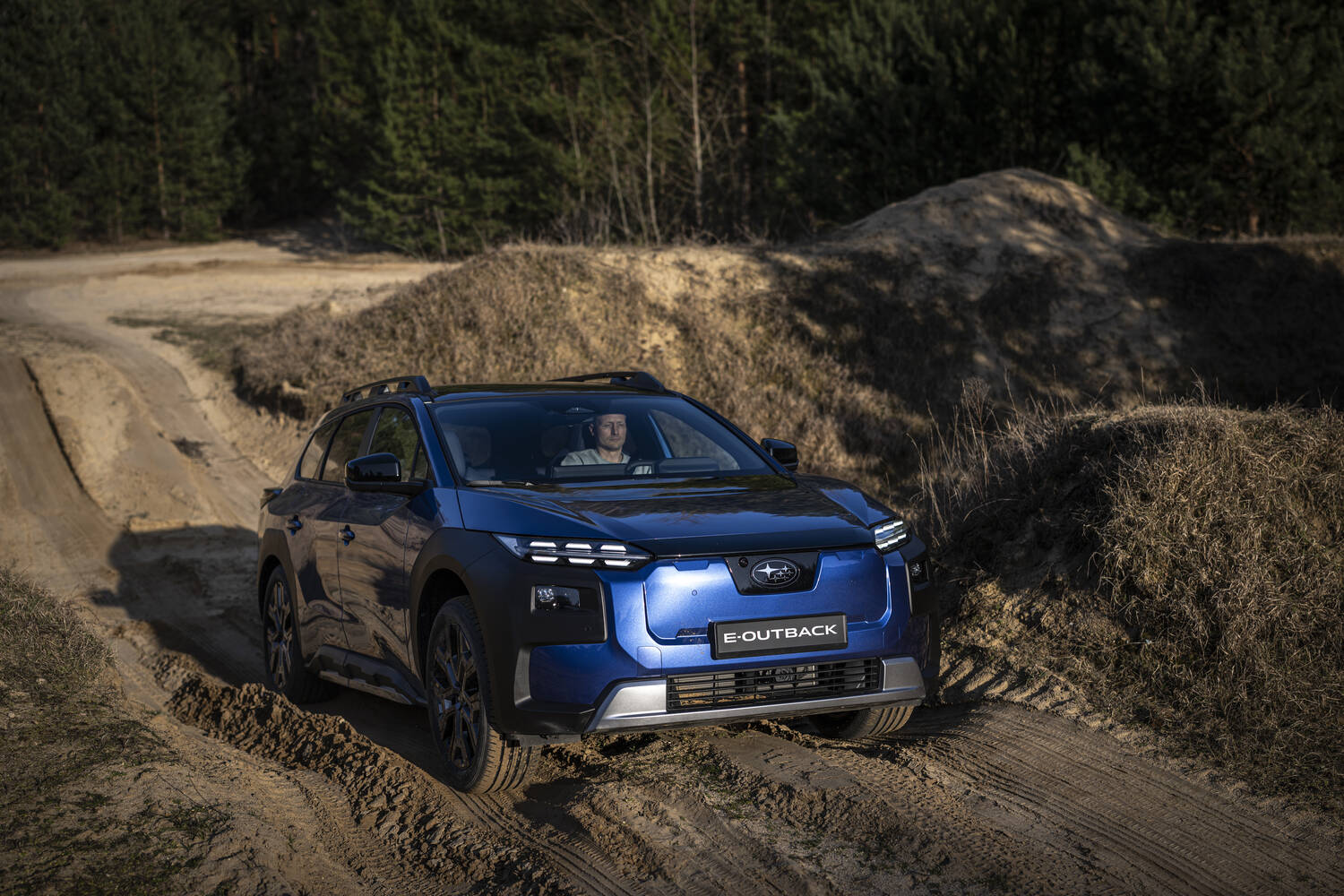
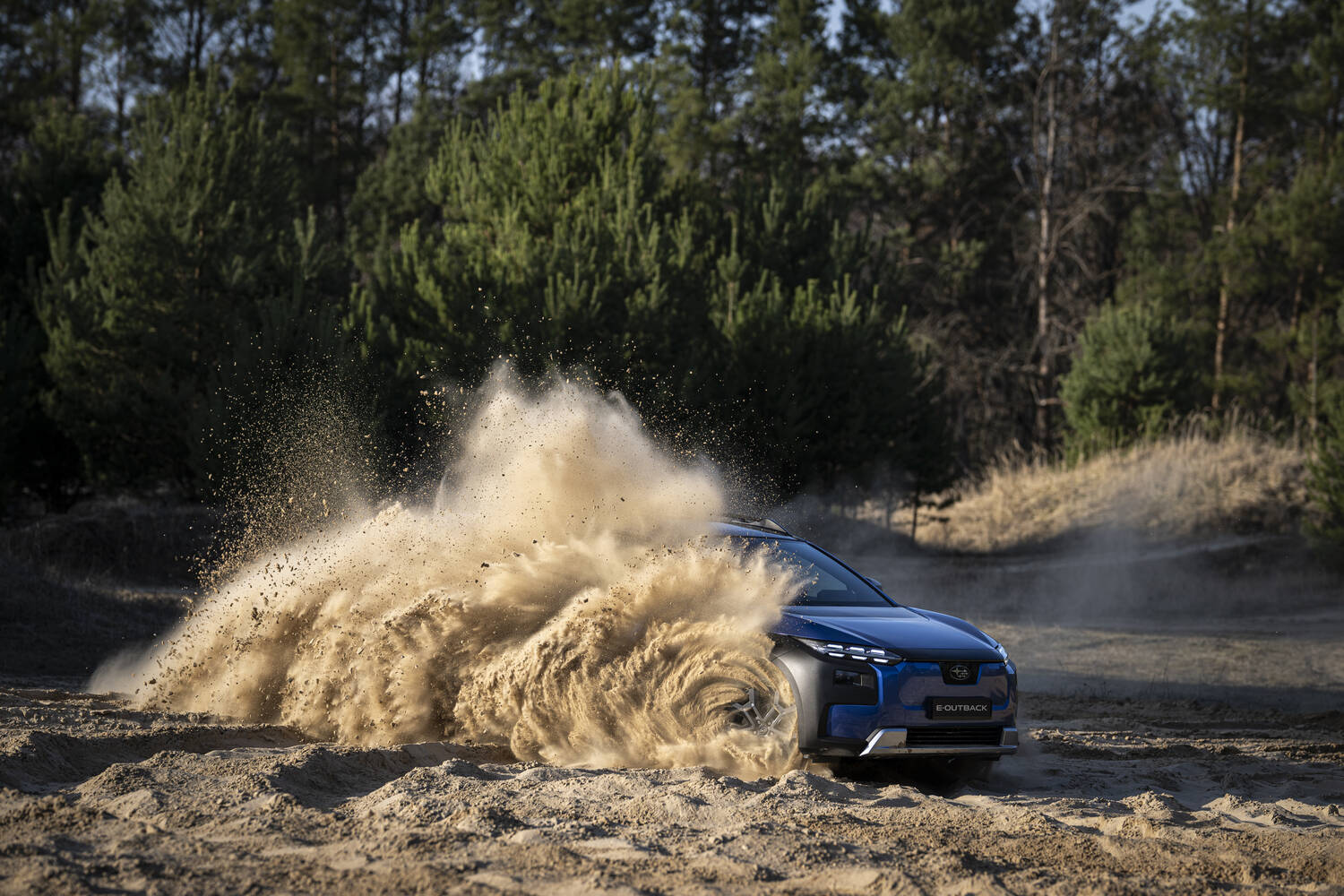
There was also a fairly challenging off-road course, including a section riddled with deep sand, to see just how Subaru-like the E-Outback was in the rough stuff.
So, accepting that we don't have any town-driving impressions or long-distance cruising or electric efficiency reports to bring you as yet, we can say that from what we've experienced behind the wheel of this EV so far, we like it very much - it's one of the better, more satisfying electric models of any type available.

The performance of the E-Outback shouldn't be in any doubt, for starters. It's properly rapid, although it delivers its ample power in a nice, smooth, progressive fashion, even if you have it in its Power setting.
Some might lament that the step-off acceleration is therefore not quite as sharp and violent as it might be, but we prefer the more organic accelerator control such measured behaviour brings to the fore - which stays faithful even in Normal and Eco modes, albeit the right-hand pedal isn't very responsive in the last of these.

The road sections of the test track showed us a car with excellent high-speed stability, plus steering with enough granular detail and sweetly calibrated responses that adjusting the car's cornering line with the suspension loaded up didn't feel hairy at all.
Indeed, one of the best things we can say about the Subaru E-Outback is that, while driving around the street sections of the test facility, the EV never felt unwieldy or anything like its two-tonne kerb weight. Instead, it felt balanced and agile, and that's a highly commendable pair of traits for a hefty dual-motor electric estate to possess.

Its ride quality on the 20-inch wheels also seemed plush, although there wasn't much chance to put this to the most strenuous and varied of tests given the location, and noise suppression is comprehensive enough that the loudest disturbance we could discern in the cabin while going along at 130km/h was a background susurration of the wind ruffling around the roof rails.
But that smoothness of suspension was evident off-road, where the E-Outback put on a comprehensively brilliant performance.
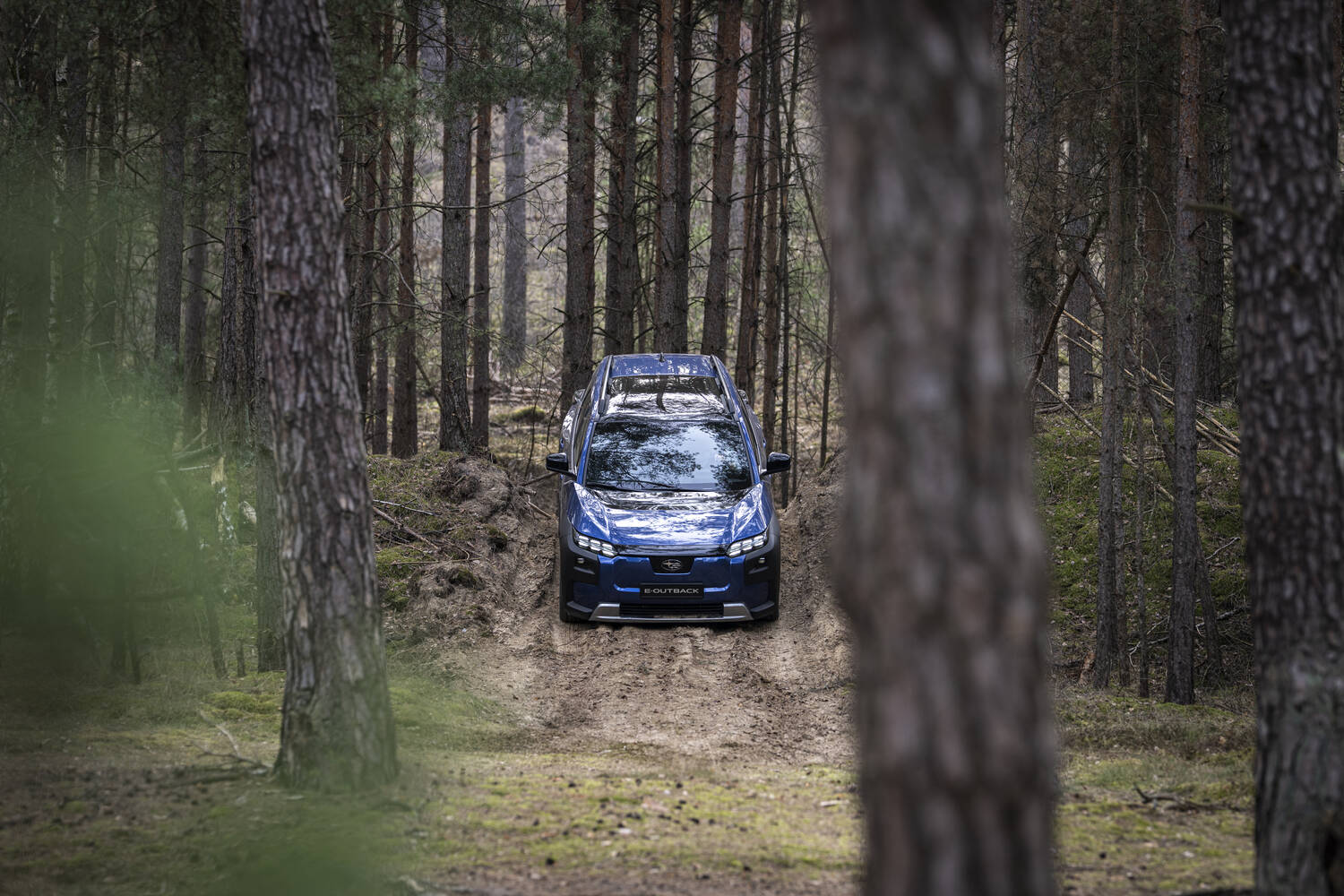
There were times, when running along tree-root-rutted trails in the woods and bobbling along on compacted, firm sand, that the Subaru felt as if it was running on polished glass - it really was quite uncanny, yet thoroughly accomplished too.

Better yet was how phenomenally well the E-Outback got around the route, especially the bits where it was frolicking about in deep sand, spinning rooster tails of grains into the air while never once looking like it might get stuck.
With its X-Mode off-road setting and the Grip Control system - which Subaru itself informally refers to as 'off-road cruise control' - there's rarely a situation where the E-Outback looks like it might get stuck.

This included coming to a complete stop in the middle of a ludicrous 36-degree incline, formed of two concrete wheel paths strewn with loose sand. Using nothing more than the Grip Control function, the car moved off under its own auspices with barely any wheelspin or drama, which was an exceptional display of competence.
Sure, the E-Outback is probably way more talented off-road than it has any need to be, as owners will likely never subject it to the sort of rough-riding of which it is ultimately capable. But it's nice to know these abilities are there should you ever need them - and, most astoundingly of all, the Subaru did all of this running on summer-spec, road tyres - 20-inch Dunlop Sport Maxx rubber, specifically.

For those wanting the full off-road minutiae, the approach, breakover and departure angles of the E-Outback are 17.6, 18.2 and 20.2 degrees, respectively.
Range, battery, charging and running costs of the 2026 Subaru E-Outback
- Just the one - 74.7kWh - battery
- More than 500km of range
- Max charging speed is only 150kW
Subaru is going to offer the E-Outback with just one size of battery pack, which is of an acceptable size - but it's not extraordinarily generous for capacity, by the same token.
As a result, the range of the car is OK, rather than eye-catchingly long-legged, while the peak charging speeds of the 400-volt architecture lag behind some rivals which are ultra-rapid in this regard.
Battery options and official range
Subaru has not announced the usable capacity or chemical make-up of the E-Outback's battery. However, we do know that the battery is a CATL-sourced unit of 74.7kWh gross capacity, and if it is a CATL pack then it's highly likely it will be a nickel-manganese-cobalt (NMC) item, rather than lithium-iron phosphate.
Officially, the range of the E-Outback in its 381hp guise is 526km, regardless of the alloy wheels fitted or the specification of the car.
Charging up the Subaru E-Outback
Subaru quotes an 11kW AC charging rate and the option to upgrade that to 22kW if required, with this latter specification bringing the 10-100 per cent charging time down to 'less than four hours'.
It'd be more like seven-hours-plus for the same job at 11kW, and getting on for 11 hours at a typical 7.4kW domestic wallbox.
Less stellar is the 150kW DC peak, which provides a 10-80 per cent top-up of the battery in around 28 minutes in optimal conditions. This isn't terrible, by any means, but a lot of premium EV rivals (SUVs, hatchbacks and saloons of comparable price and powertrain spec) will frequently offer closer to 200kW for the same process - and, if they're 800-volt machines, more than double the Subaru's fastest rate.
Servicing the Subaru E-Outback
Subaru's other EVs, the Solterra and Uncharted, are normally on a 12-month, 15,000km maintenance cycle and so we'd be surprised if the E-Outback deviated from this.
Subaru E-Outback warranty
Following the pattern of the Solterra, the Subaru E-Outback should be covered by a three-year, 100,000km 'bumper-to-bumper' warranty in the main, along with eight years and 160,000km of cover for the high-voltage battery.
Irish pricing & rivals to the 2026 Subaru E-Outback
- Prices not confirmed as yet
- But likely to be fairly robust
- Few, if any direct competitors

We don't have any Irish pricing for the Subaru E-Outback as yet, but it is considered a grander, bigger product than the Solterra with which it shares some hardware, while its more powerful drivetrain is another factor to consider.
Specifications should follow the usual Limited and Touring grades but expect the E-Outback to be some way beyond the opening €44,995 figure of the Solterra - it's almost inevitable that we'll be looking well beyond €50,000, although hopefully its EV status will keep it this side of the €61,000 needed for a Subaru Forester.
Playing in the E-Outback's favour is its unique off-road-estate nature. Aside from the Toyota bZ(4X) Touring, which is effectively the same car, the only things which'll go head-to-head with the Subaru are either regular electric estates, or plain-and-simple zero-emission SUVs.
This context makes more sense of a price tag that might land in the €55,000-€60,000 bracket, so watch this space.
Verdict - should you buy the 2026 Subaru E-Outback?
This is the most likeable, convincing, rewarding-to-drive and talented Subaru EV we've yet tried, but the key to its success is going to hinge entirely on pricing.
As it's a very powerful dual-motor EV and one that functions as the brand's flagship, it's highly likely that the E-Outback will be considerably more than the €44,995 starting price of the Solterra, while it should even outstrip the cost of the 340hp Uncharted.

So the E-Outback is sure to be relatively expensive, but then there's not much else quite like it on (or off) the road right now when it comes to zero-emission machines.
If that's enough to tempt you into a showroom to have a closer look at it, there's precious little in the Subaru's dynamics that should dissuade you from signing on the dotted line to purchase an E-Outback, because it's an excellent thing in most key regards.
FAQs about the 2026 Subaru E-Outback
Is the Subaru E-Outback available with all-wheel drive?
Yes, it will exclusively be sold as a dual-motor model because it's seen as an electric analogue of the outgoing, petrol-fuelled Outback, and so there won't be single-motor, front-wheel-drive options in the E-Outback family at all.

Where it differs from dual-motor versions of the Solterra and Uncharted EVs elsewhere in the Subaru range is that the E-Outback has a more powerful rear electric motor, hence its peak output is 381hp and not 343hp.
How fast is the Subaru E-Outback for acceleration?
It is the quickest-accelerating production Subaru in history to this point, capable of running a 4.5-second 0-100km/h sprint despite the fact it weighs two tonnes. Sure, there were some ultra-limited versions of the old Impreza and WRX STI legends for various world markets which were perhaps a bit quicker (the Cosworth CS400 springs to mind), but Subaru itself says the quickest mainstream factory STI of them all did the run in 5.2 seconds - so the E-Outback is well in advance of that.
Does the 'Touring' in the spec name of the Subaru E-Outback mean estate?
No, it's the higher trim grade that Subaru typically offers, sitting above 'Limited'. The problem here is that the Toyota equivalent is called the Touring for its body shape, while there are plenty of other manufacturers who use the word 'Touring' or spin-offs like 'Sports Tourer' to denote an estate, so the E-Outback blurs the lines somewhat.
Has the Subaru E-Outback got any other tricks up its sleeve?
Given it is an off-roader primed for the remoter parts of planet Earth, Subaru says it has made the E-Outback 'winter ready' so that it will excel when the mercury plummets. For instance, the heated steering wheel has its entire rim warmed, rather than just the sections where your hands might naturally fall upon it, while the EV has seats with extended patches of heater elements that go right up to your shoulders.
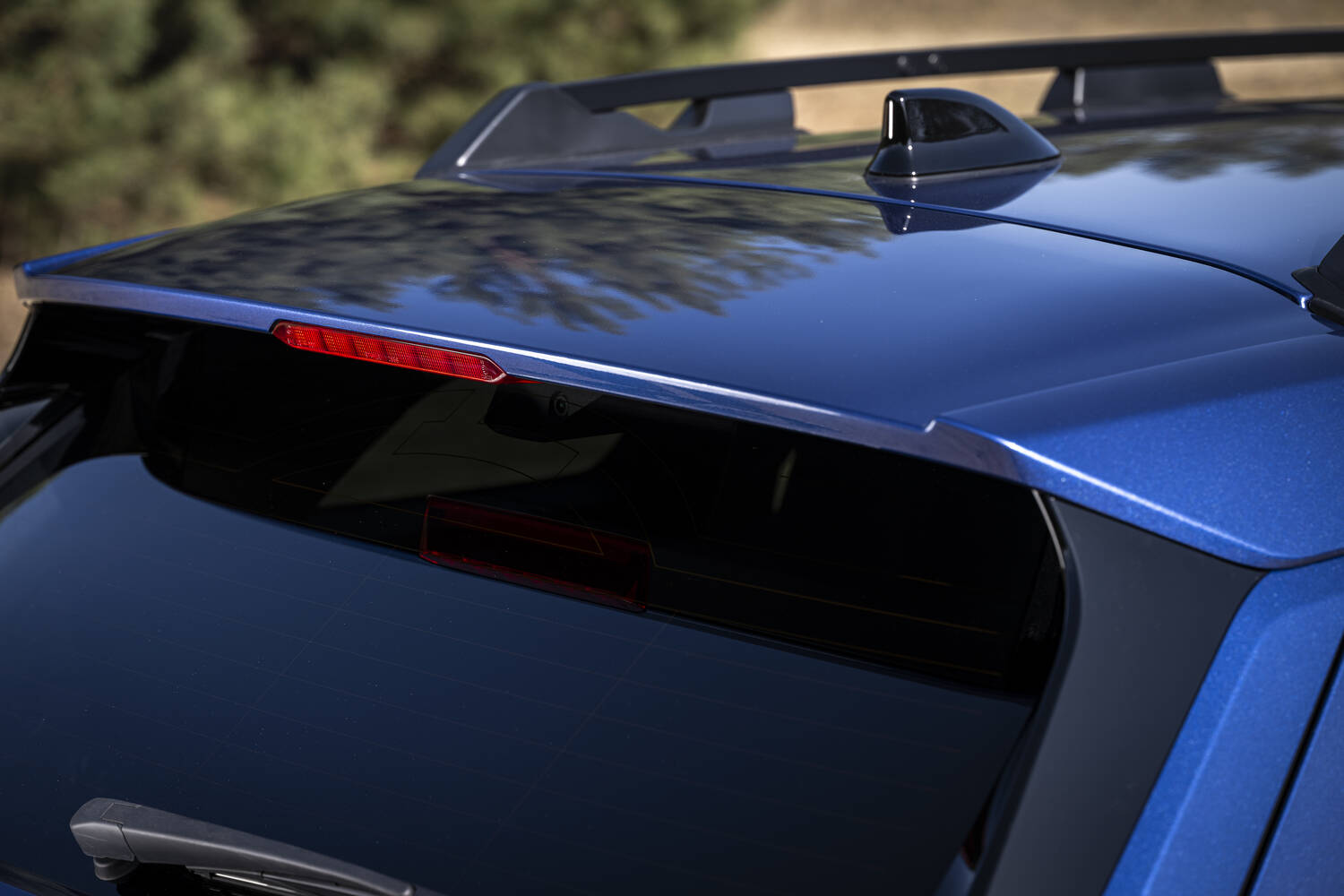
At the back, the windscreen glass has a wider heat-generation area than the petrol-fuelled Outback, so that it more quickly clears in frosty weather, while the rear-facing camera is inside the rear glass and within the sweep of the tailgate wiper, so that the digital interior mirror always presents a clear view.

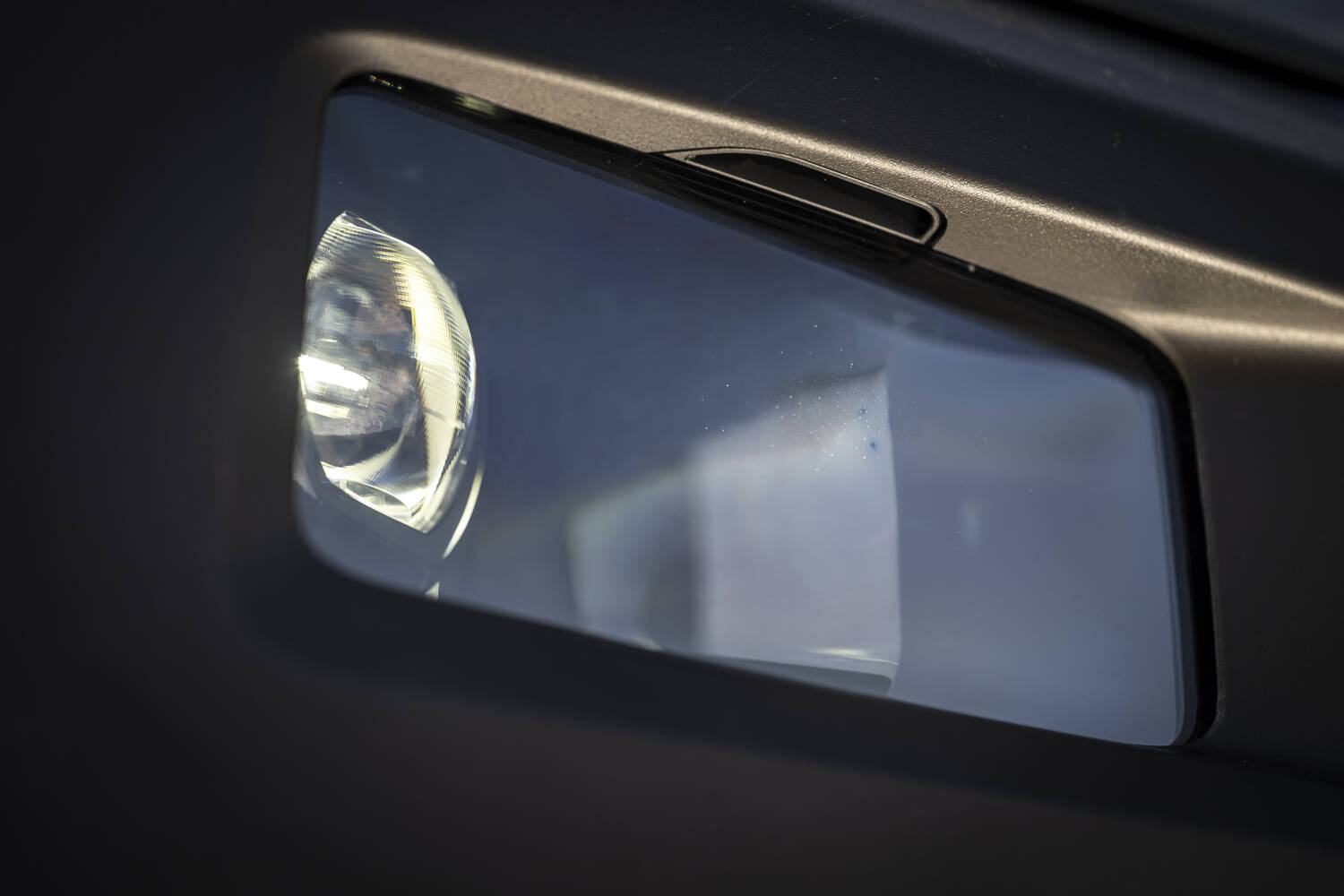
And on the outside at the front, those square lamps beneath the six-point DRLs are the main illumination, so they've been shaped to prevent the build-up of snow on their lenses to maintain forward visibility in blizzard conditions - and if the white stuff does start to congregate on the lights, then a powerful washer jet tucked in above the lamp can blast the accumulated snow away.
Want to know more about the 2026 Subaru E-Outback?
If there's anything about the new Subaru E-Outback we've not covered, or you'd like help in choosing between it and other cars, you can avail of our expert advice service via the Ask Us Anything page.