

Exterior & design of the 2027 BYD Shark DMO
- Distinctive light clusters bring character
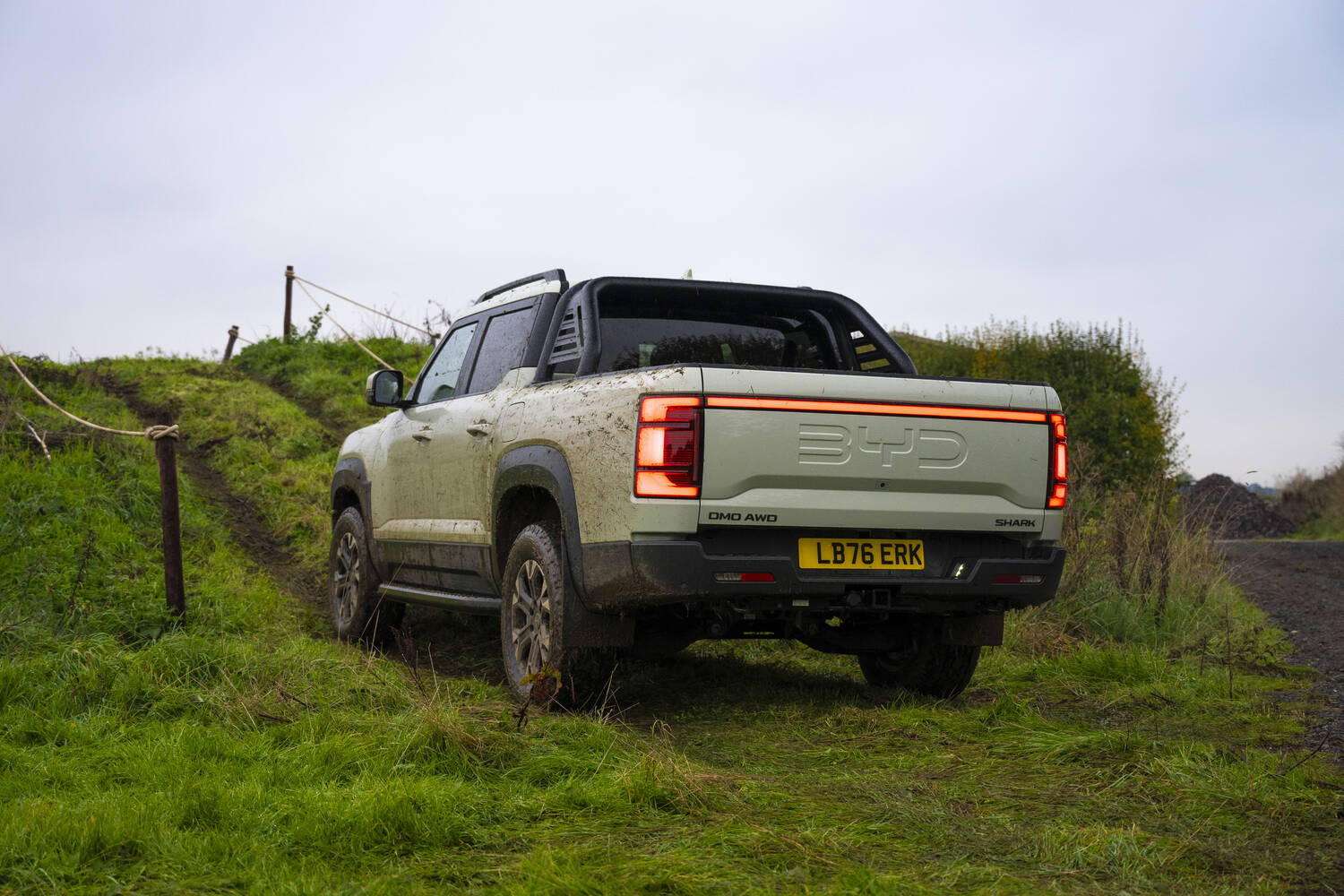
- Huge body, even by pick-up standards
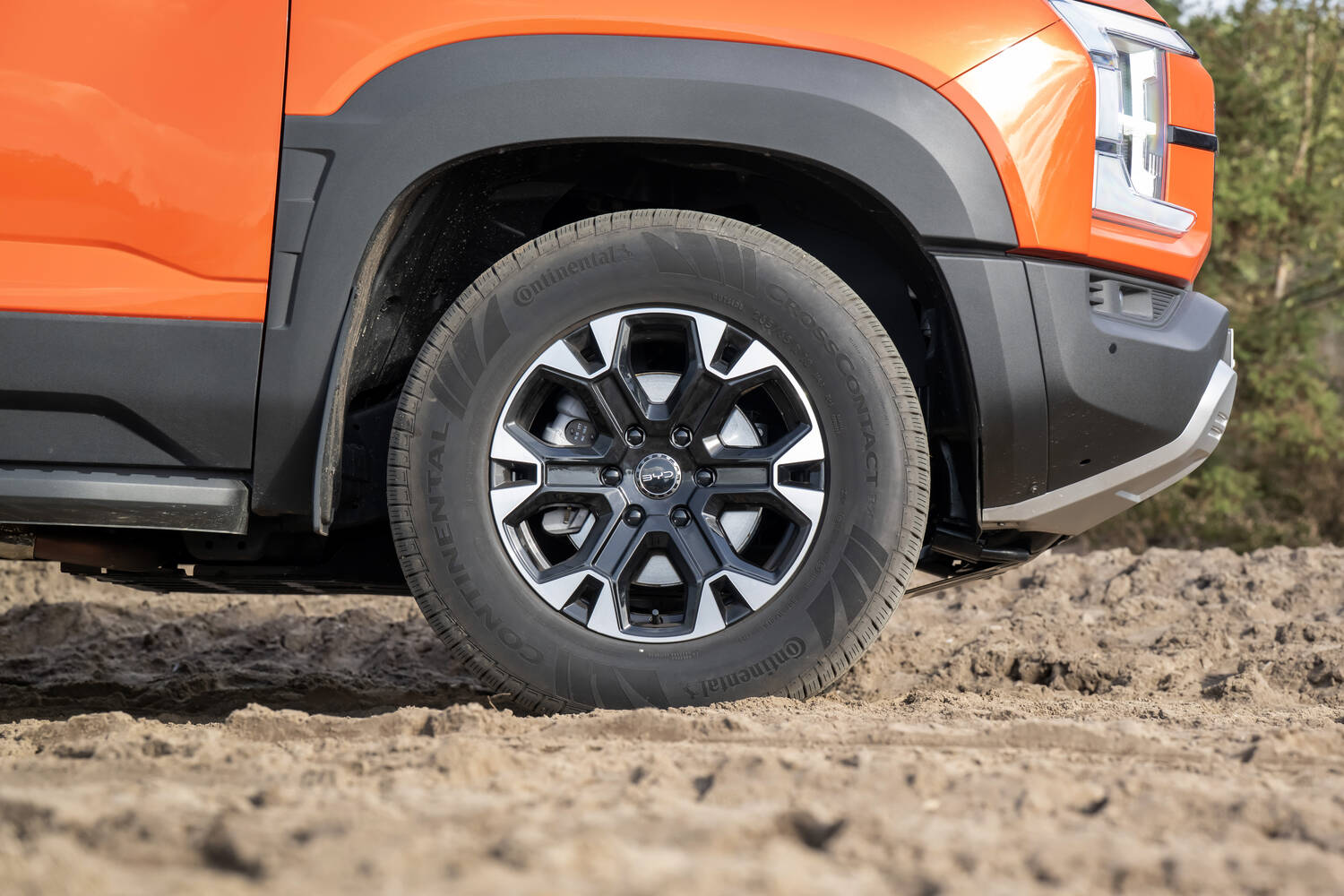
- Solitary design of 18-inch wheel
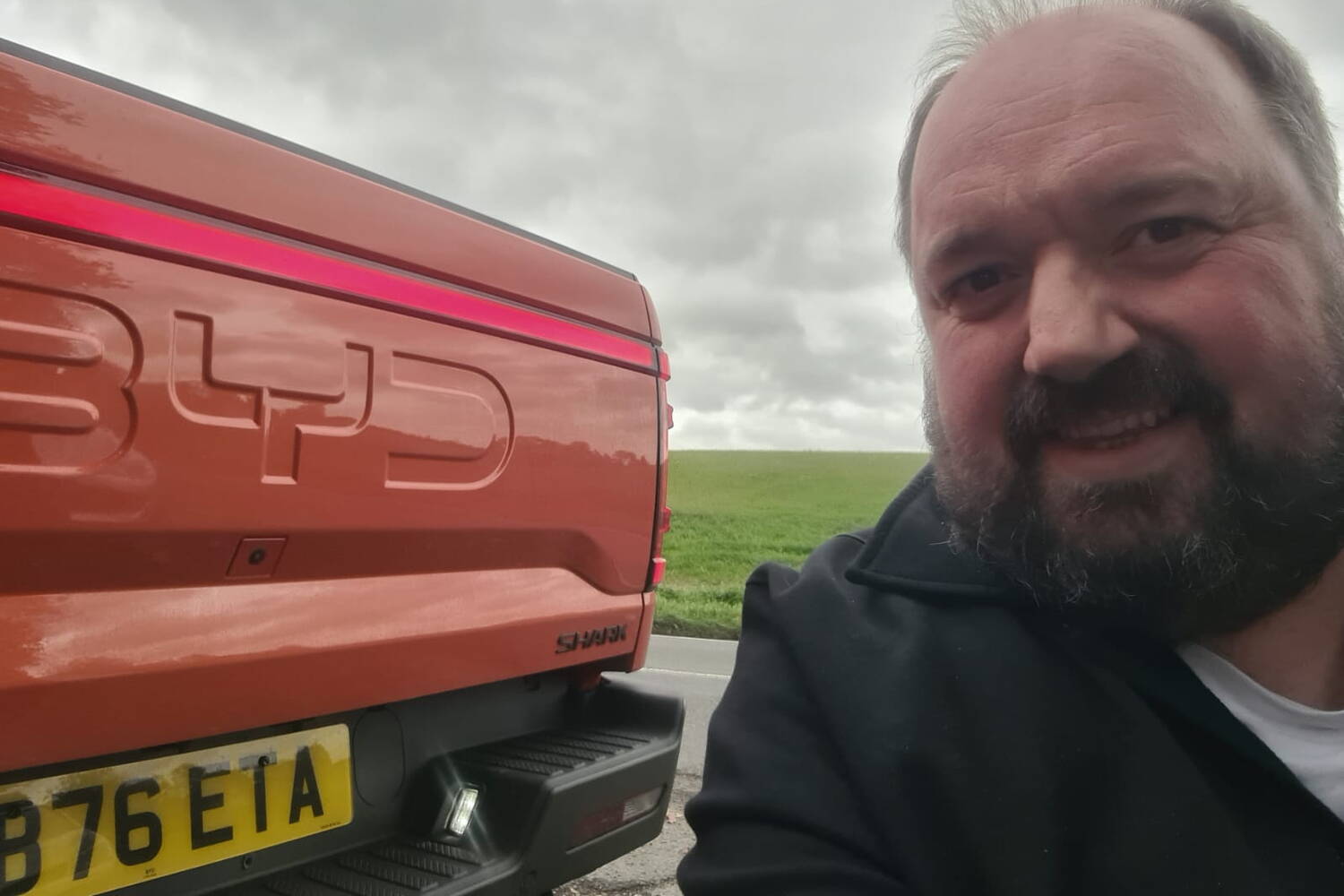
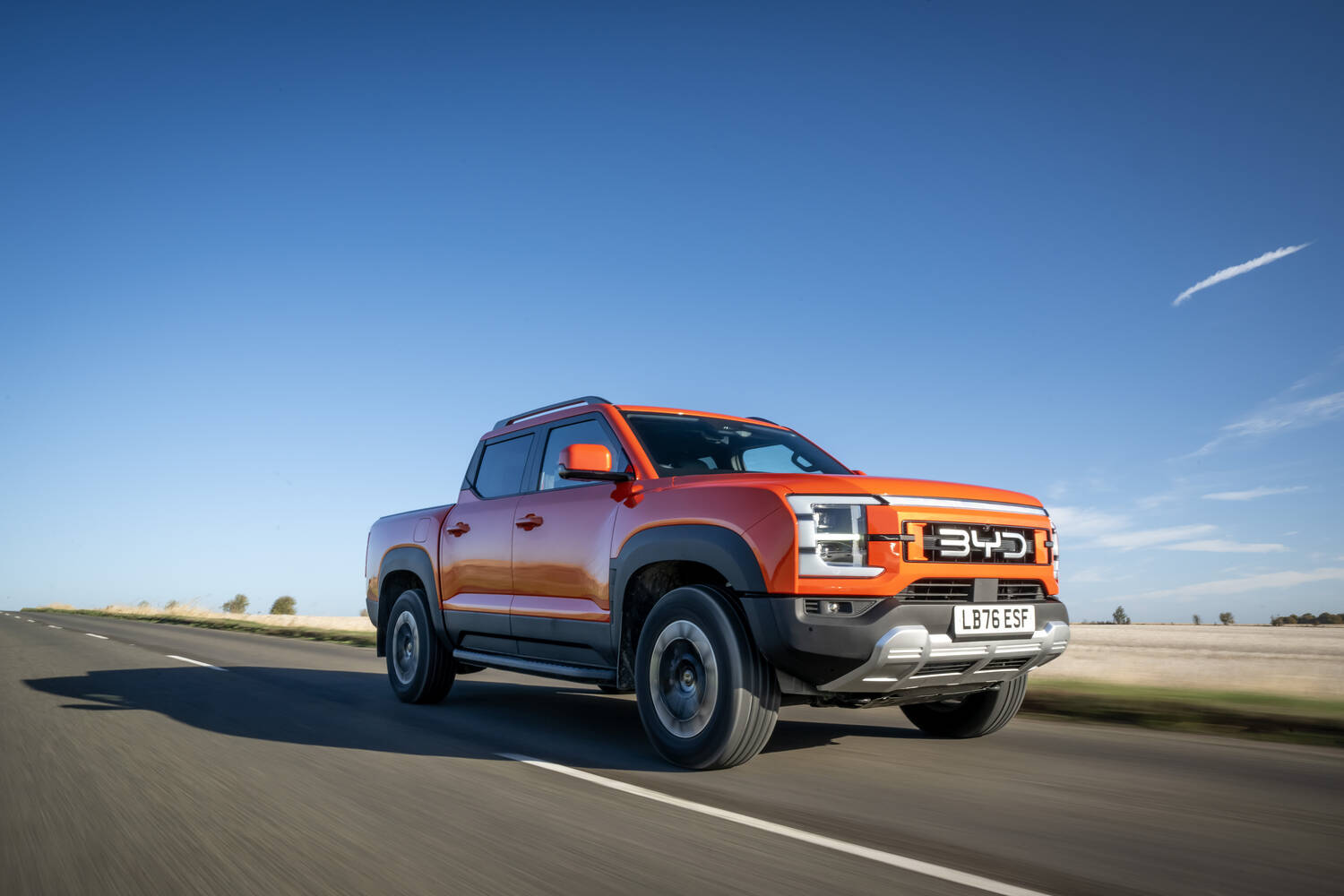
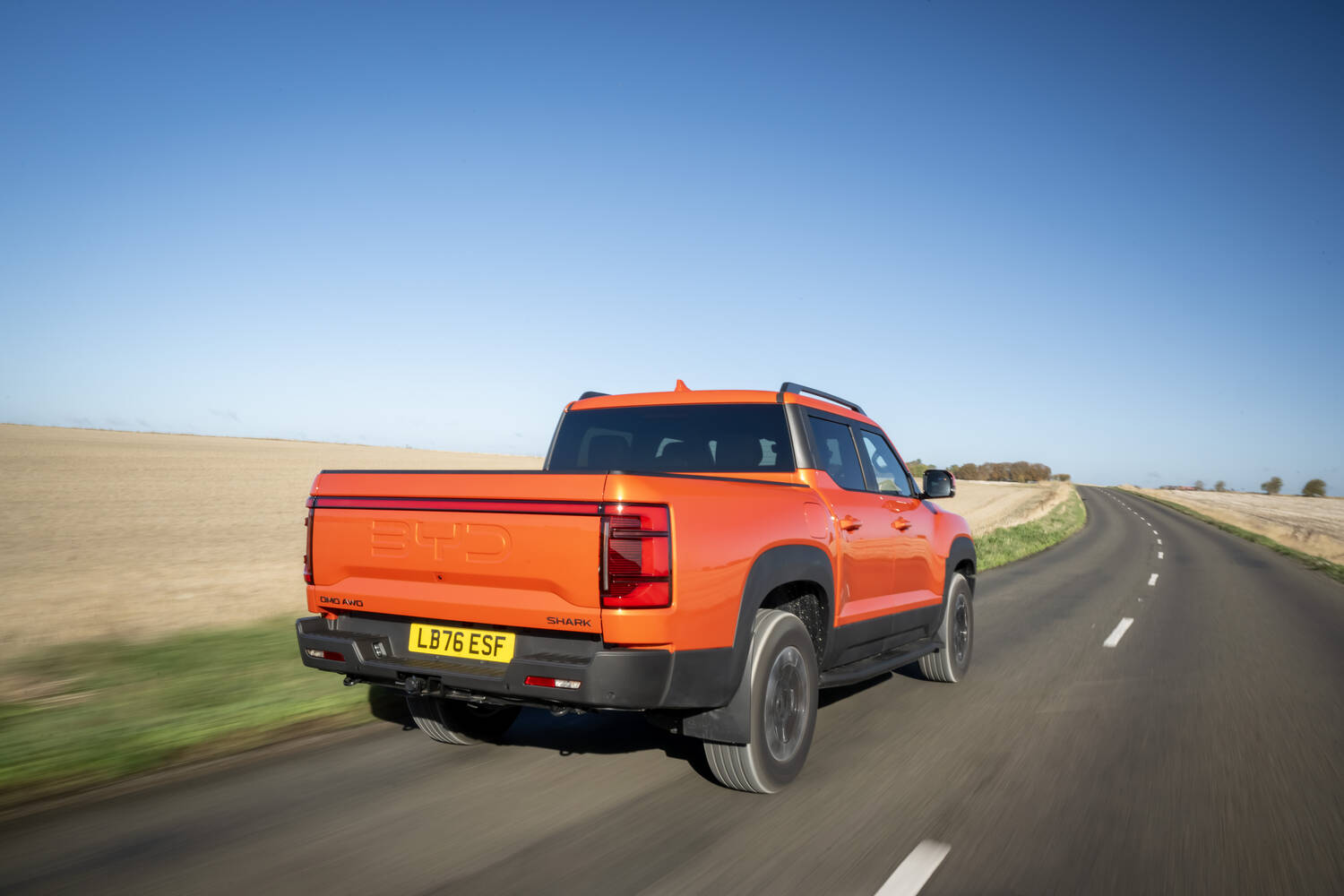
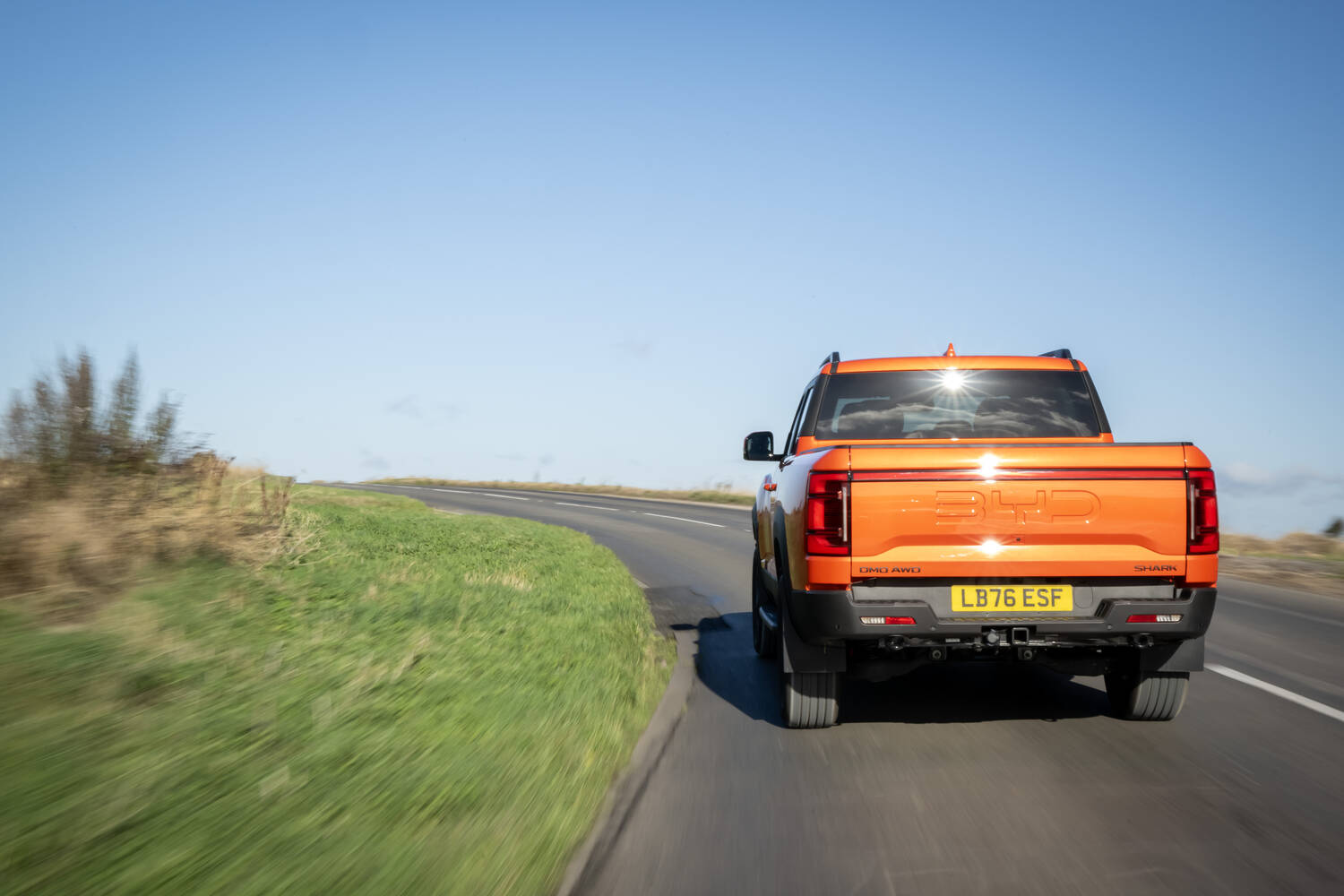
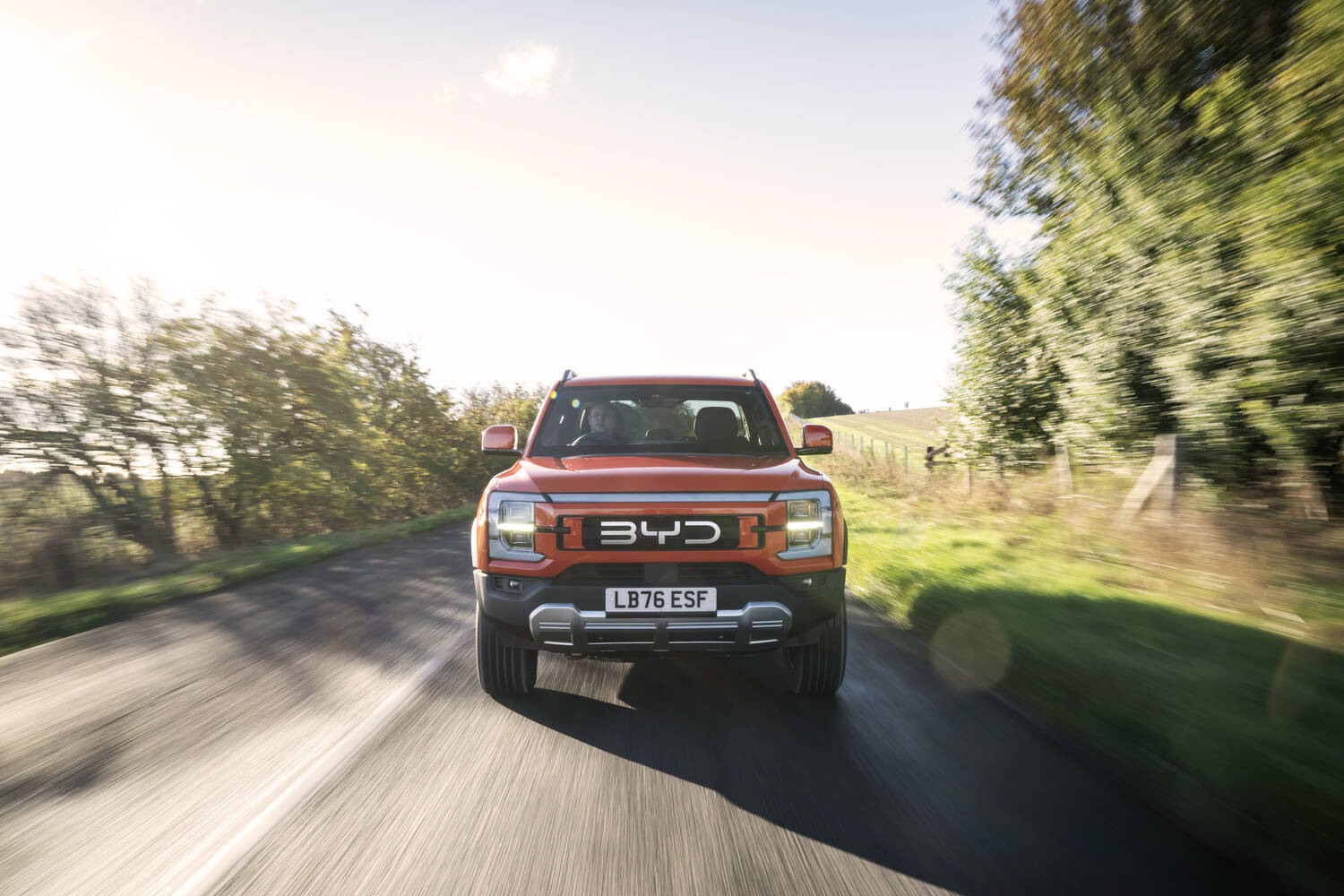
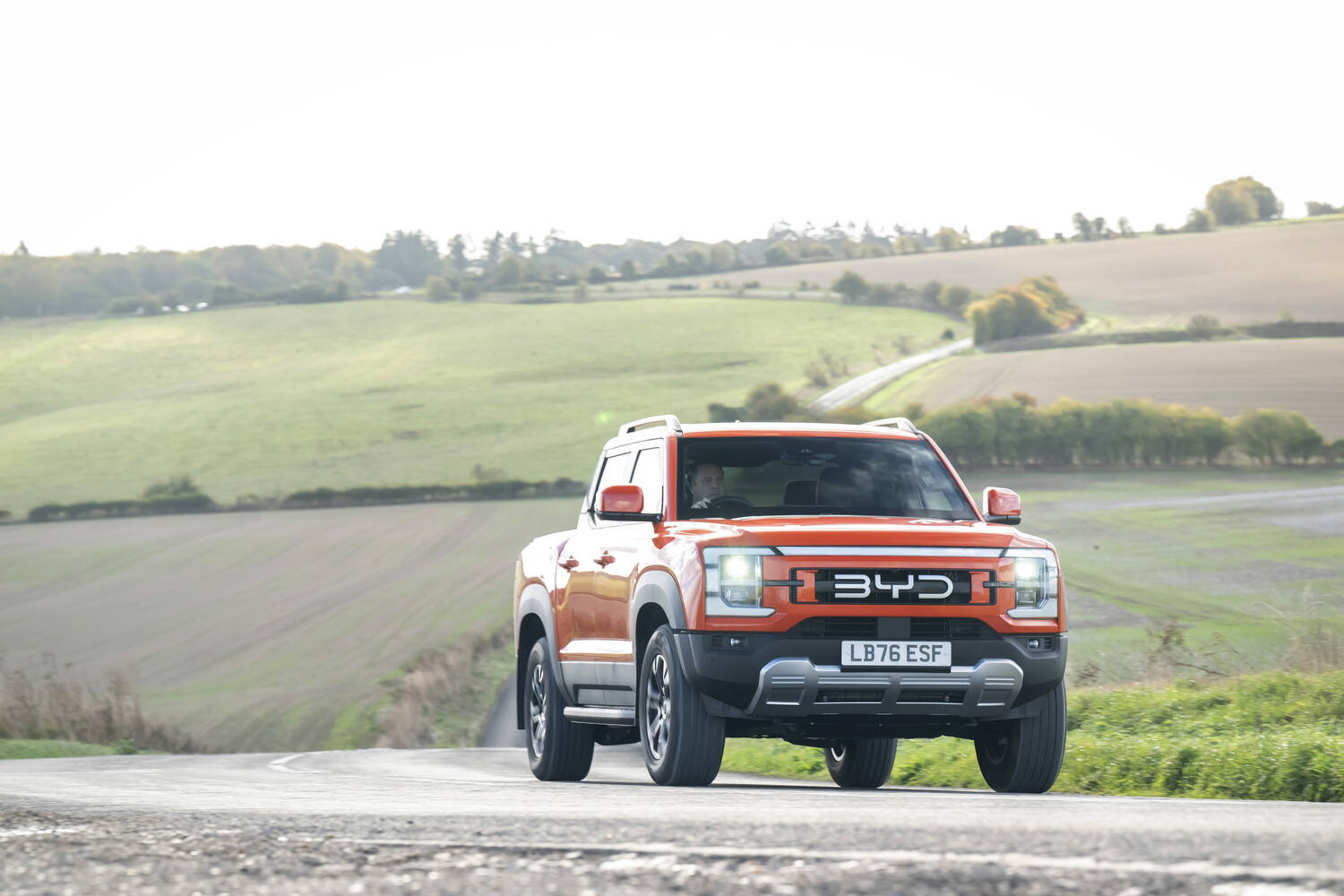
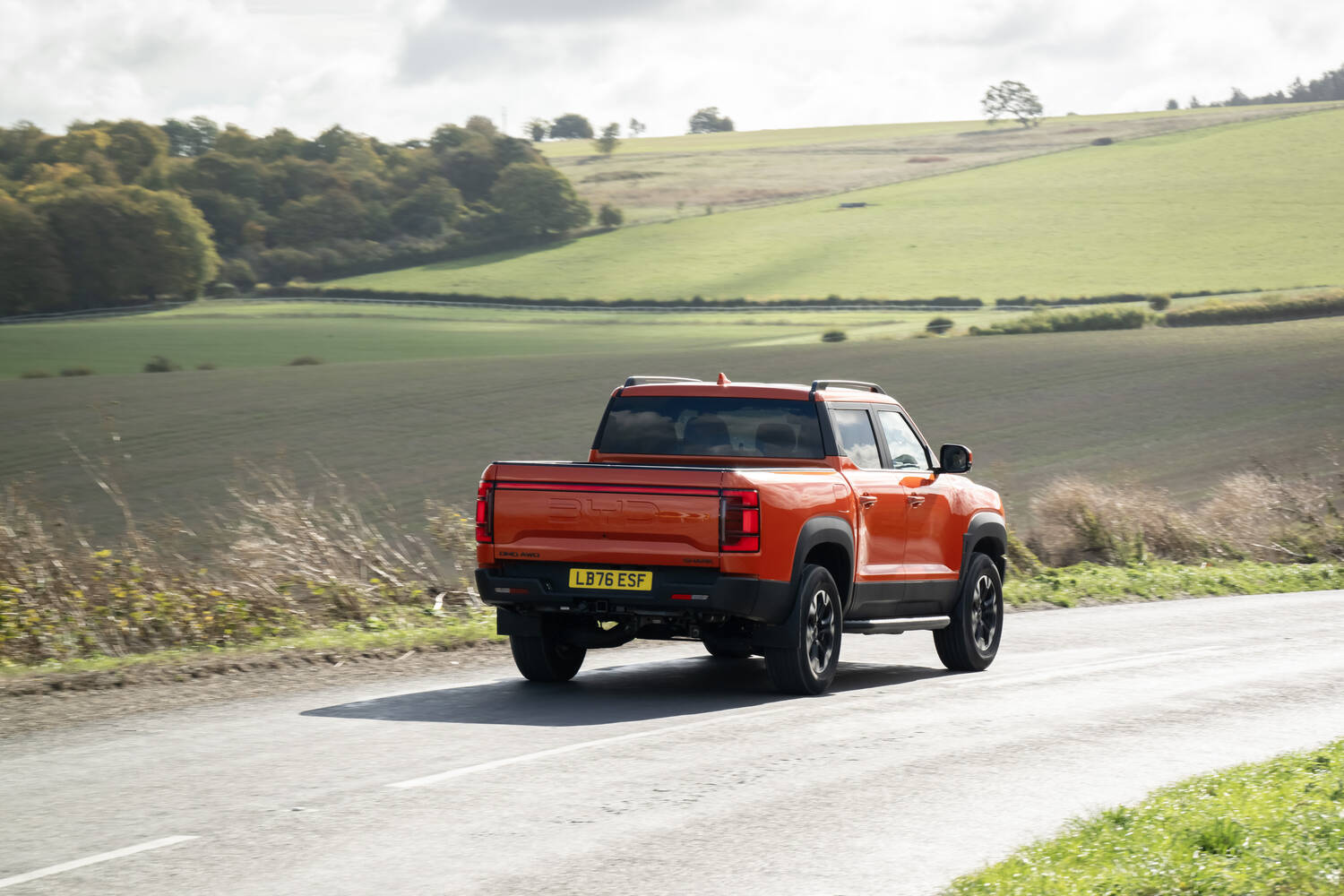
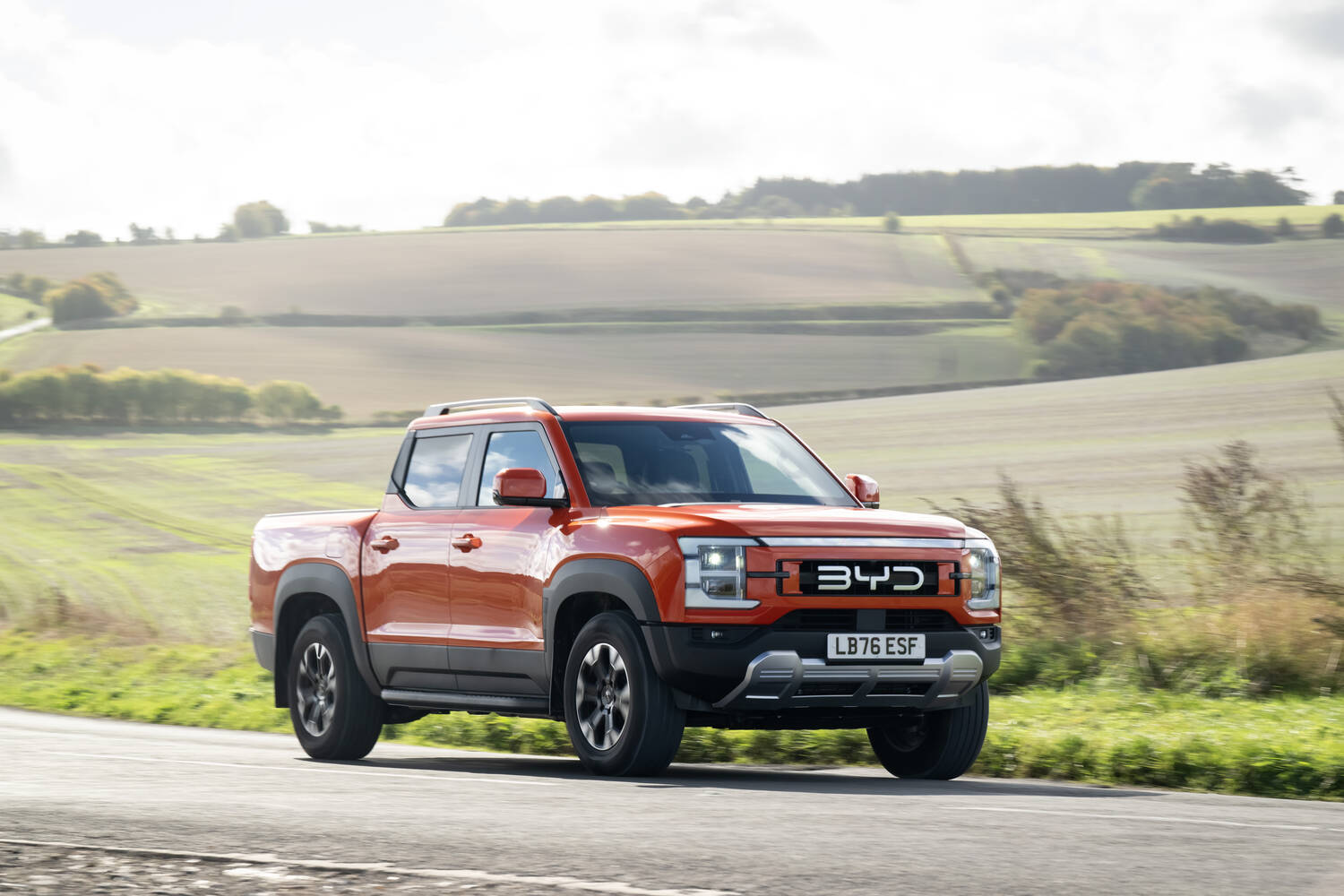
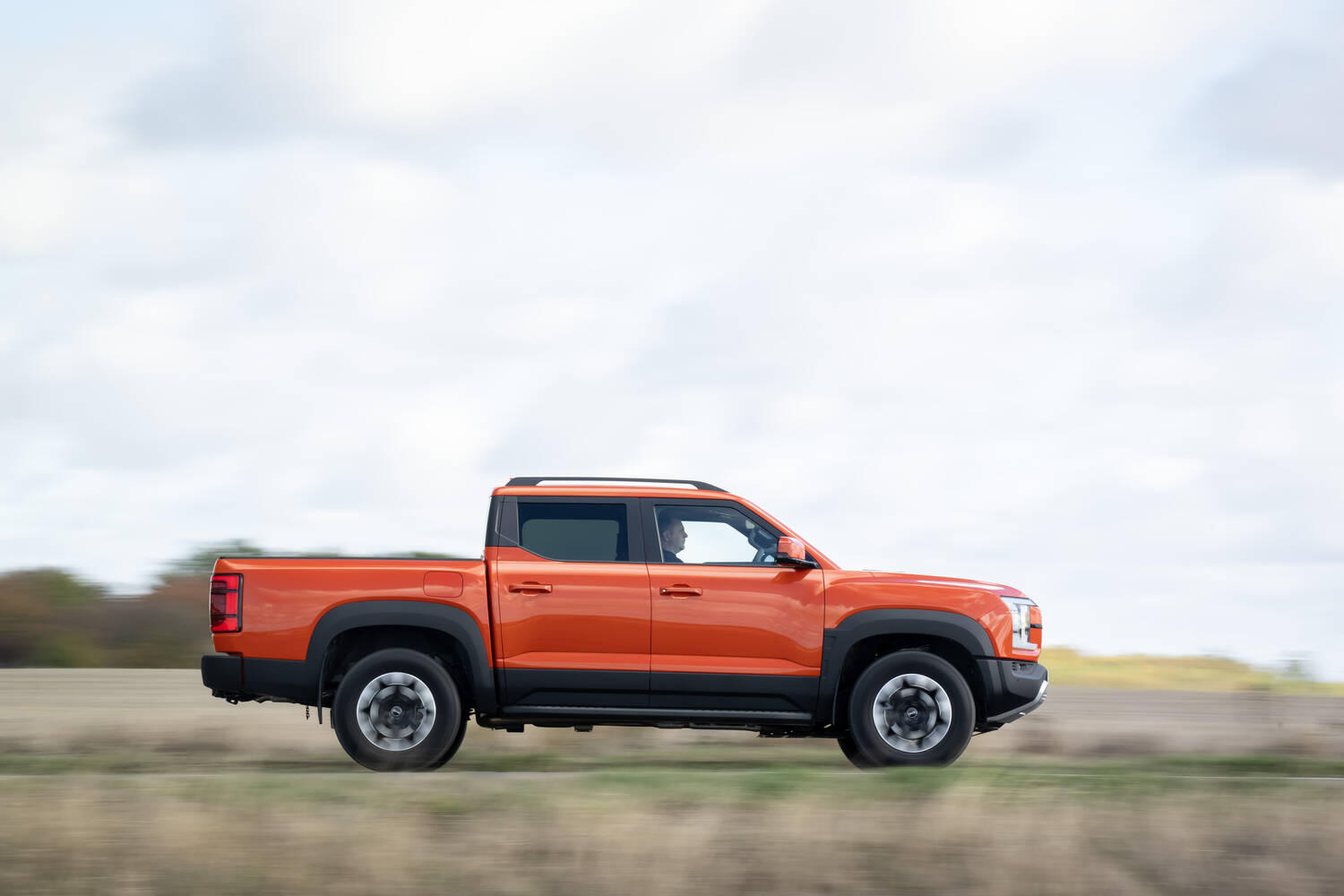
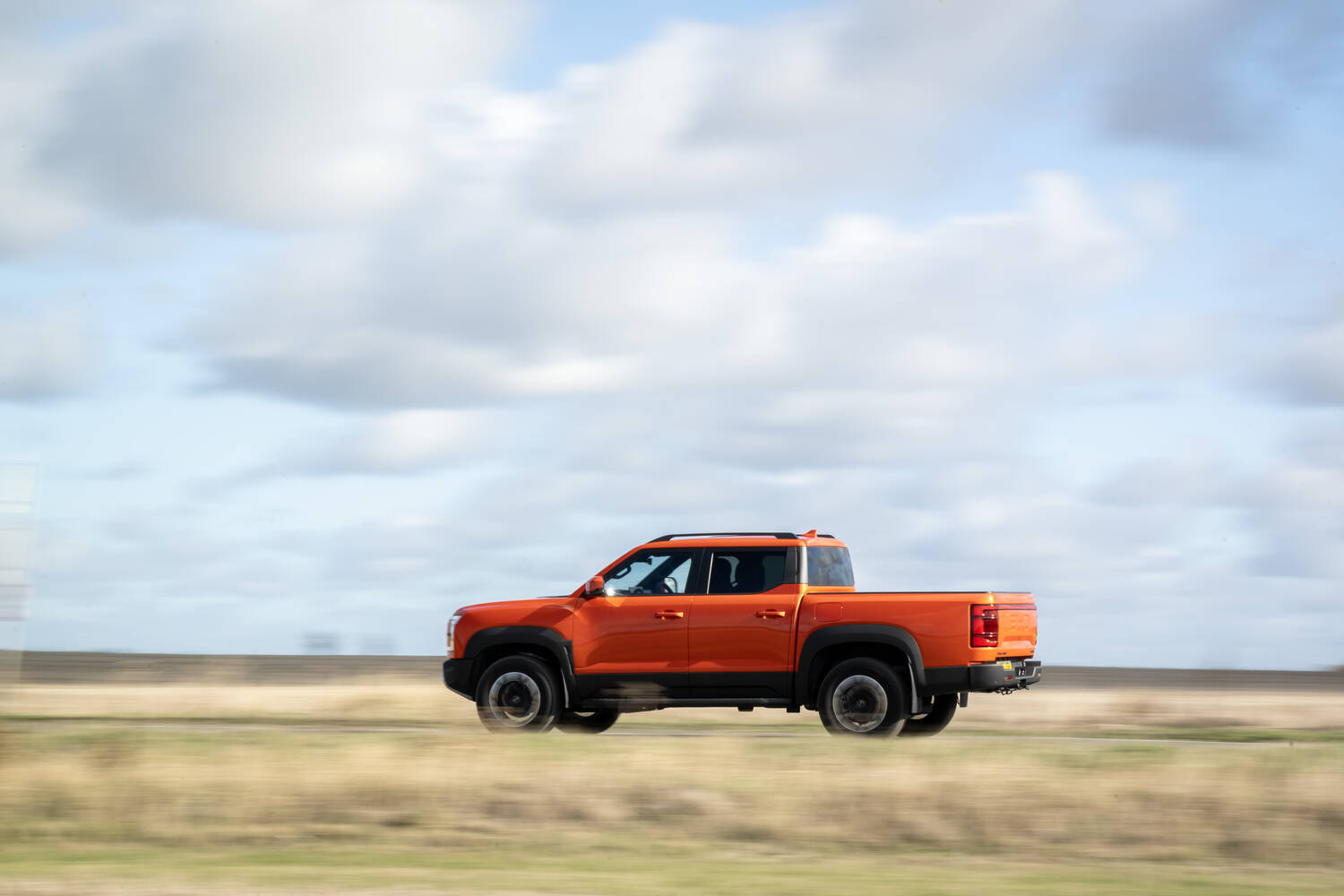
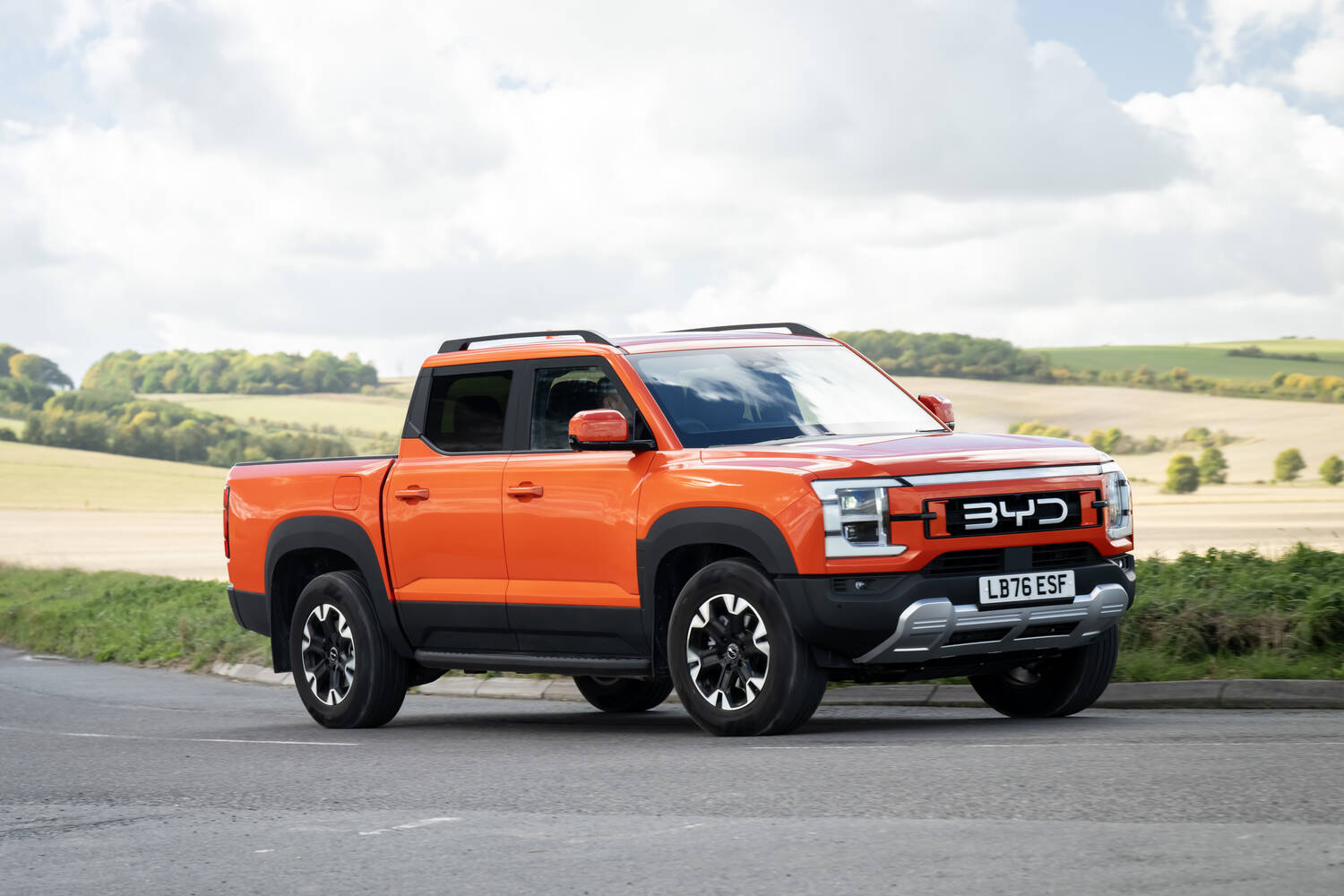
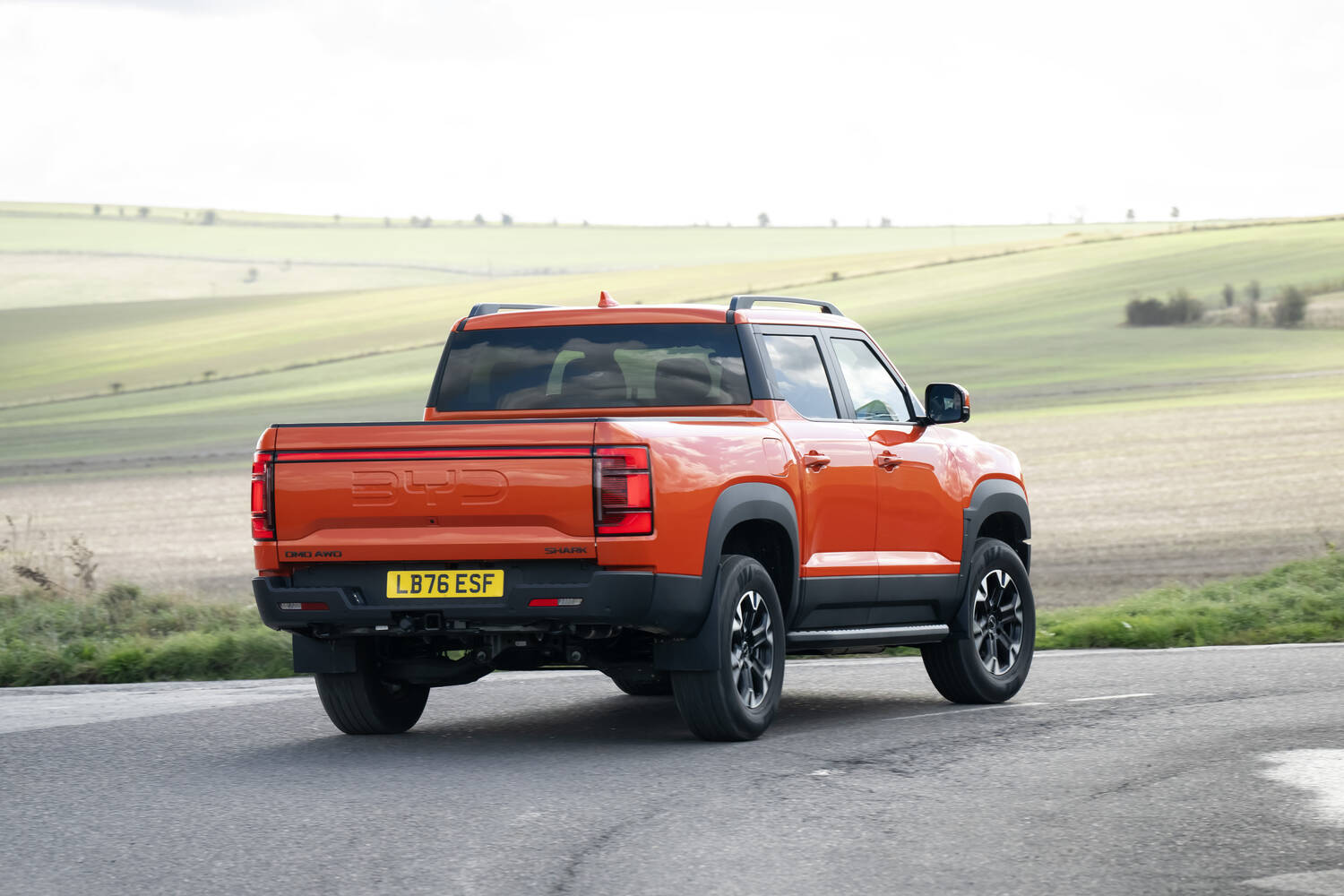
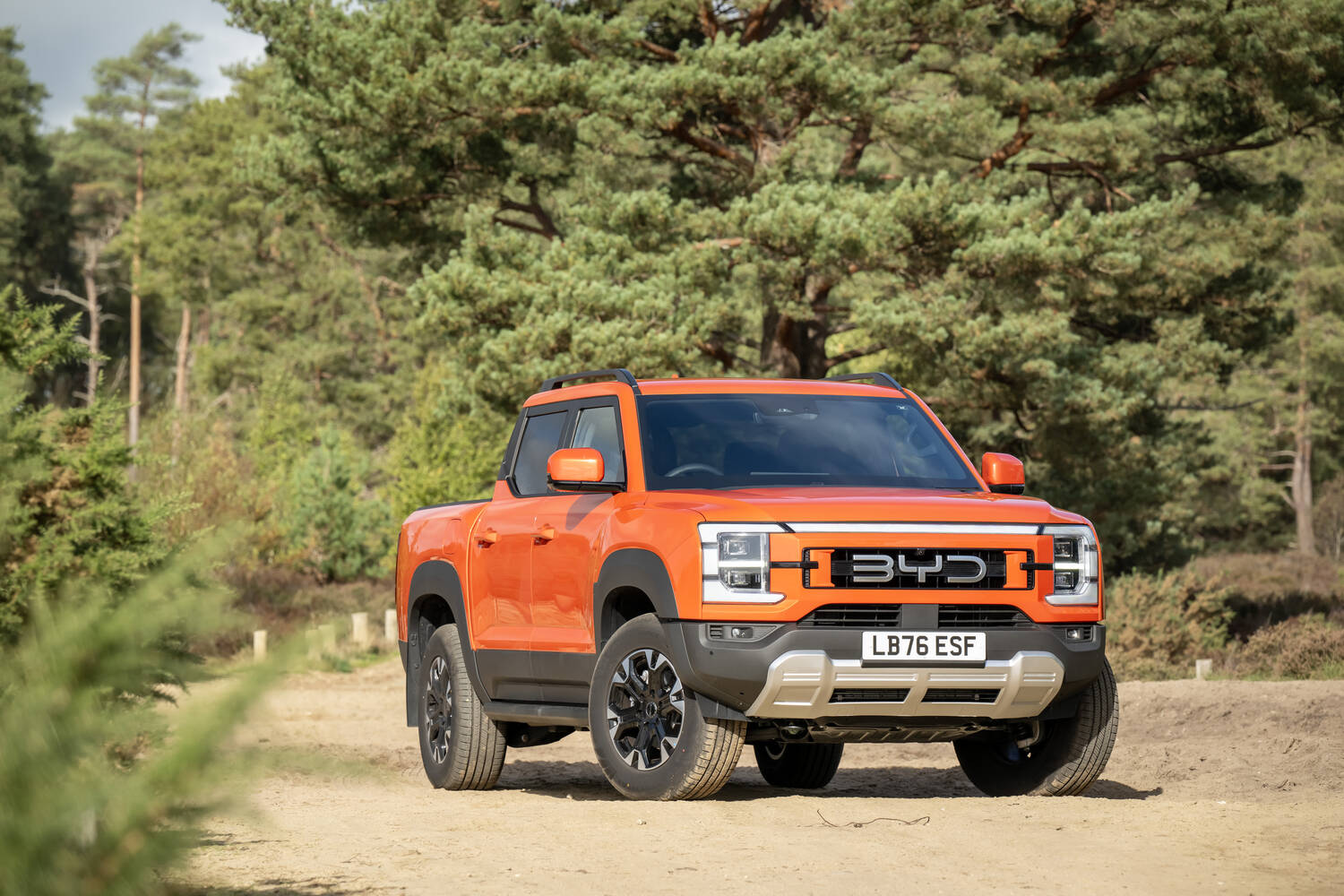
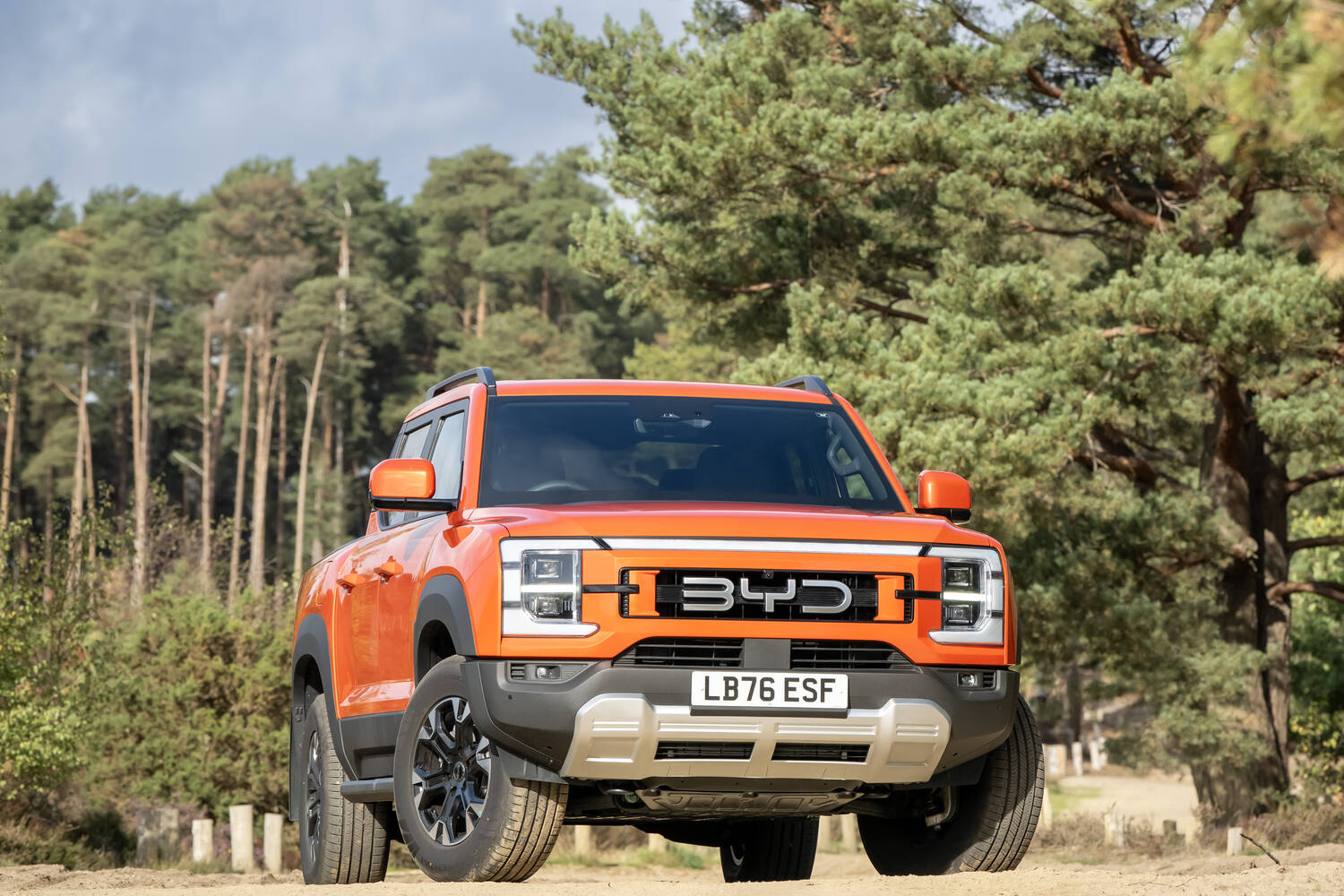
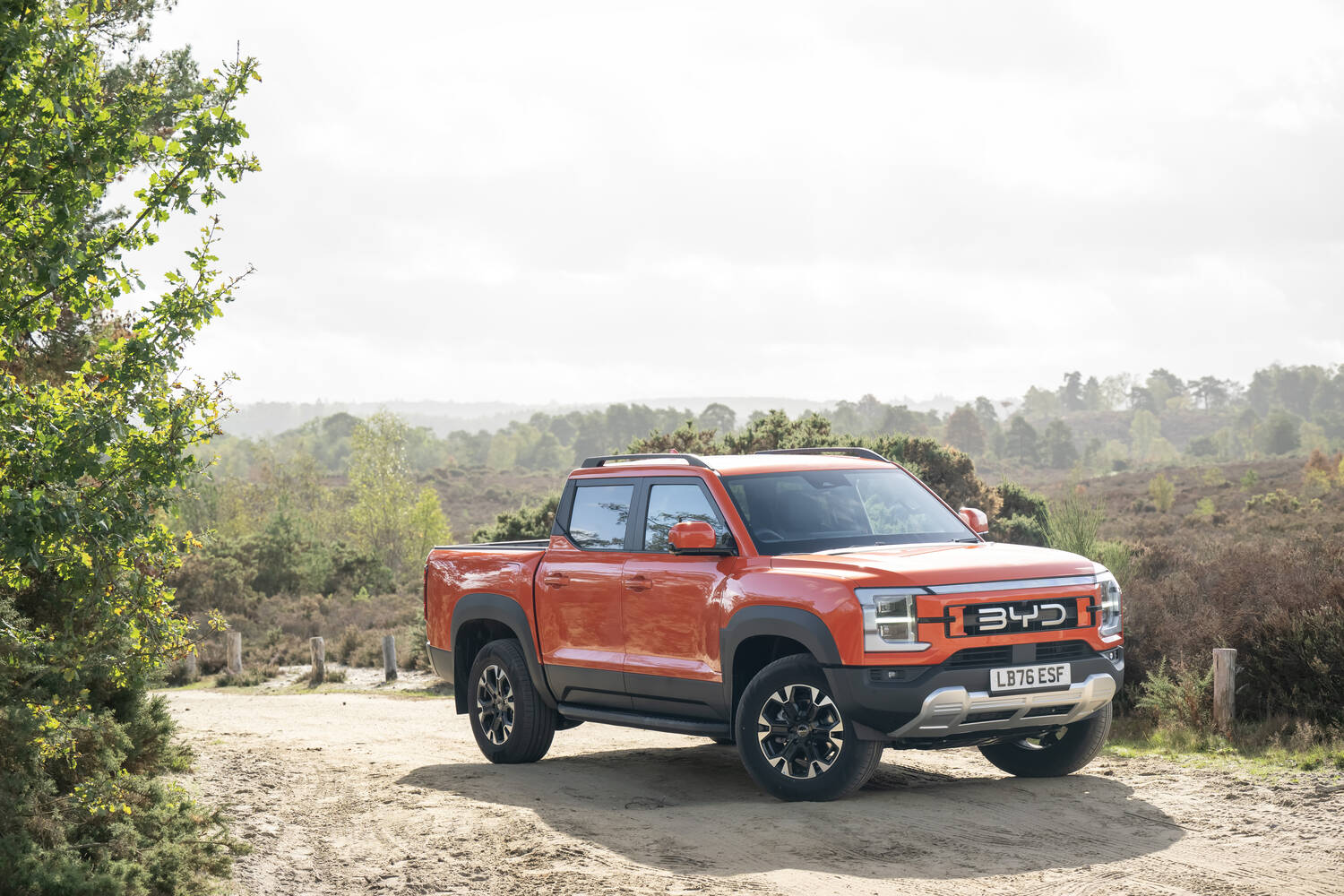
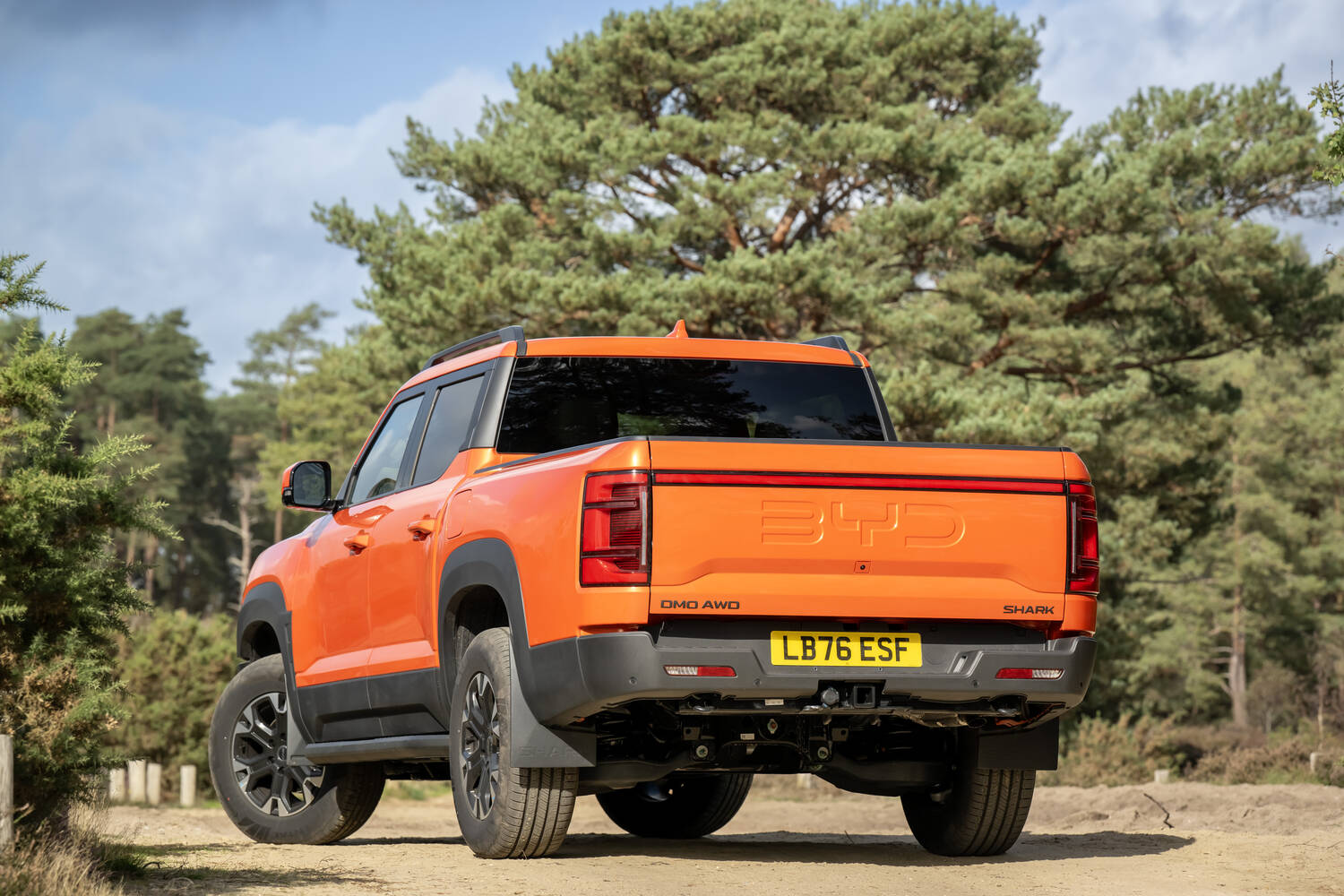
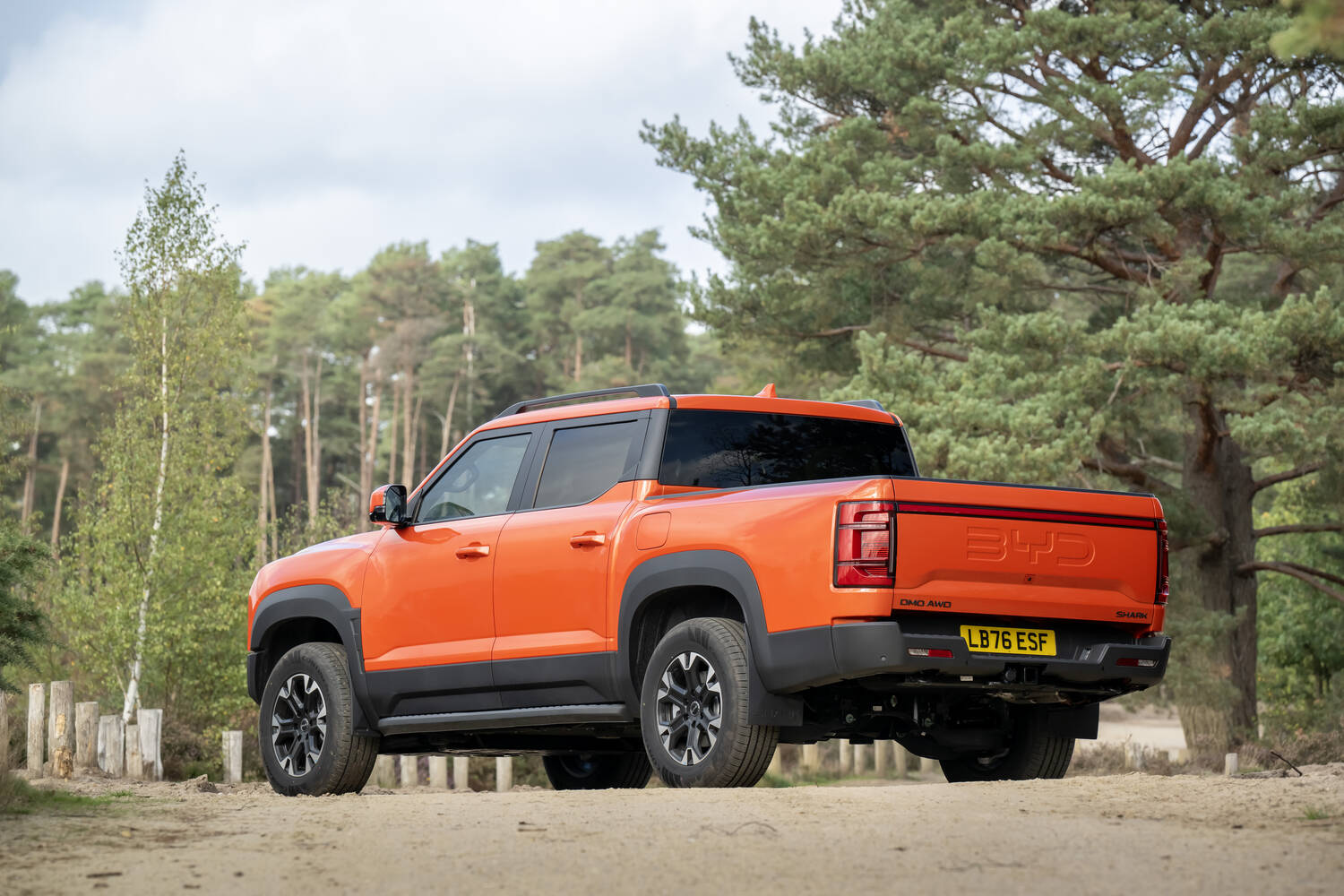
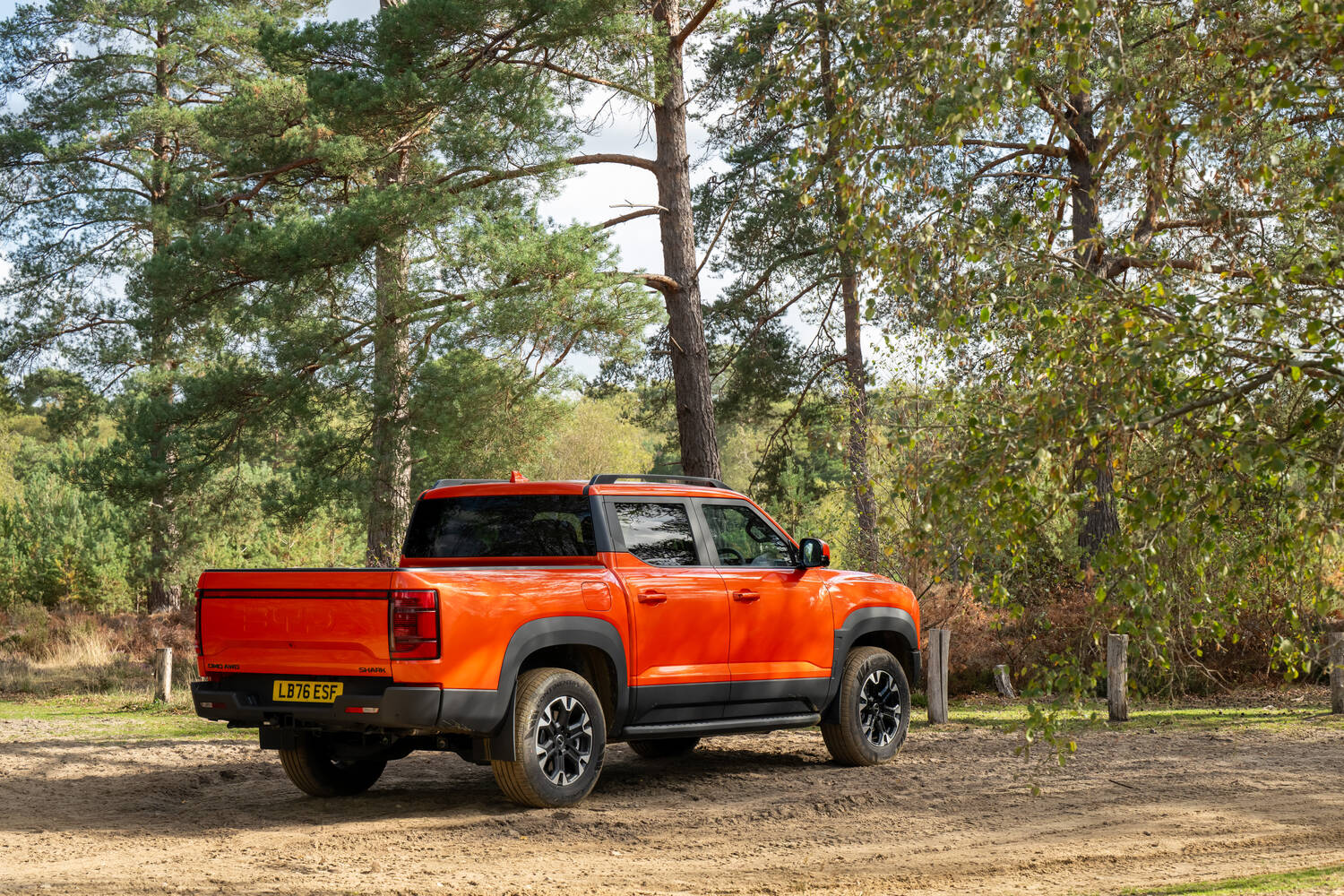
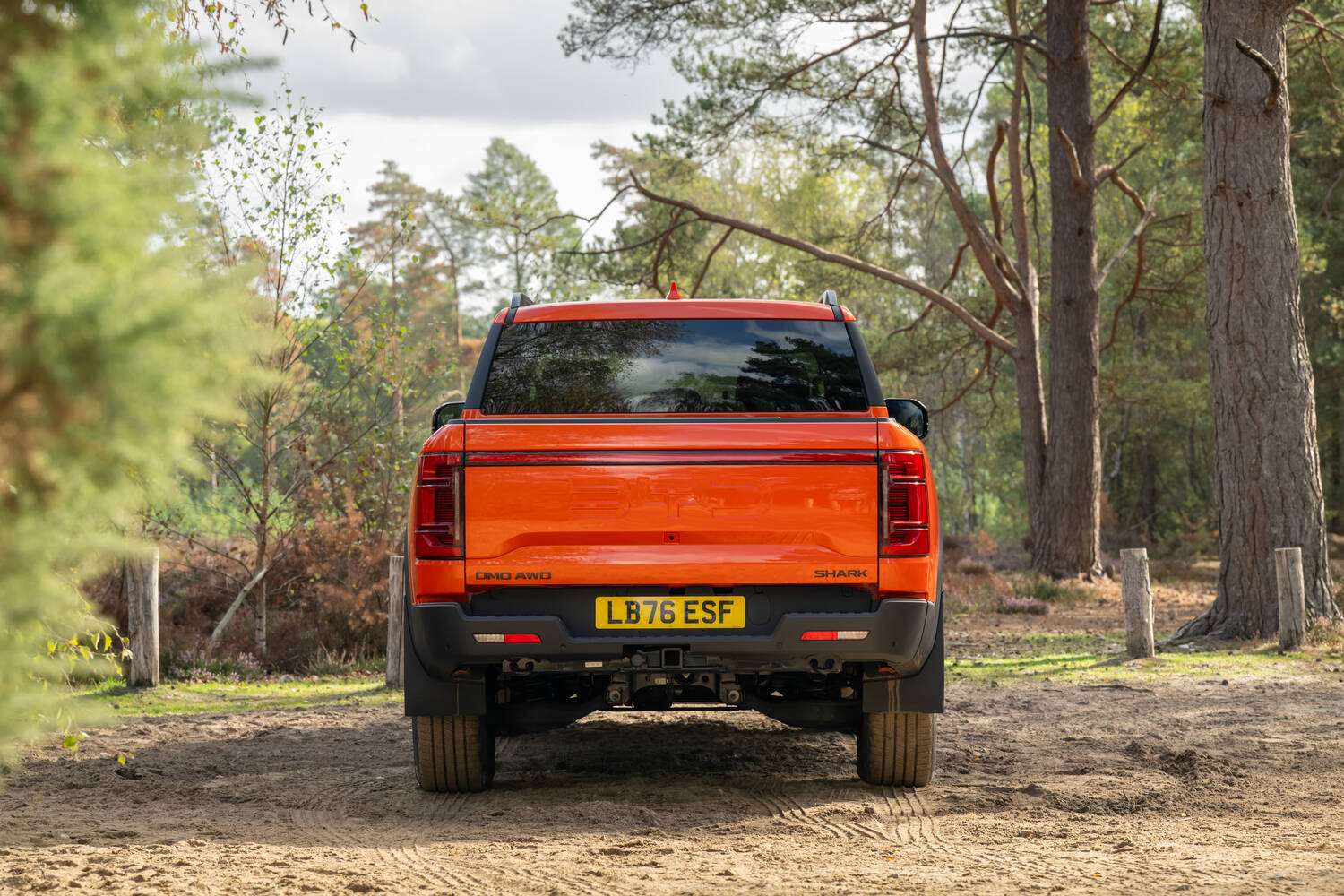
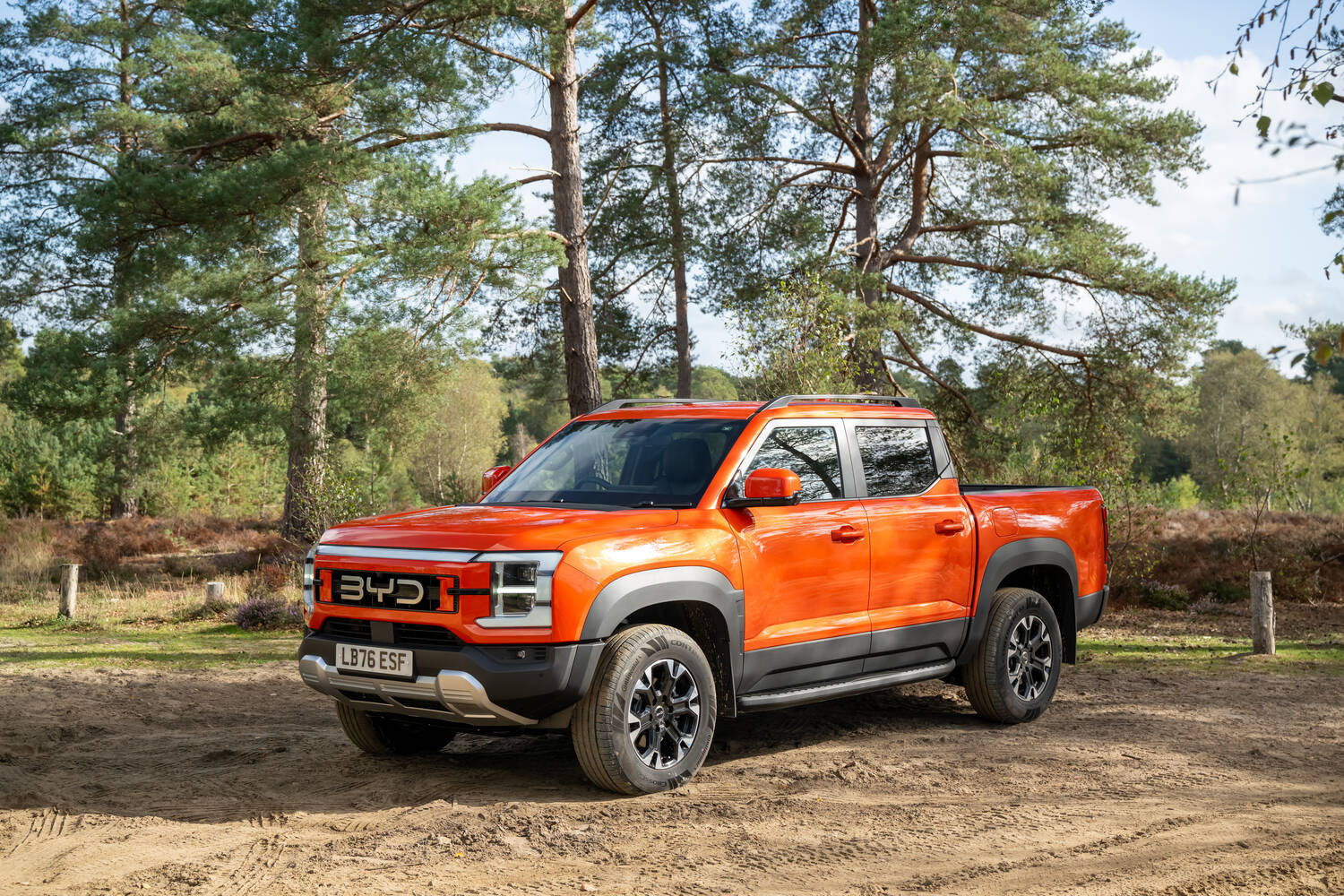
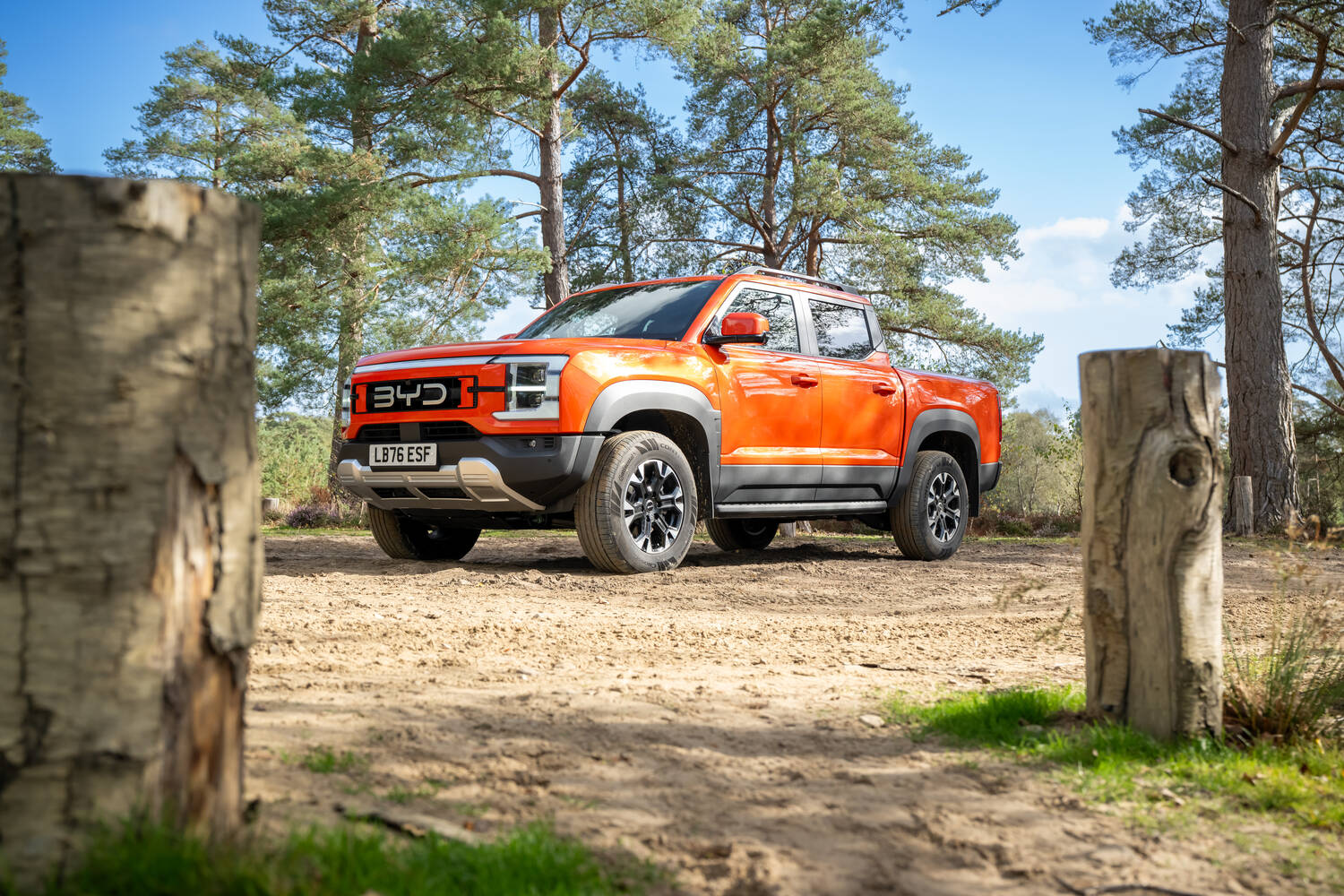
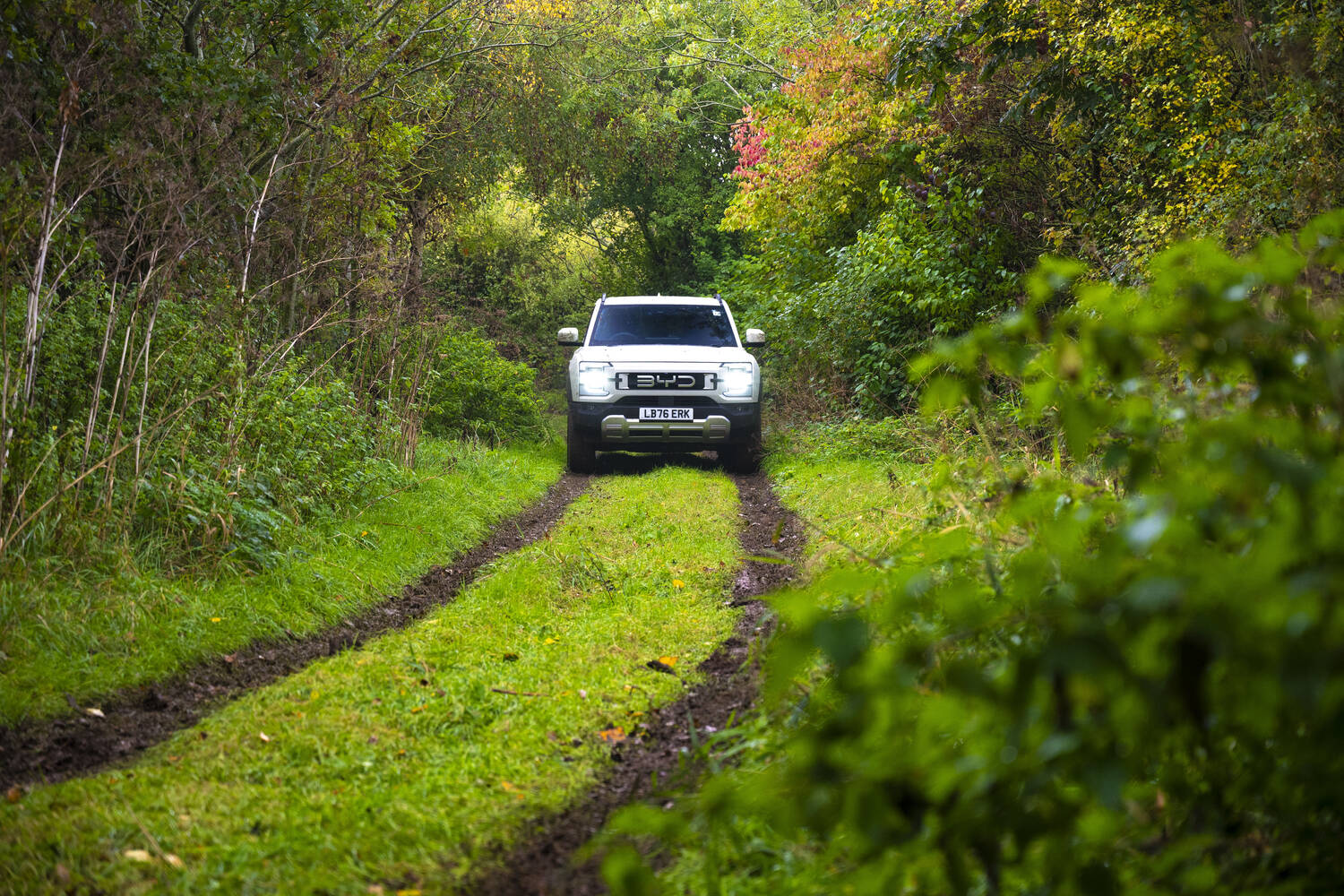
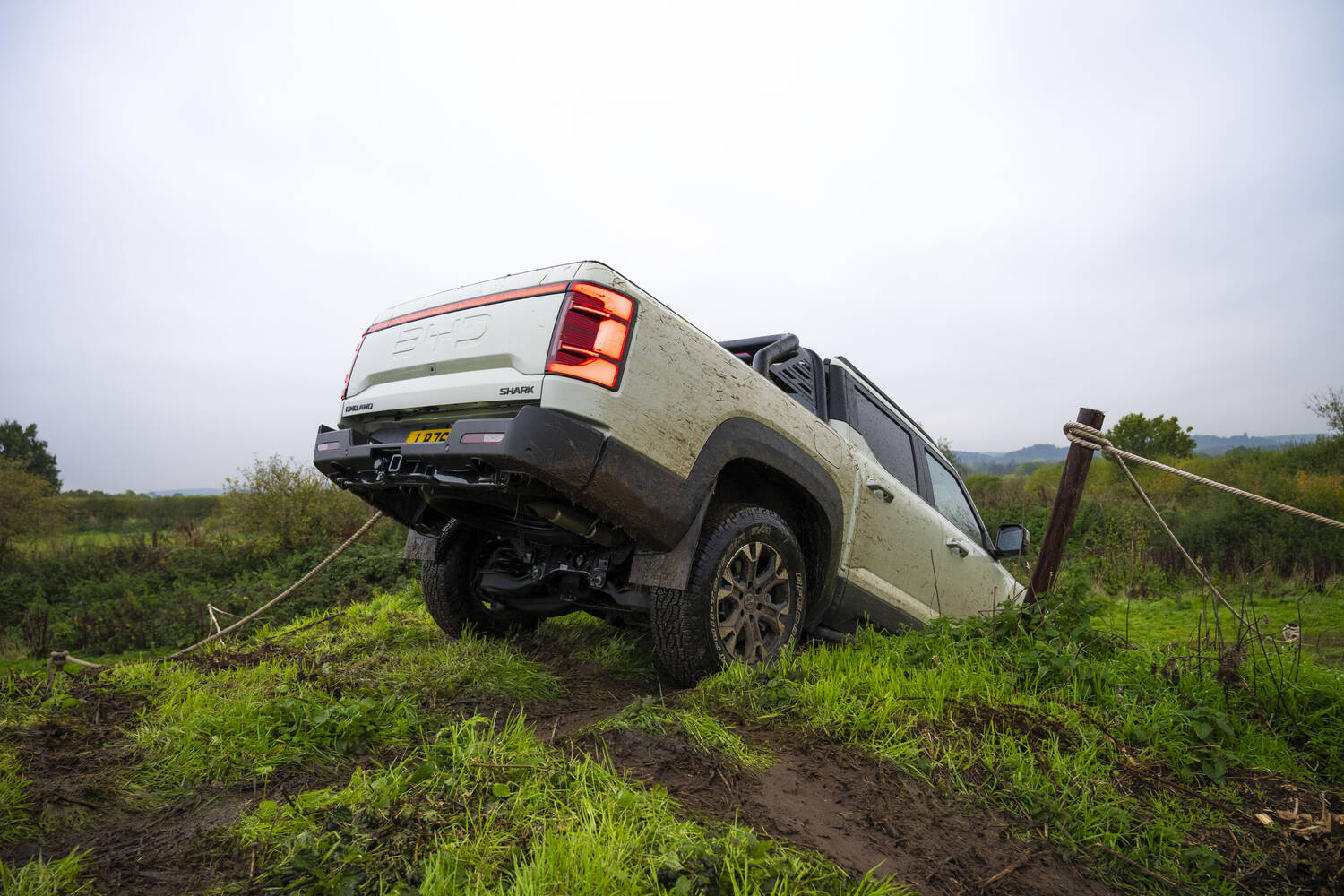
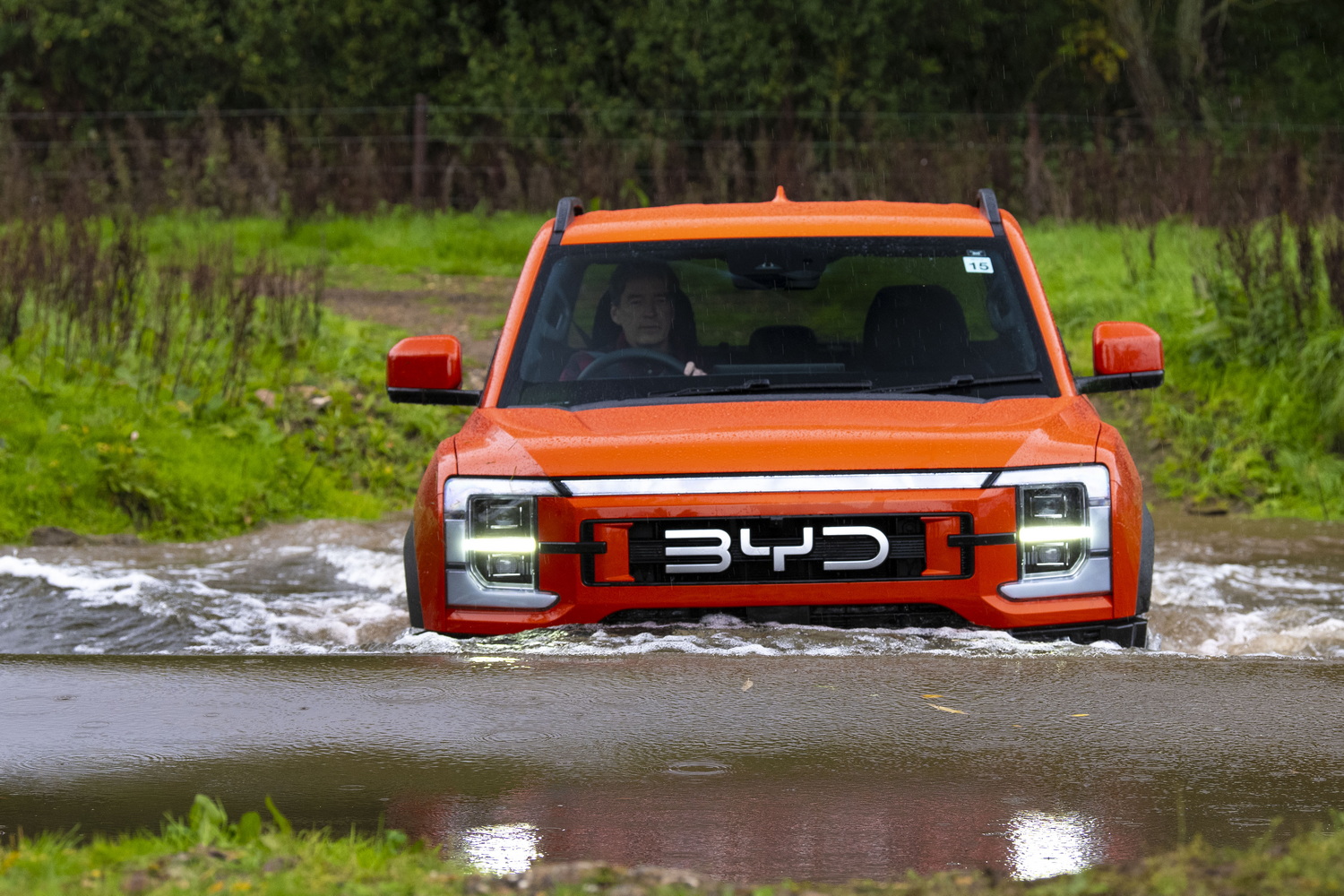
With its large, bracket-shaped light clusters linked by full-width strips of illumination, both fore and aft, and then some absolutely huge 'BYD' emblems on both the nose and tailgate, you won't mistake the Shark DMO for any other pick-up truck.
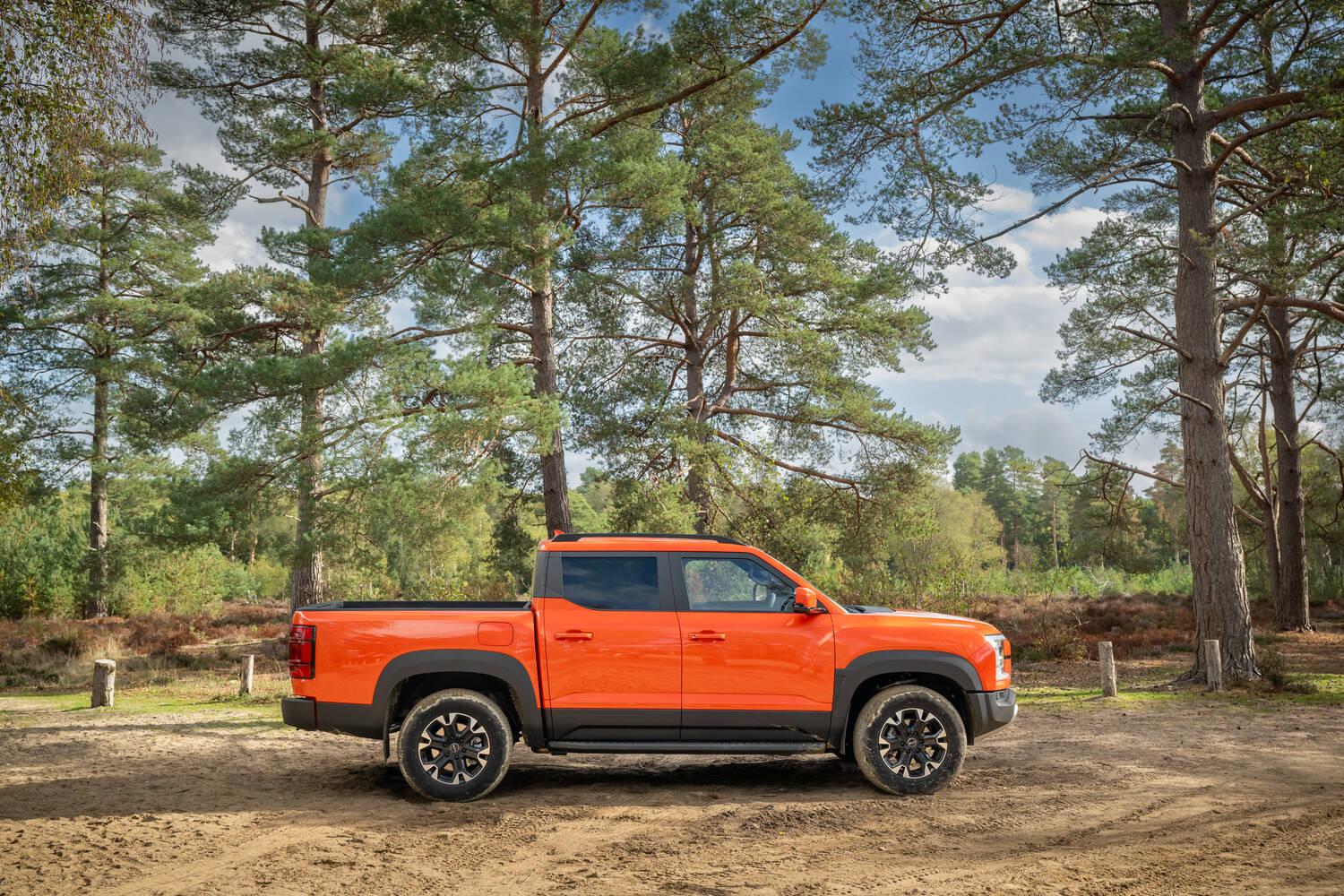
It looks good and purposeful, and it comes on a solitary design of 18-inch alloys wrapped in chunky Continental CrossContact all-terrain tyres.
Dimensions of the 2027 BYD Shark DMO
- Length:
- 5,457mm
- Width:
- 1,971mm (excluding mirrors)
- Height:
- 1,925mm
- Wheelbase:
- 3,260mm
Paint colours for the 2027 BYD Shark DMO
Polar White is the standard, non-metallic colour for the BYD Shark, with four metallics as cost options above that - Obsidian Black, Atlantis Blue, Grey Green and Sunrise Orange.
As far as palettes go for any Chinese car, that's a bright and eye-catching array, and it reflects the more lifestyle-oriented aspirations BYD has for the Shark DMO.
Interior, practicality, tech & comfort of the 2027 BYD Shark DMO
- High tech count within
- Material quality is very good
- Impressive amount of rear legroom
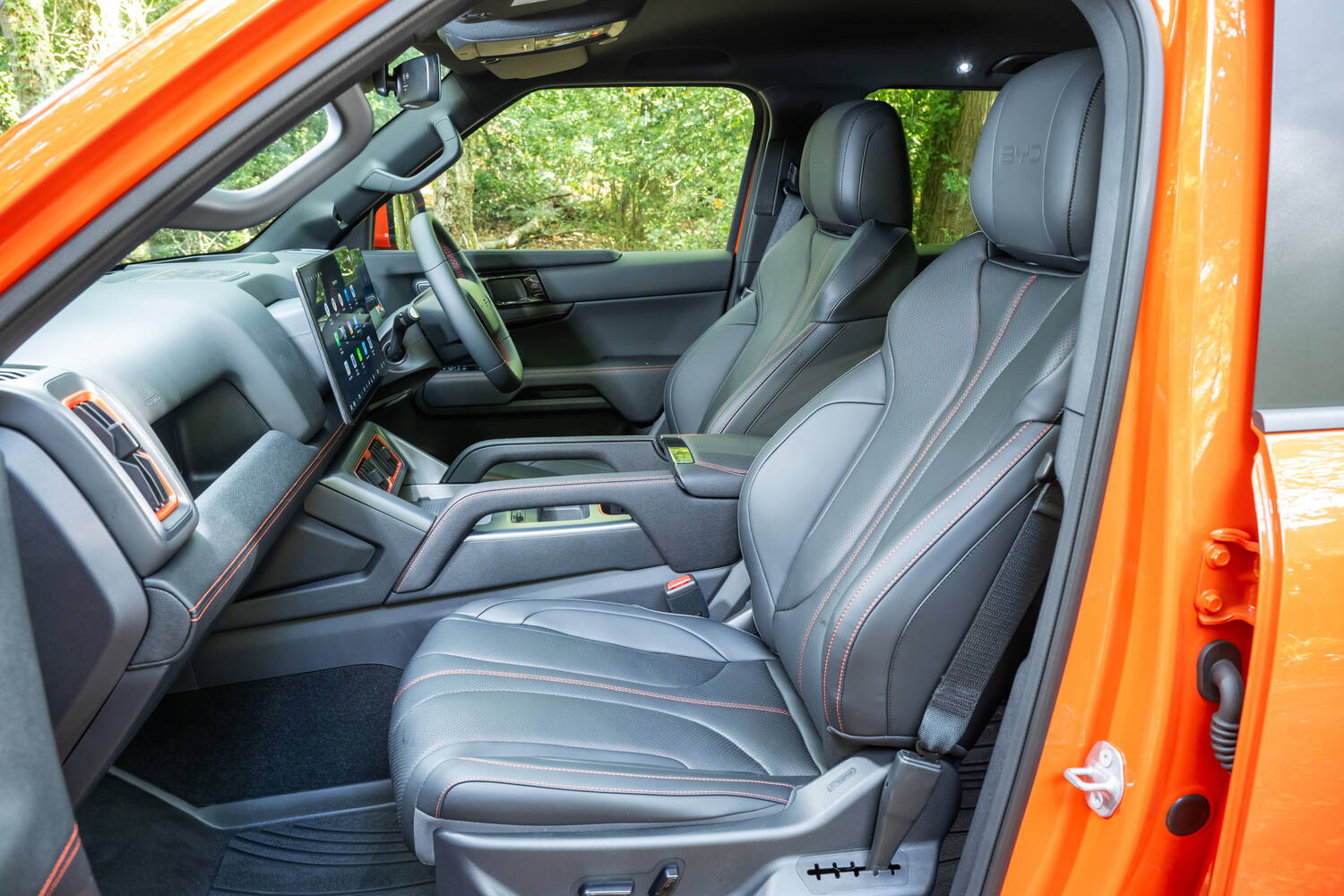
Once inside the cabin of the BYD Shark, it's clear to see this truck is angled more at outdoorsy SUV owners than fleet and commercial users.
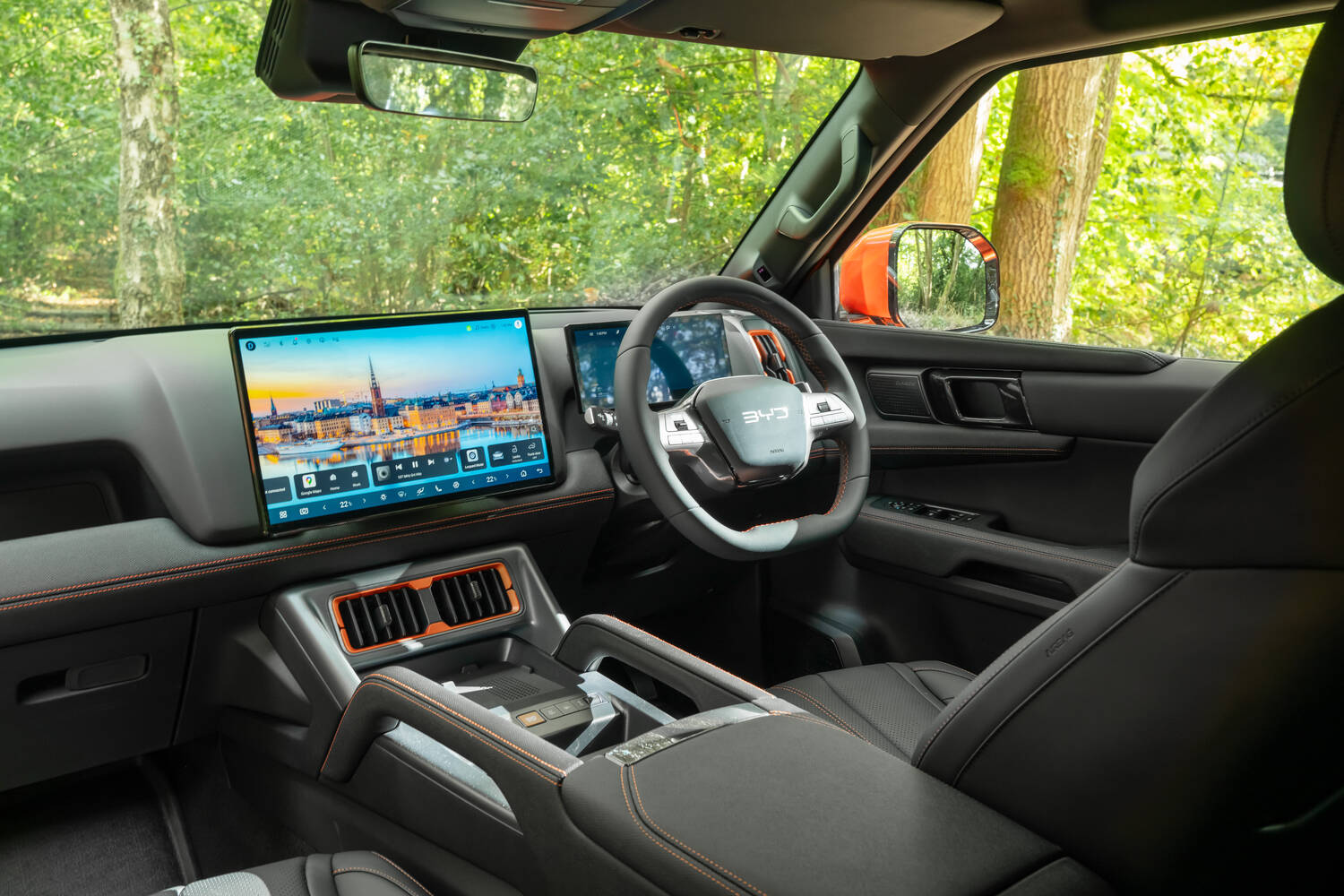
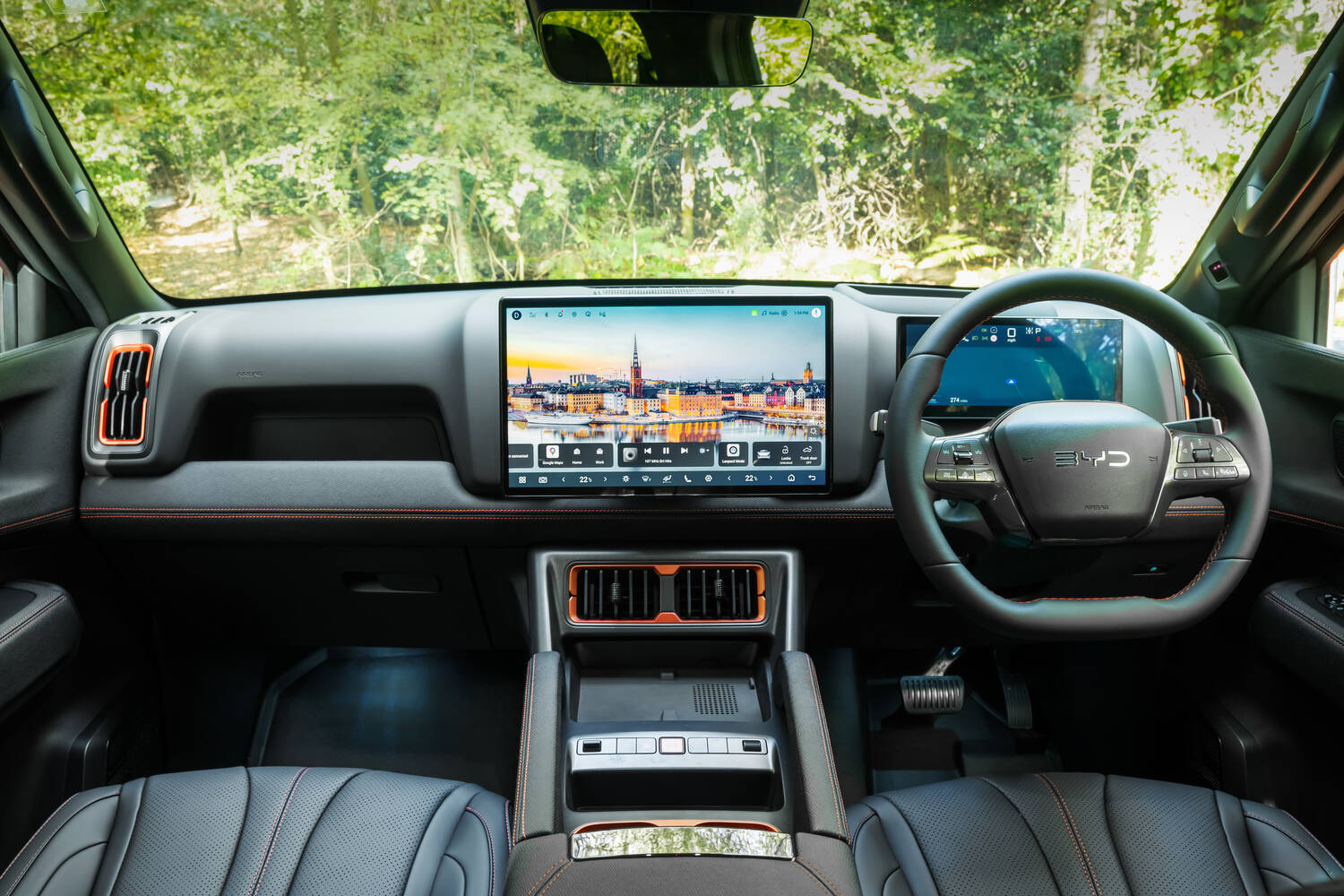
The material finishing is of a suitably elevated standard, there's a lot of desirable equipment fitted from the factory and contrast stitching and detailed upholstery finishes further up the luxury ambience.
Getting comfortable in the driver's seat
There's electric adjustment for the driver's seat and a manually adjustable steering column with reach and rake adjustment in the BYD Shark DMO, catering for a wide range of physiques.
The lofty driving position and large glasshouse also mean visibility is excellent in all directions.
Infotainment and technology
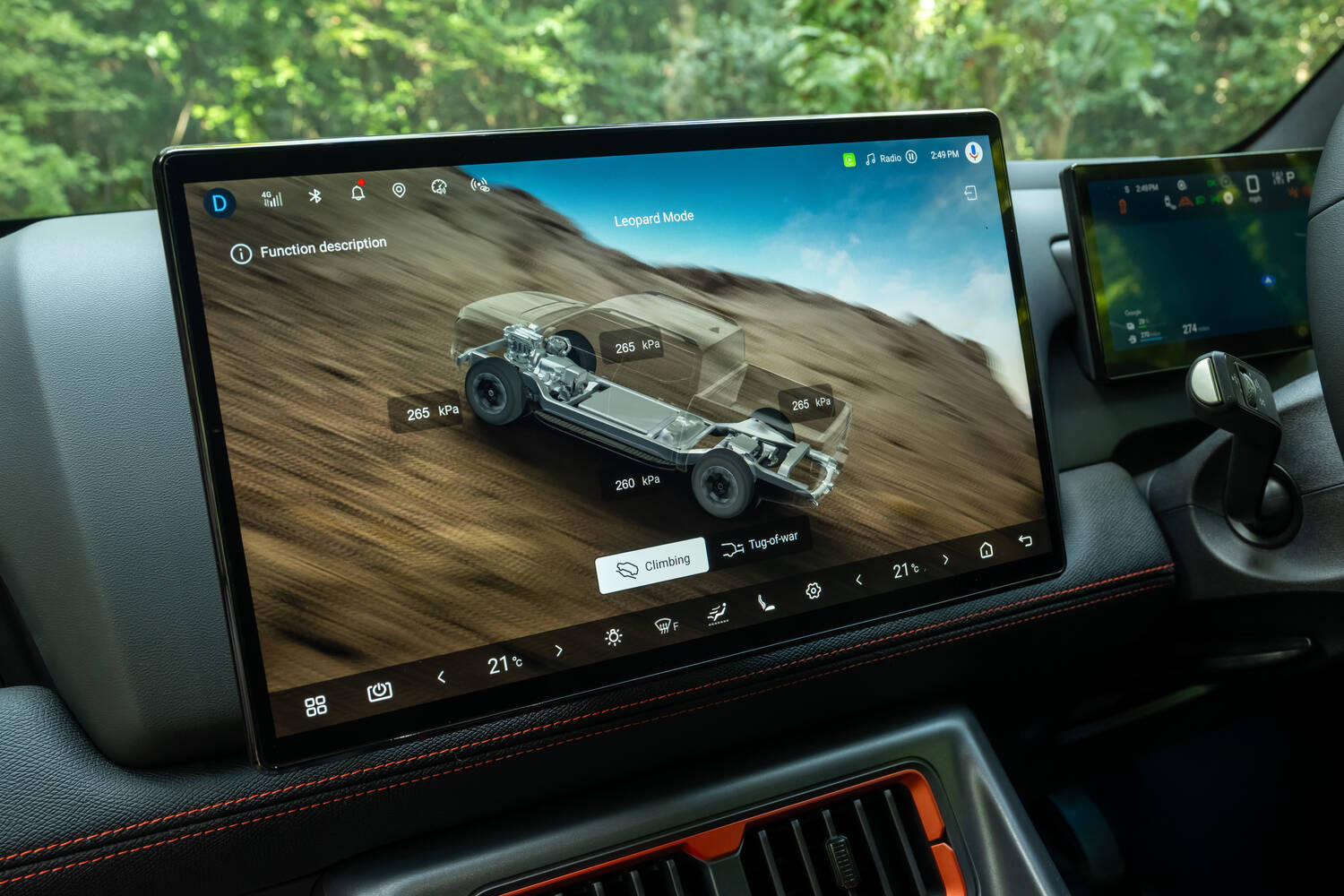
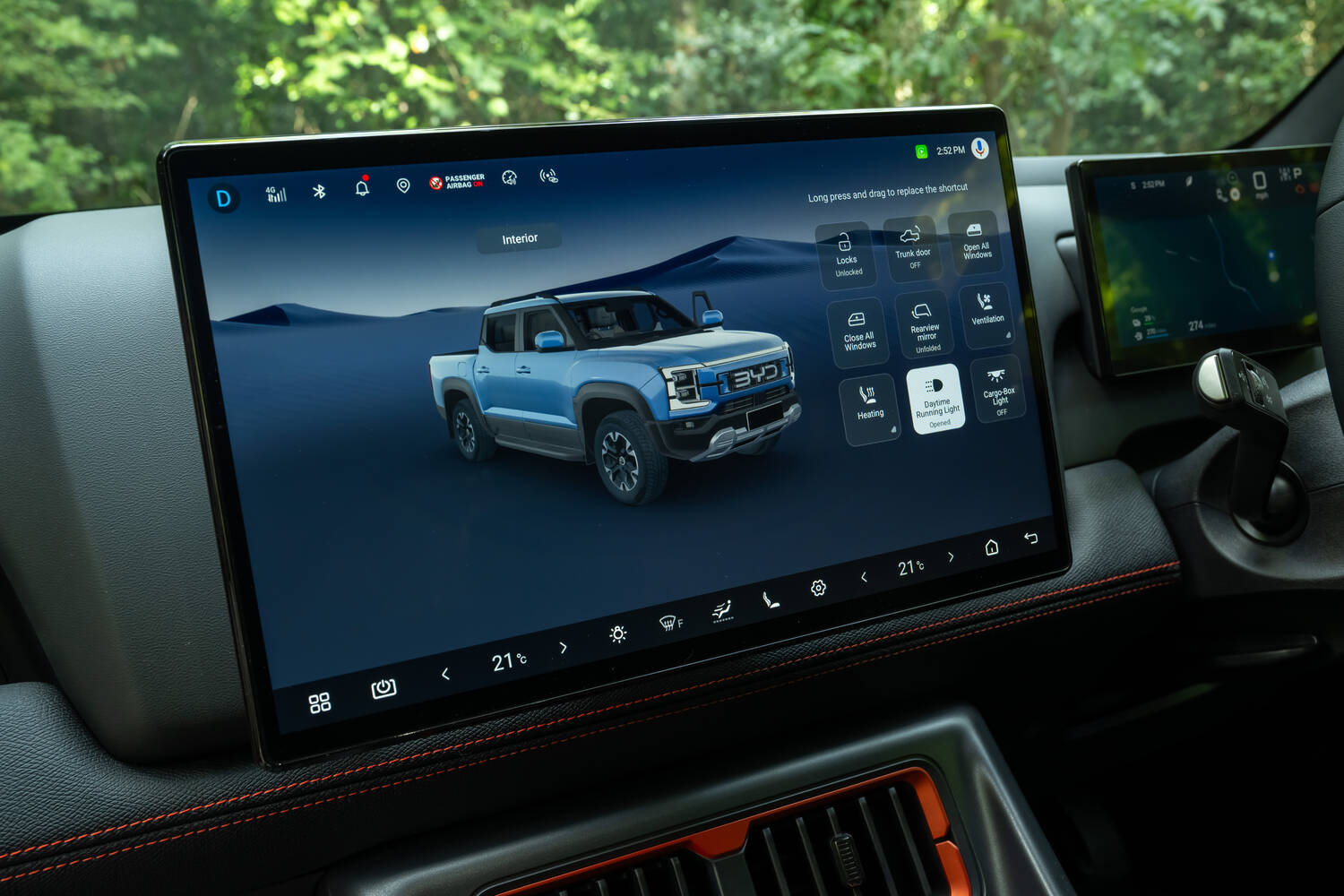
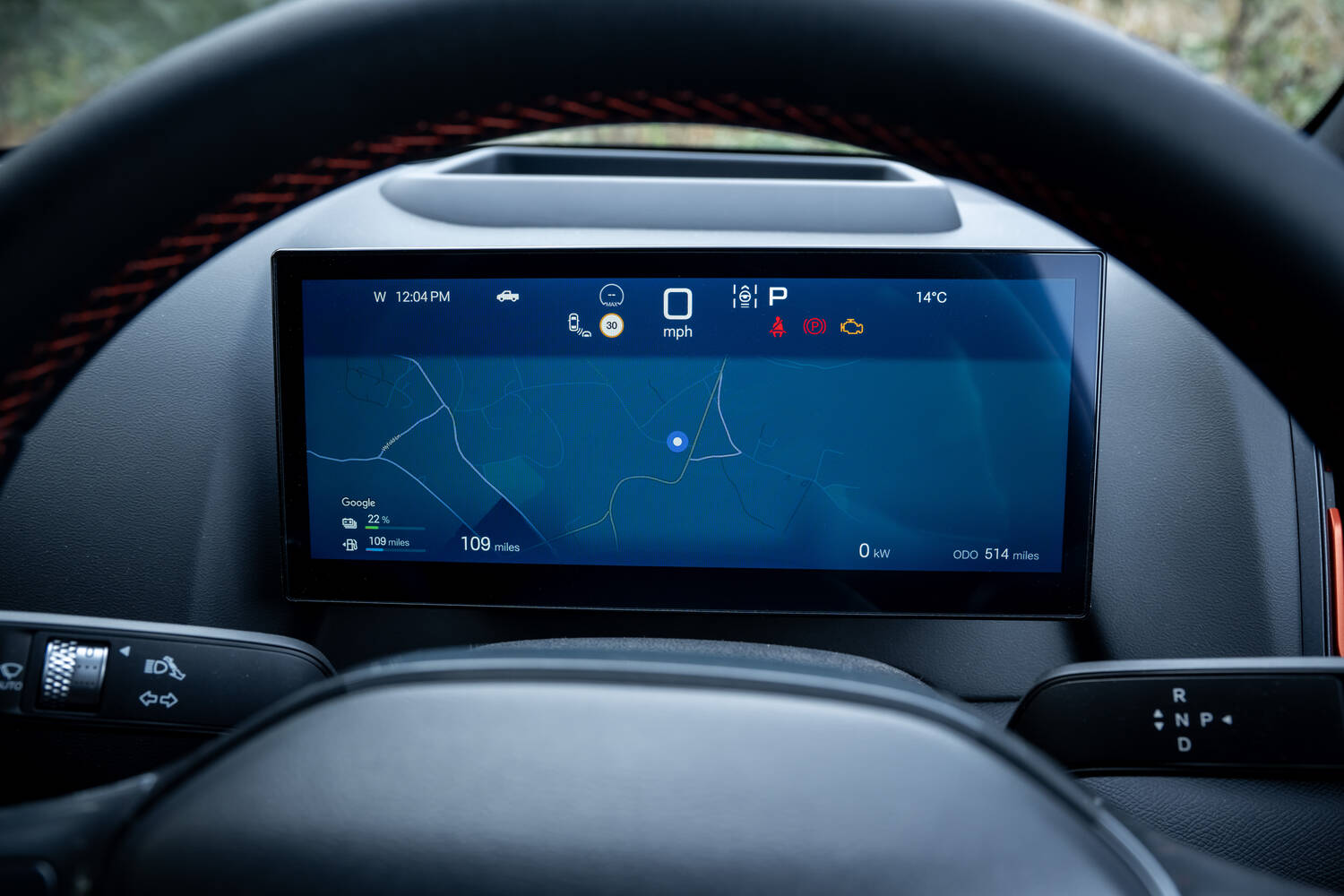
With a 15.6-inch infotainment display and a 10.25-inch instrument cluster, the BYD Shark fits in neatly with other products from this manufacturer, which are all high-tech machines.
Further, the Shark has a head-up display, which BYD says is unique for pick-up trucks - it certainly is in the European sector, maybe, although there are some larger North American models which have the technology.
All of these screens work well in the Shark, even the main infotainment, which has Google Maps as its native navigation, as well as the ability to wirelessly support Android Auto and Apple CarPlay.
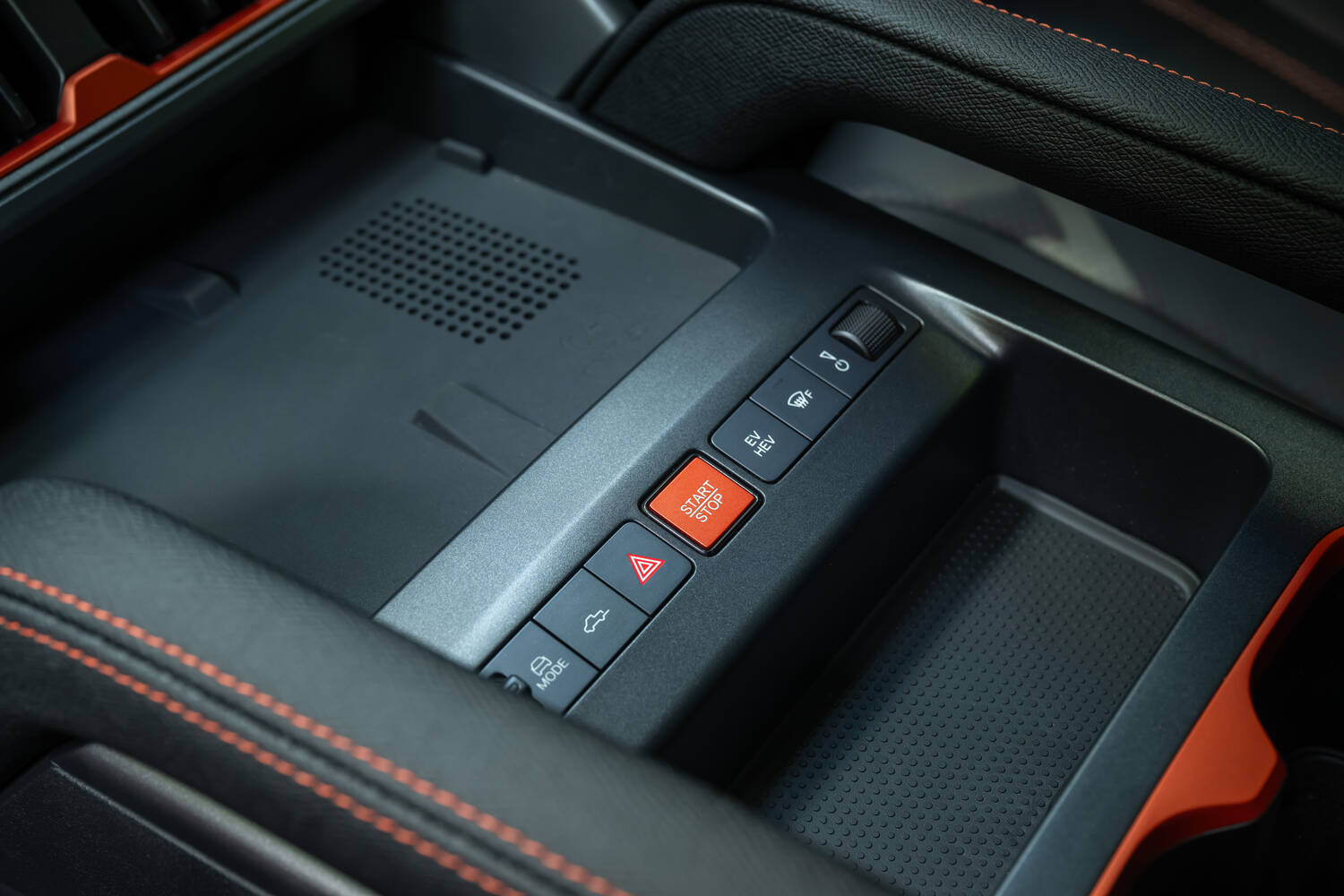
And as the Shark has more physical buttons than other BYDs, operating this set-up is less frustrating than it might ordinarily be, even if some of the safety systems are buried quite deep in the menus - and despite the fact just switching on the heated or ventilated seats is a multi-tap faff on the central display.
Other tech in the Shark includes a 50-watt wireless and cooled smartphone-charging pad, an in-car Wi-Fi hotspot and four USB ports (two 60-watt USB-Cs, one in the front and one rear, and also a pair of USB-As, 7.5-watt front and 18-watt rear).
There's also a 12-speaker Dynaudio premium sound system. This is the sort of thing that is usually an expensive cost option on most of the BYD's rivals.
Practicality around the cabin
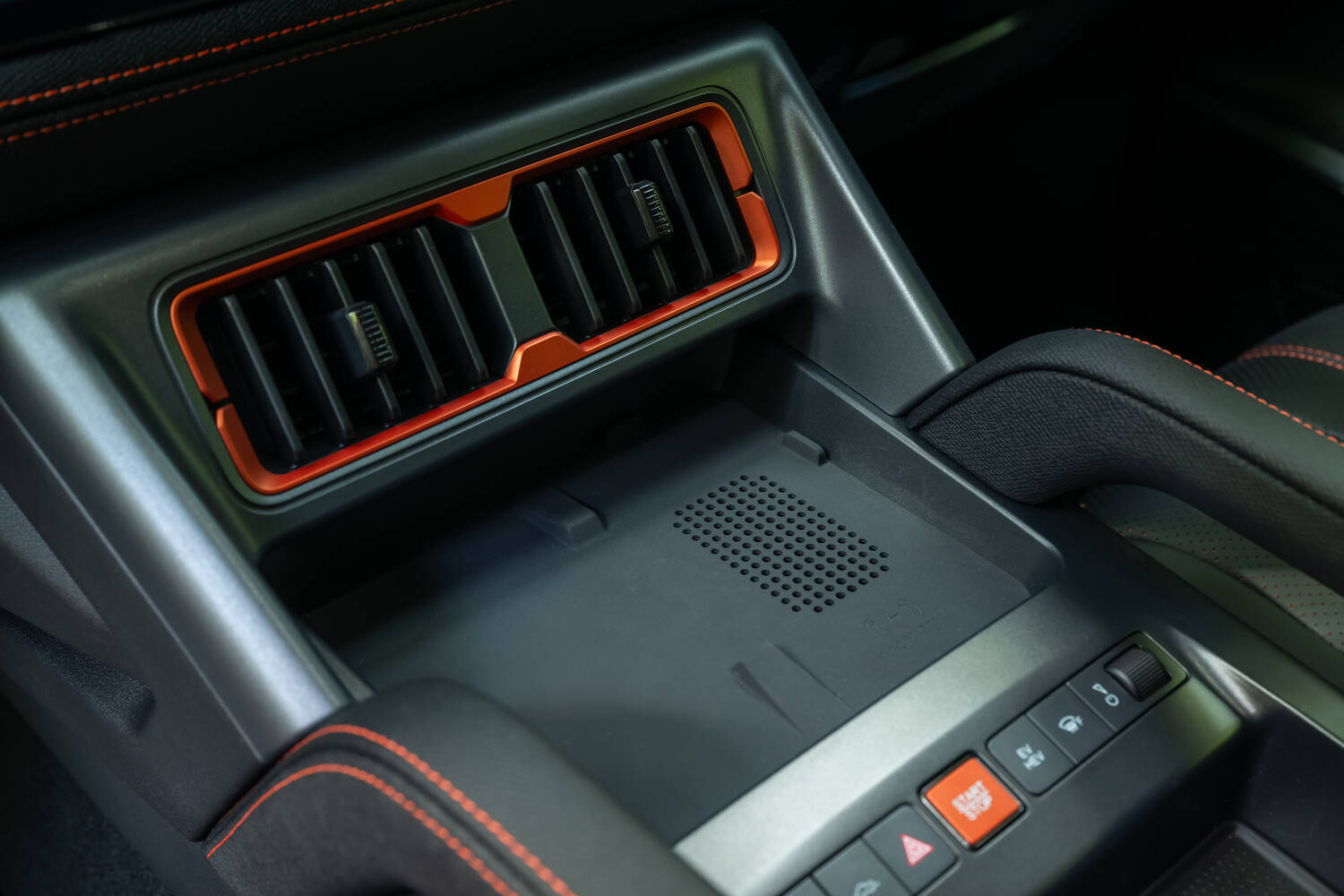
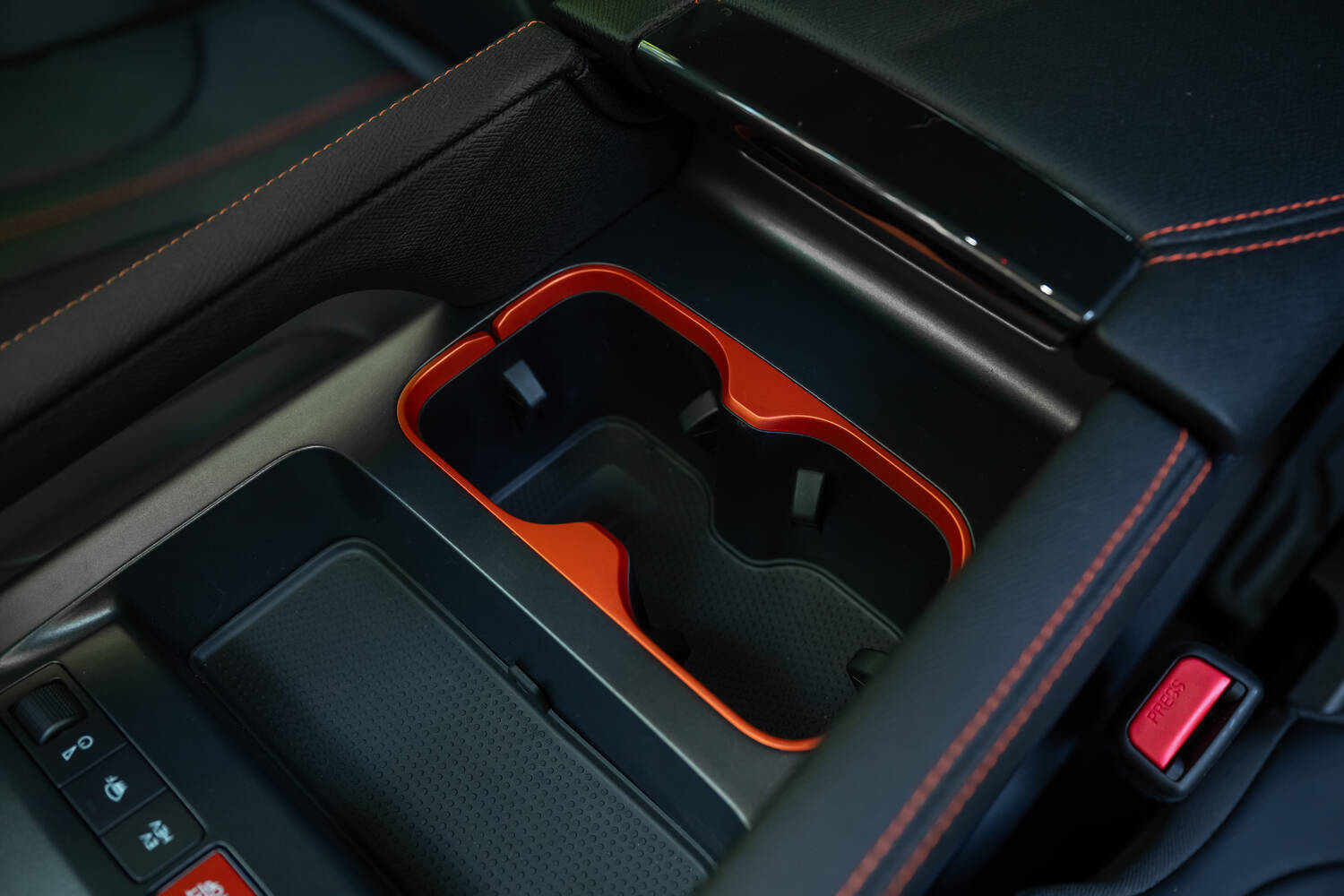
Behind the charge pad for the smartphone, which sits alongside a space where another device could be stored, there are two fixed cupholders in the BYD Shark and then a very deep central storage cubby underneath the armrest lid. Inside, you'll find the two USB sockets.
There's no underdash storage in this pick-up, but there are sizeable door pockets and a decent glovebox too, plus useful rubberised storage zones underneath the front door pulls, with another similar, open item down on the console.
BYD has also fashioned a cubby out of the upper passenger-side dashboard of the Shark, too.
Rear-seat passenger space
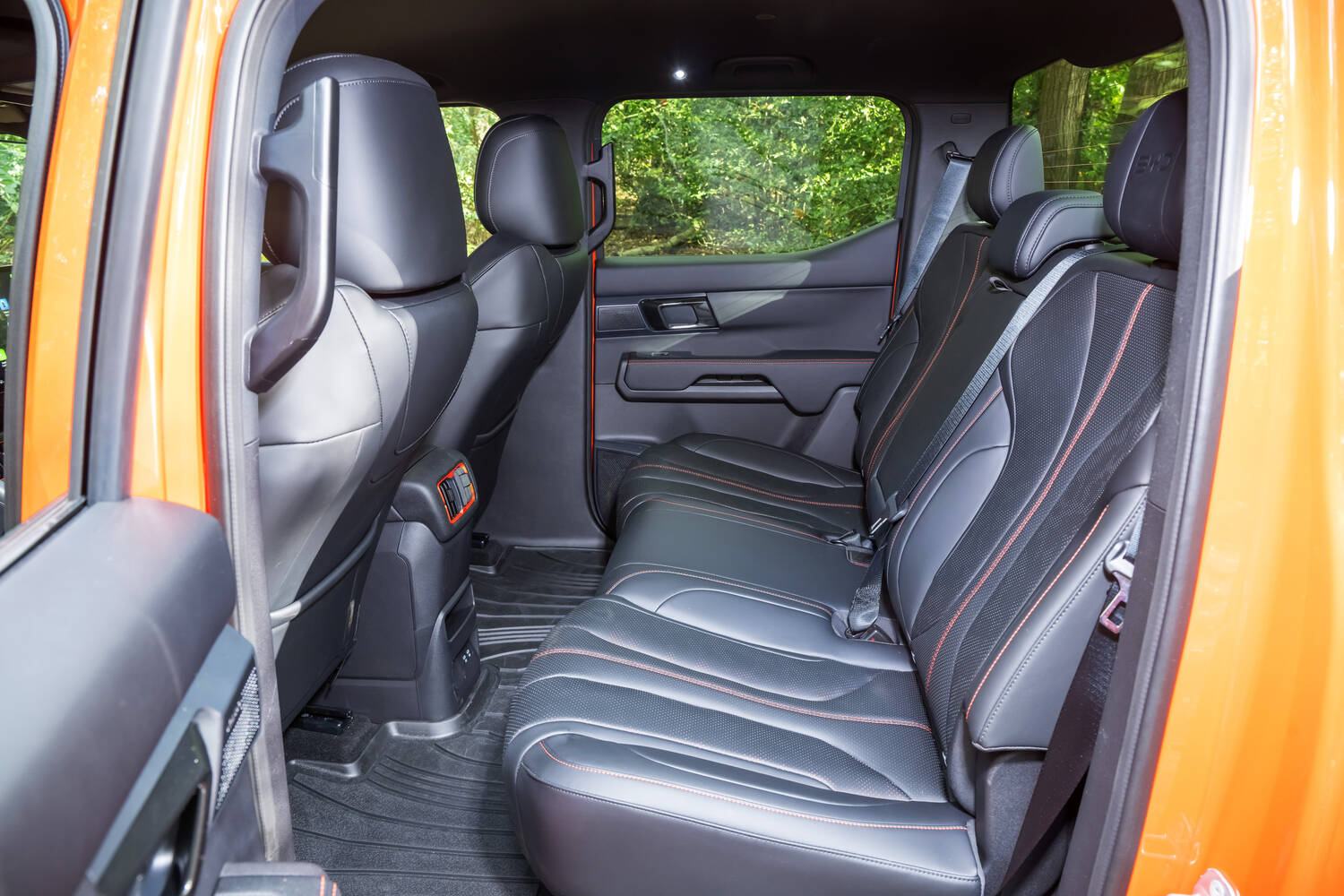
The long wheelbase and body of the BYD Shark result in arguably the best rear-passenger seating in the pick-up truck class.
The back of the second-row bench is positioned at a 27-degree angle, meaning occupants there aren't forced to sit bolt upright, and leg- and headroom are notably generous as a result.
Furthermore, due in part to the lack of a physical link between the axles of the Shark, the rear footwell is completely flat.
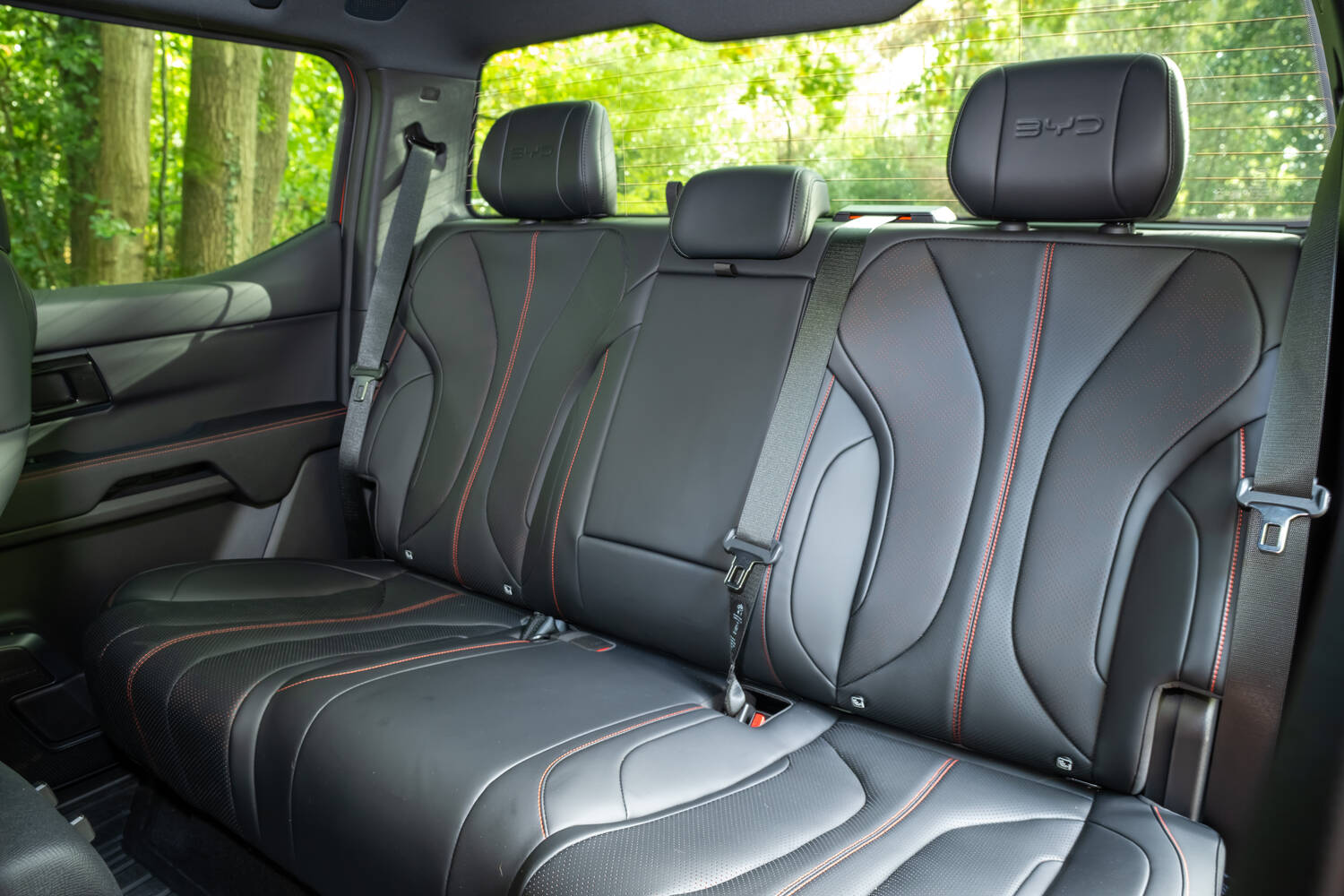
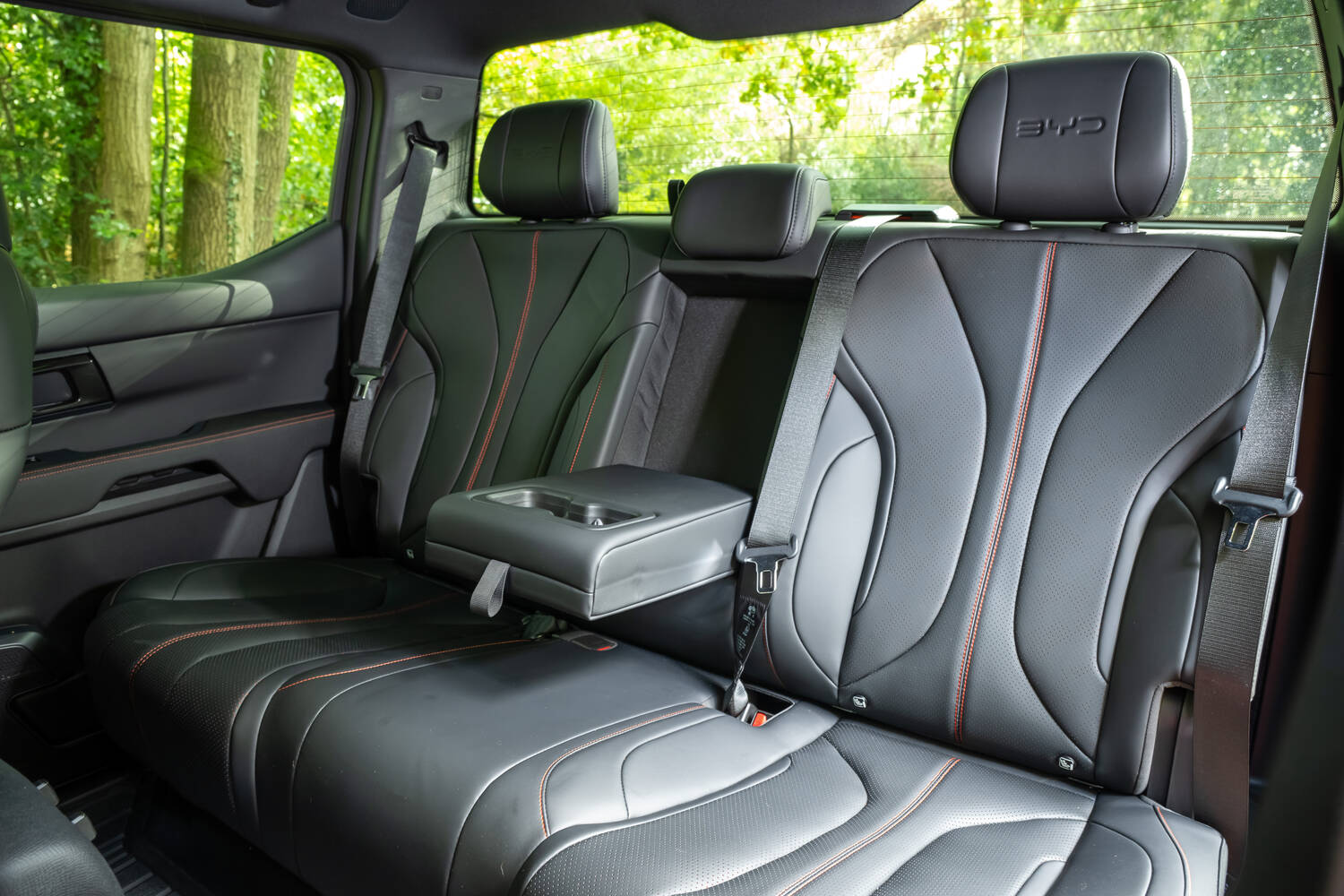
Sure, the centre-rear seating position would be more occasional use, as the squab is narrow and firm, and the front tunnel construct juts into the available legroom a touch, but there's the realistic possibility of getting three people into the back of the Shark when needed.
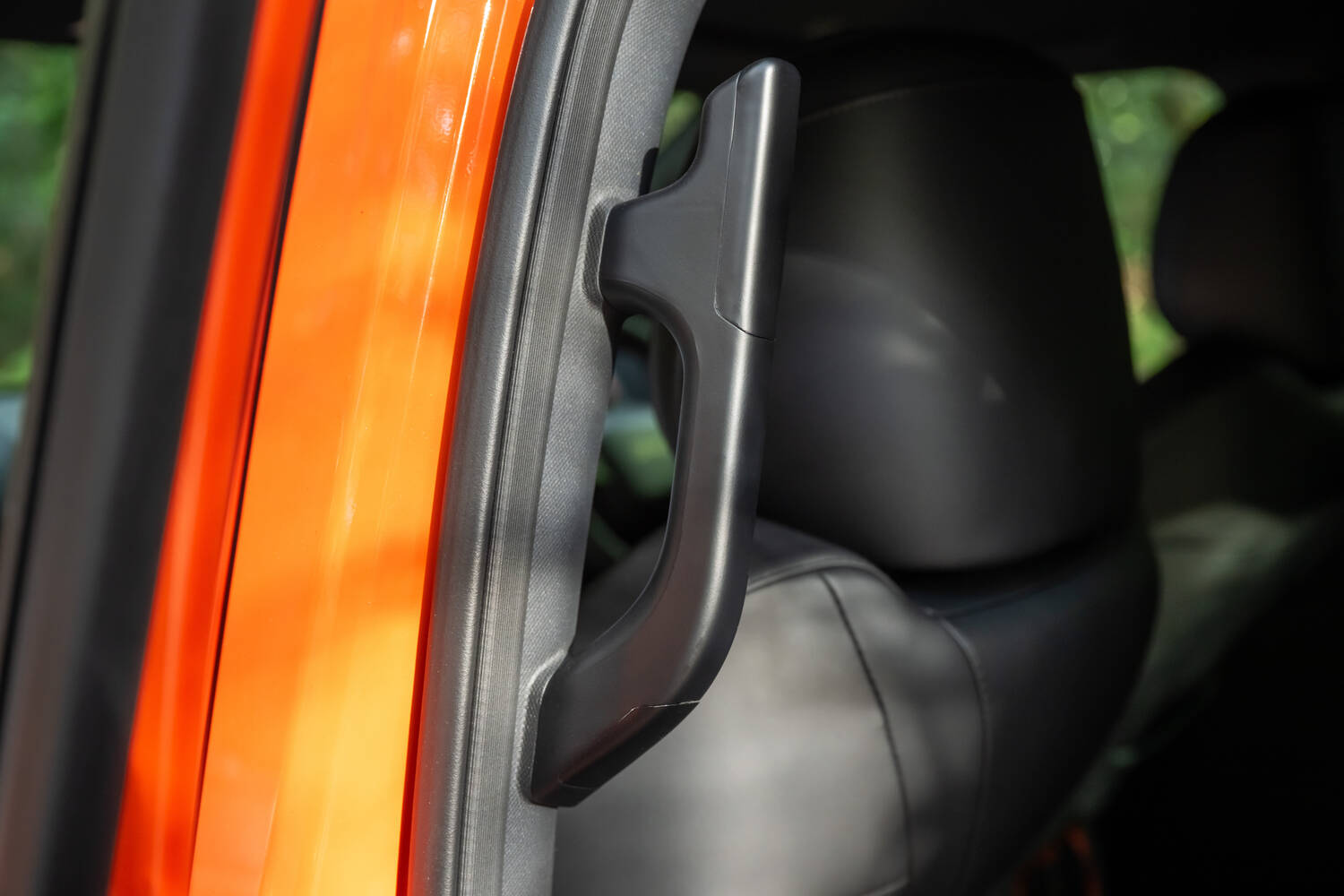
Passenger accoutrements in the rear of the BYD include two air vents, another storage shelf and the two USB ports on the back of the centre console, as well as door bins scalloped out to take drinks bottles and elasticated map pockets on the rear of the front seats.
A fold-down central armrest including two cupholders is also included.
Finally, the entire seatback of the rear bench can be folded down in the Shark, revealing a neat storage location for the vehicle's charging cables, as well as a slot for a warning triangle and the top tethers.
Fitting child seats to the BYD Shark DMO
There are two ISOFIX positions in the back of the BYD Shark and with its high cabin elevation, large rear doors and the roominess of the second-row footwell, fitting even bulky child seats in the back of the truck should be no bother at all.
Load bed capacity in the BYD Shark DMO
This is an area where the BYD Shark lags behind its rivals, especially if you're considering using it as a commercial vehicle.
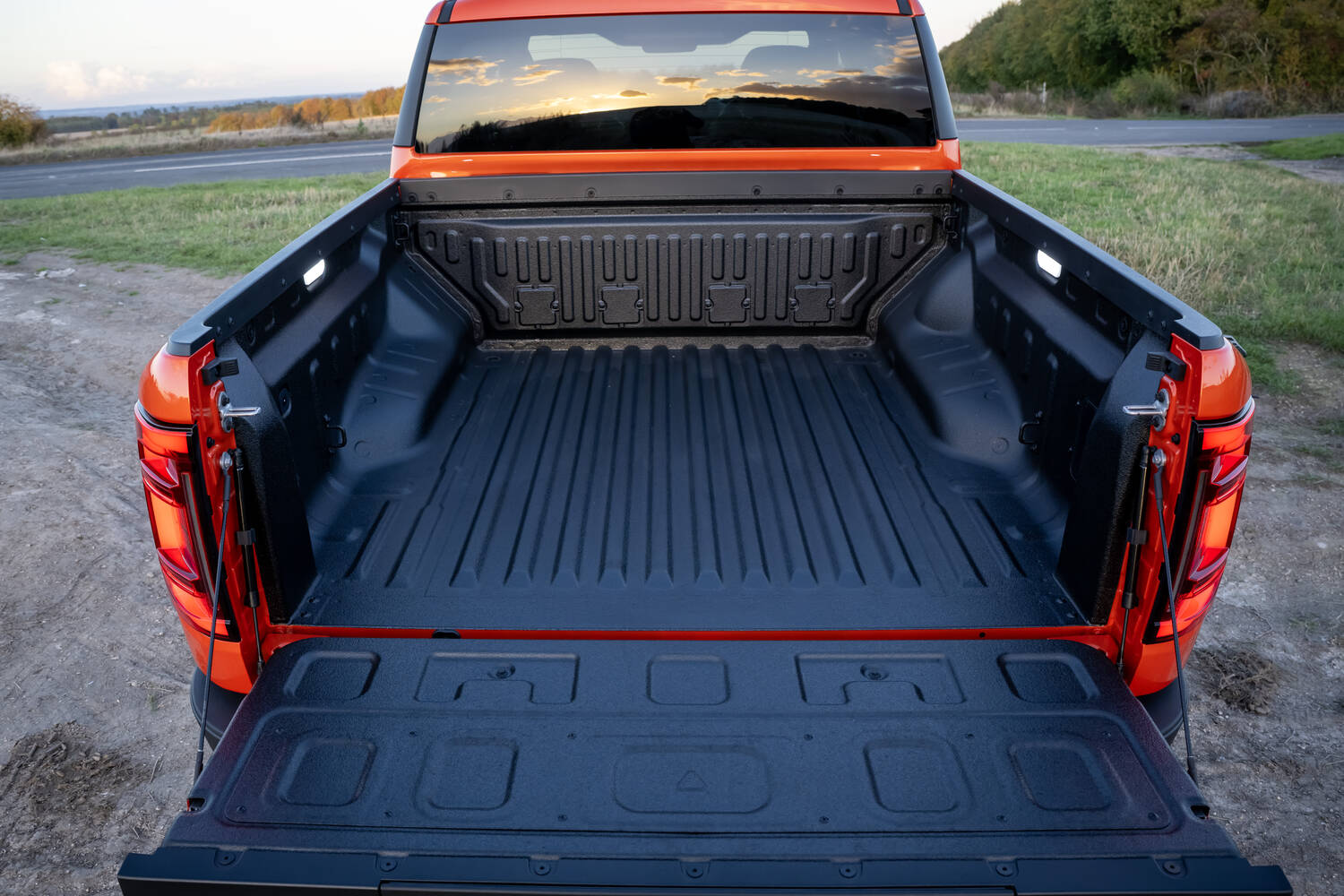
Thanks to the rear suspension design and the 2,710kg kerb weight of the truck, the Shark is limited to just 790kg of payload. That means it's not a 'one-tonne' pick-up at all, despite competing in that class.
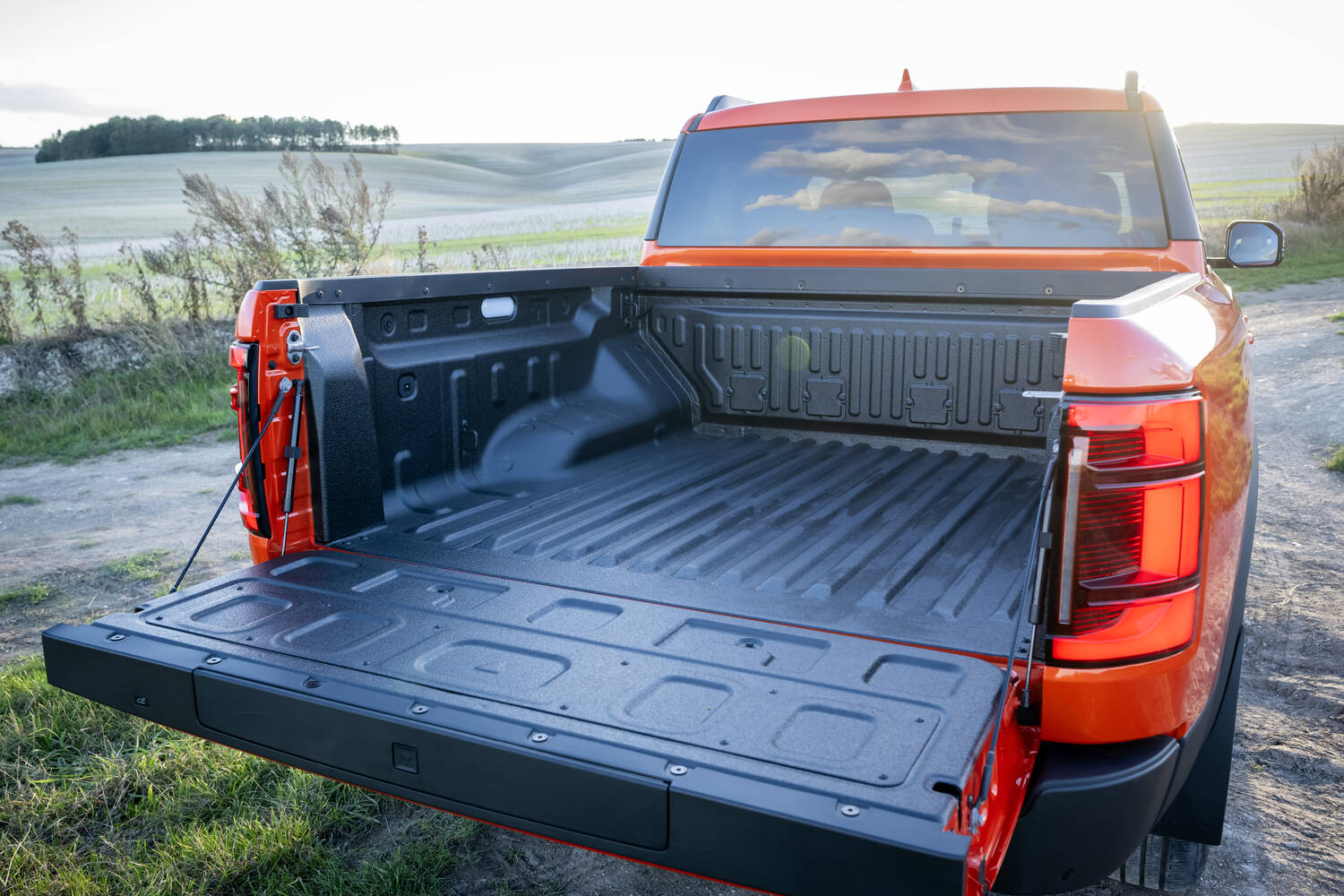
The volume of the load bed is 1,200 litres, so it doesn't lack for space, and there are useful features back there, including twin lights with a neat, weatherproof switch and a rain-shielded vehicle-to-load (V2L) socket rated at 6kW.
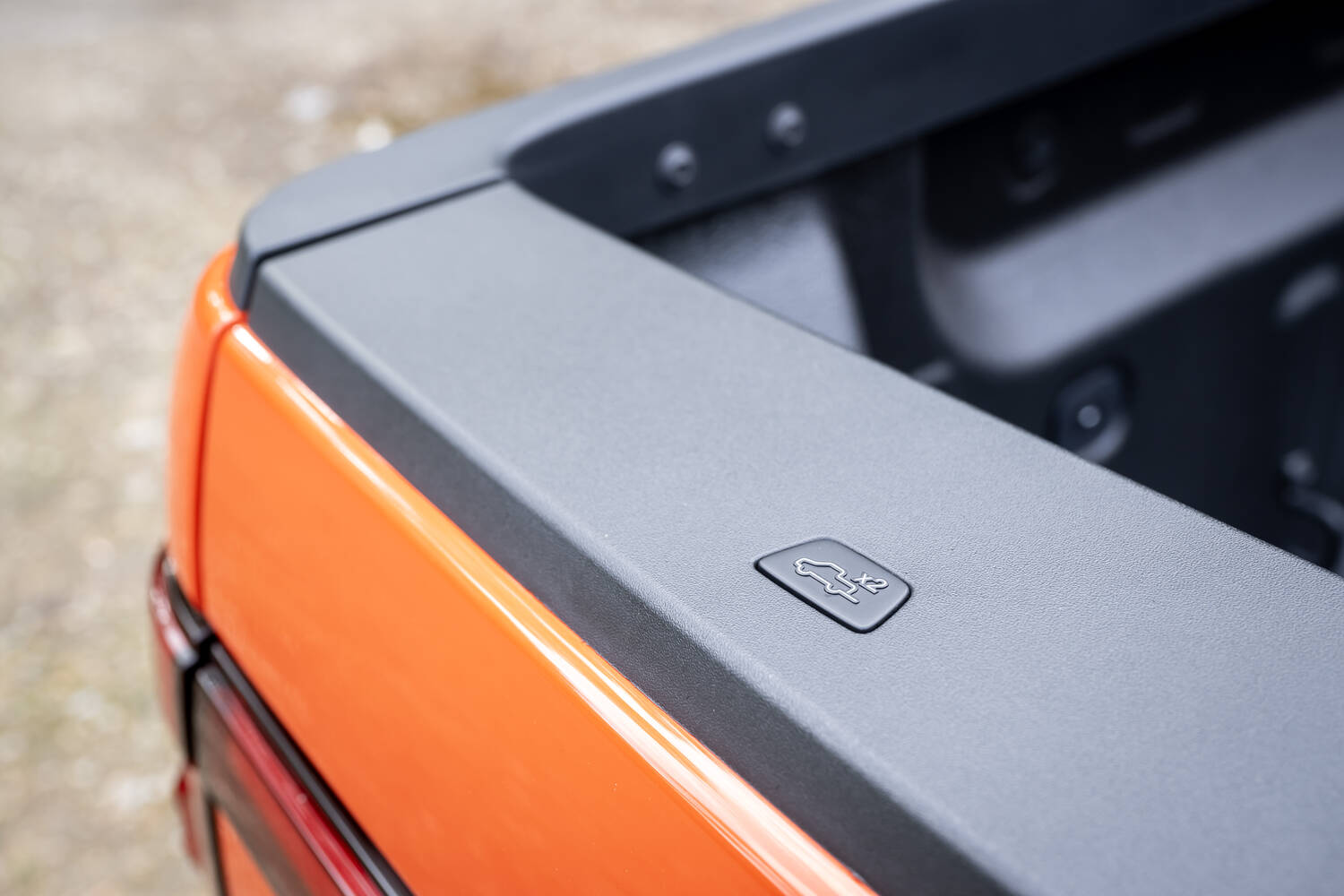
There's even a deployable step which pops out the top of the tailgate to make stepping up into the back of the Shark a lot easier than it would be without this device.
But that outright weight limitation could be construed as a significant drawback to some buyers.
Safety in the BYD Shark DMO
The BYD Shark has picked up the top five-star rating in Euro NCAP safety tests, and it managed this as recently as 2025, although the safety-testing body has changed its assessment programme in the interim.
As it comes with advanced driver assistance systems (ADAS) like front and rear parking sensors, adaptive cruise control, lane keep assistance and emergency lane keeping assist, blind-spot detection, a driver monitoring system, rear cross-traffic alert and brake, traffic sign recognition and a 360-degree camera system, among more, then you can be assured of the BYD's safety levels.
Performance of the 2027 BYD Shark DMO
- Plug-in-hybrid drivetrain only
- Has loads of power for a truck like this
- Advanced suspension leads to pleasing drive
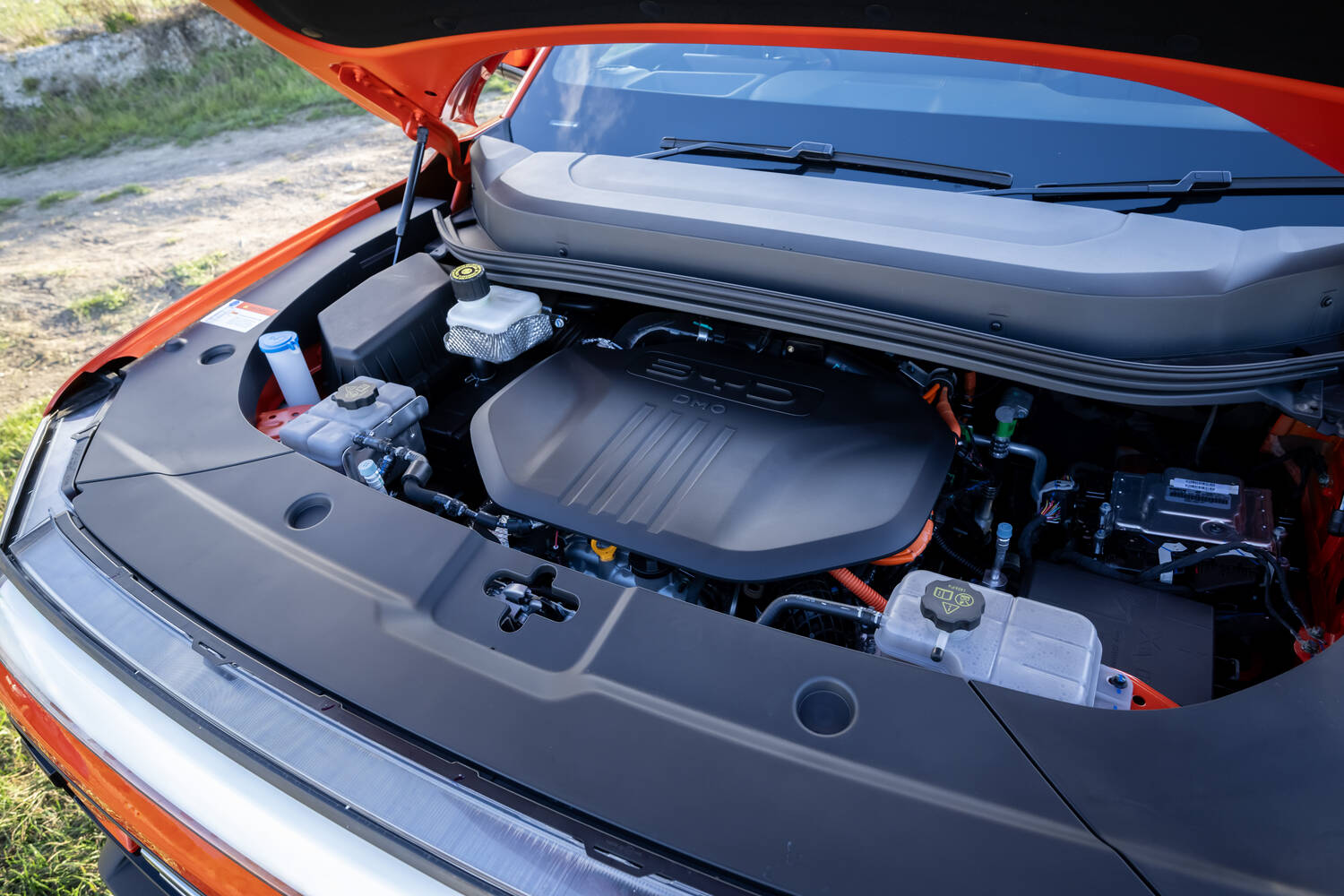
BYD deploys one of its 'Super Hybrid' PHEV set-ups in the Shark, which it here christens DMO - that's 'dual mode off-road', a spin on the DM-i (dual mode, intelligent) system as it is badged in BYD's passenger cars.
This uses twin electric motors and a turbocharged 1.5-litre petrol engine, the latter item working more like a range-extender to keep the Shark's battery pack topped up.
Various drive modes including Mud, Sand, Snow and Mount, and even a Leopard setting, show that the DMO system is more off-road-focused than designed with fuel economy in mind.
It's a powerful set-up, delivering maximums of 436hp and 650Nm - way in advance of any other truck operating in this sector, even the Ford Ranger Raptor).
To that end, the BYD Shark can streak from 0-100km/h in just 5.7 seconds, despite weighing more than 2.7 tonnes.
Driving the BYD Shark DMO on UK roads
Words by Matt Robinson on 23 October 2026
BYD has taken the extraordinary decision to fit the Shark DMO with fully independent, double-wishbone suspension on both axles. This is a setup that is more usually associated with high-performance cars.
The aim is to give the Shark the sort of cultured driving experience that eludes other one-tonne trucks and, largely, it has worked.
This BYD has heavy, slow but accurate and even vaguely detailed steering, which makes the Shark feel more agile and precise in the corners than its sheer size and mass would have you believe.
And once you've got it rolling and up to higher speeds - say, 70-80km/h and more - its ride and refinement really come into their own.
The assured way the Shark floats along motorways, for instance, is way in advance of other trucks we can think of, short of the Ranger Raptor on its competition-derived chassis.
The problem is that the comportment is still a bit too gritty at lower speeds. By no means bad for ride comfort sub-60km/h, there remains a background nuggety feeling to the way the Shark handles lumps and bumps in the road.
This is all the more surprising when you know how it's suspended, and how balloon-like its tyres are around comparatively modest 18-inch alloys.
However, it doesn't exhibit the characteristic 'shudder-and-shake' of an unladen pick-up truck running on primitive leaf springs, so BYD's decision to go with double wishbones all round looks to have been validated.
We've also no real complaints with the power on tap, as the Shark does feel remarkably rapid. There are occasions where the petrol engine can be a little noisy in operation when supporting the two powerful electric motors, but these are rare and they're not even unbearable when you can hear the four-cylinder unit, either.
The roll-on acceleration in the BYD, in particular, is quite startling in its potency.
The highest compliment we can therefore pay the Shark is that its driving experience makes it feel like an unusually shaped SUV, more than it does a commercial vehicle that has been gussied-up with the interior cabin accoutrements of the passenger-car world.
Range, battery, charging and running costs of the 2027 BYD Shark DMO
- Good-sized battery for a PHEV
- Up to 90km of electric range
- Supports DC charging
The PHEV system in the BYD Shark DMO is supposed to give it diesel-beating economy and emissions numbers, but we'd sound a note of caution on the real-world consumption following our first test on the truck.
That said, the quoted electric range and the inclusion of rapid DC-charging capabilities do bring other benefits to the ownership proposition.
Battery options and official range
BYD fits a 32.2kWh lithium-iron-phosphate (LFP) 'Blade' battery to the Shark DMO, which confers upon it an official 89km electric-driving range.
Coupled to a 60-litre fuel tank, the combined distance the pick-up is said to go on its dual reserves is a theoretical 675km.
Real-world range and efficiency of the BYD Shark DMO
We drove the Shark on a 100km route around the northern English Midlands (a mostly flat area, although a few hills were included on the circuit), taking in country lanes, faster-flowing trunk roads and also some dual carriageways and motorway running.
The conditions were cold and rainy, and we were using the in-cabin climate and heated seats for the duration.
While admittedly driving the Shark somewhat unrepresentatively at first, enjoying the hits of 436hp and 650Nm, an indicated 21.7 litres/100km shown on the trip computer was alarming in the extreme.
Later, gentler use did improve this to 12.8 litres/100km, but with plenty of charge in the battery we were hoping for better - diesel trucks tend to hover around the 10 litres/100km mark in all-round use in our experience.
You'd therefore need to make regular use of the Shark's rapid charging and try and drive it without ever waking the petrol engine to outstrip a diesel pick-up truck's economy, and even so, the idea of getting near 3.5 litres/100km seems pretty far-fetched.
Charging up the BYD Shark DMO
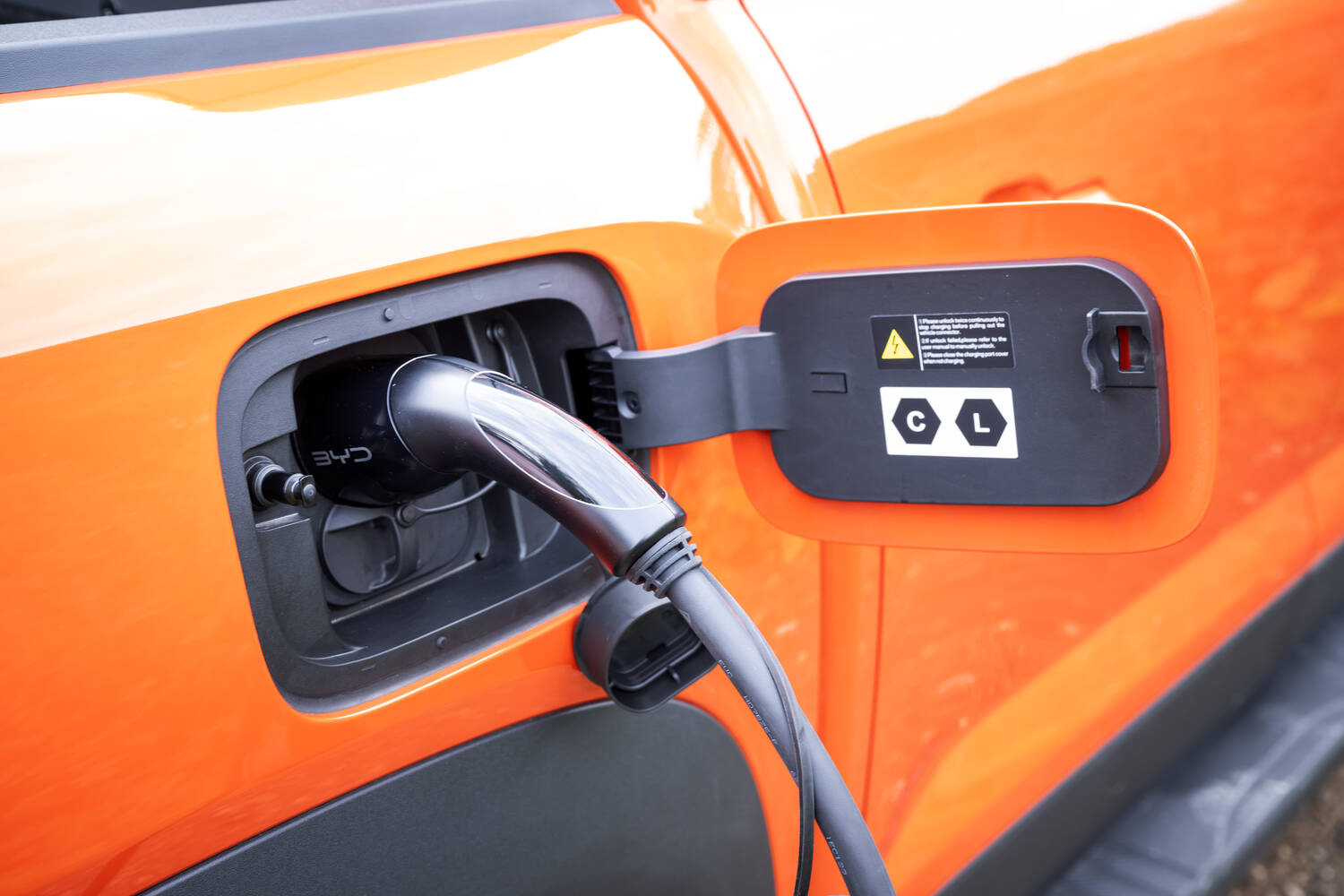
The BYD Shark supports DC charging. The peak rate at which the DMO can replenish its battery is 55kW, which'll achieve a 30-80 per cent top-up in 21 minutes.
On a three-phase AC connection, the BYD maxes out at 11kW, so a 15-100 per cent charge should take a little more than three hours.
On a typical 7.4kW wallbox, we'd expect the time required for the same cycle to increase to around four-and-a-half hours.
Servicing the BYD Shark DMO
The Shark should conform to BYD's 7,500km or 12-month servicing schedule, although there is an initial check required after six months or 3,500km of ownership.
BYD Shark DMO warranty
The BYD Ireland warranty is six years or 150,000km, whichever is triggered sooner, while there will be eight years' worth of cover on the Shark's electric motor and its attendant control unit.
The high-voltage Blade battery gains the same timescale of warranty as the motor, but the distance cap is raised to 250,000km.
Irish pricing & rivals to the 2027 BYD Shark DMO
- Prices not confirmed
- Could be hampered tax-wise by payload
- Some talented rivals available
BYD hasn't priced the Shark DMO for Ireland as yet but, in other markets, its PHEV nature, extensive standard equipment, robust performance capabilities and its lifestyle ethos make it one of the pricier pick-ups out there. It remains to be seen how competitively it will be positioned in the Irish market.
There was a point where one-tonne pick-ups were thinning out a little, as vehicles like the Nissan Navara and Mercedes X-Class were killed off, but it feels like there has been a resurgence in recent years.
Both the Ford Ranger and Volkswagen Amarok provide the same sort of high-end alternatives to the Shark, while the Toyota Hilux continues to be the standard-bearer for ultra-dependable, workhorse-truck duties.
Other alternatives, from similarly 'outsider' manufacturers like BYD, include the KGM Musso, the Isuzu D-Max and the Maxus T60.
Some of the models listed here are available in fully electric flavours, if required (the Toyota, the KGM, the Isuzu and the Maxus), but PHEV rivals are thinner on the ground.
Most competitors offer a diesel powertrain, of some sort, something for which the Shark obviously lacks.
Verdict - should you buy the 2027 BYD Shark DMO?
We wait to see what Irish pricing will be like and it's clear that BYD is not targeting dedicated business users with its truck, instead aiming for a lifestyle clientele who want something different to a default SUV, but the Shark DMO has lots of potential and some clear USPs.
Two of those are its impressive power and performance, and the high-speed refinement of it on the move - although question marks remain over the real-world efficiency.
But if you like its rugged looks and commendable interior, there's plenty to recommend the BYD Shark as an unusual pick-up selection.
FAQs about the 2027 BYD Shark DMO
Is the BYD Shark DMO all-wheel drive?
Yes, it has motors for both the front and rear axles, although there is no physical link between the two of them and no heavy-duty locking differentials, as you'd find on some rivals to allow them keep going in tricky off-road conditions.
How many child seats can I fit in a BYD Shark DMO?
There are two ISOFIX points on the outer positions of the Shark's rear bench.
Can I charge the BYD Shark DMO up at public DC units?
You can, at a peak rate of 55kW. This'll see the battery go from 30 to 80 per cent state-of-charge in just 21 minutes.
Is the BYD Shark DMO rated to tow anything?
Yes, it has an official towing rating of 2,500kg of braked trailer.
What are the off-road stats for the BYD Shark DMO?
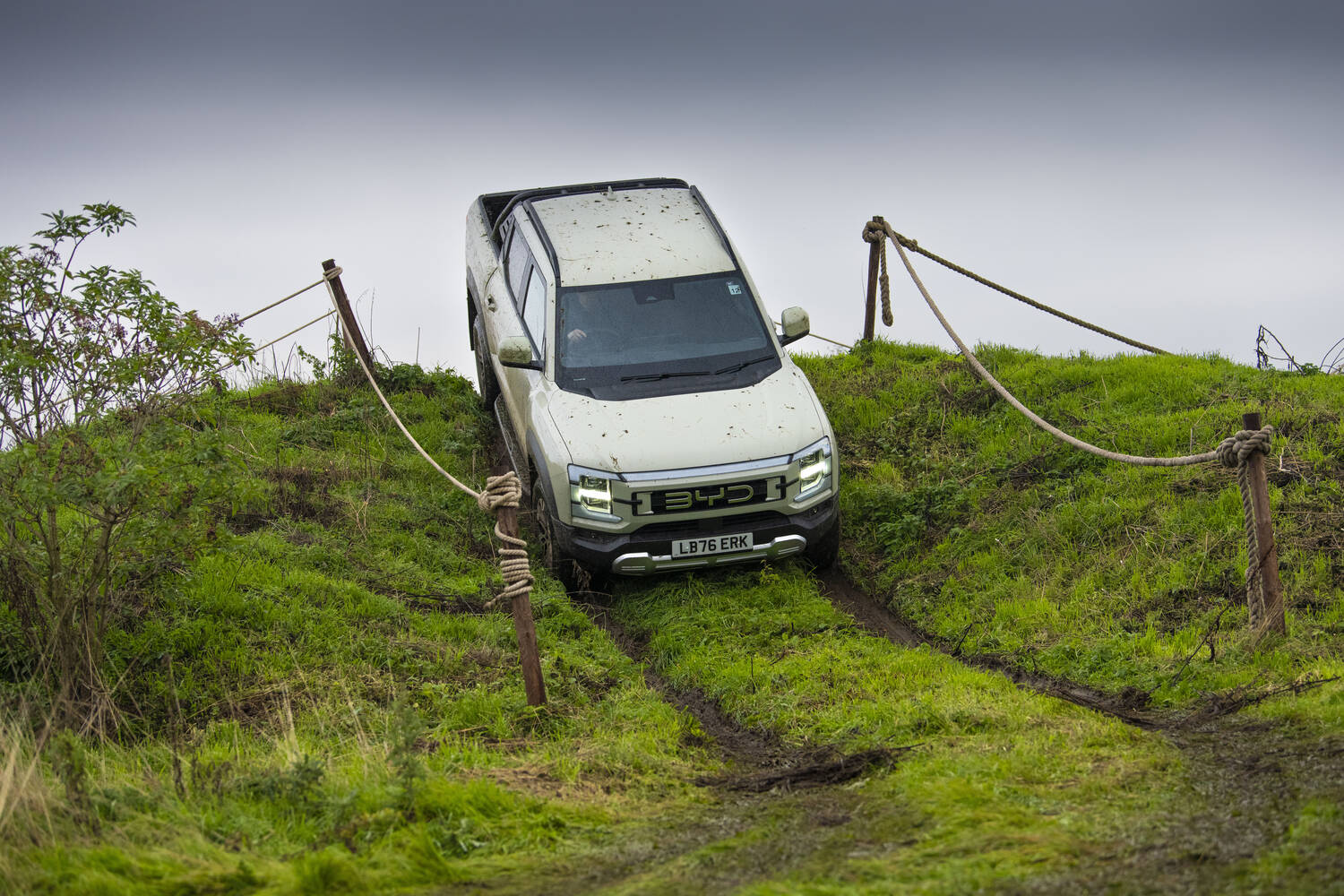
For wading depth (700mm) and its approach angle (31 degrees), the BYD Shark is among the class-leaders in these regards.
Its breakover (17 degrees) and departure (19.5 degrees) angles are less extraordinary, though, as is its unladen ground clearance of just 230mm - the LFP Blade battery as an intrinsic part of the chassis is to blame here.
Where is the charging port on the BYD Shark DMO?
It is on the offside-rear (driver's side) wing, just ahead of the back wheel. The fuel-filler cap for the petrol tank is in the corresponding position on the other side.
Want to know more about the 2027 BYD Shark DMO?
If there's anything about the BYD Shark DMO we've not covered, or you'd like help in choosing between it and other cars, you can avail of our expert advice service via the Ask Us Anything page.