
Is the 1.6 TDI engine man enough for the Volkswagen Passat?
Hi guys,
Looking closely at a 2010 Volkswagen Passat, powered by the 1.6 diesel engine. It's the Highline model with great spec. My only concern is with the 1.6 engine: is it big enough for this car? Will I be dropping the gears to overtake etc?
Thanks
Mick
Michael Mulvey (Ashbourne)Feb 2012 Filed under: performance
Expert answer
Hi Mick,
The 1.6-litre TDI engine has 105hp, which doesn't sound like much, but it's the engine's torque that matters more in the real world, and this Passat has 250Nm from just 1,500rpm. It's more than enough for the Passat in most circumstances and as all the performance is low down in the rev range you don't really change down to overtake.
Saying all that, if you plan on towing or you drive with a full car regularly you'll appreciate the extra power of the 2.0 TDI engines, but most people will find the 1.6 perfectly acceptable.
Hope that helps.
Kia Rio or Toyota Yaris - both new?
Which would you buy? 2012 Kia Rio 2012 or Toyota Yaris?
Ashlene Prasad (Fiji)Feb 2012 Filed under: choosing new car
Expert answer
Hi Ashlene,
In the past the Toyota might have been the automatic choice, but Kia has come on leaps and bounds. Toyota still has the reputation for longevity and troublefree motoring, but Kia is catching up, and its seven-year warranty is real peace of mind for a new car buyer.
Looking at the price lists (of the five-door models - the best-sellers), the Rio is available as a 1.25 petrol model for €15,550 to €16,775 or a 1.4-litre diesel for €18,190. They are all in Band A for tax with emissions of less than 120g/km.
The Toyota Yaris can be had with 1.0- or 1.33-litre petrol engines and a 1.4-litre diesel. Toyota offers far more trim levels, and pricing varies from €15,585 (1.0 Terra) to €19,725 (1.33 Sol). All versions appear to be in Band A as well.
Unless you plan on travelling more than say 12,000 kilometres a year it's best to stick with the petrol versions. The 1.0-litre Toyota is the most efficient, but not by much and the Kia 1.25 engine and Toyota 1.33-litre are largely comparable, though the Yaris engine has a little more go in it.
Kia is more generous with its equipment, but only a bit, and there are more Toyota trim levels to choose from so you can tailor your needs. We'd urge you not to go for the entry-level versions of either though (LX and Terra respectively), as the step up to the next model is well worth it for what you get.
So that's the overview. In terms of our personal opinions we prefer the Kia Rio. It feels and looks more substantial and it drives well. Best bet is to go to a Kia and Toyota dealer and try them both out for yourself.
Let us know how you get on.
Is it worth paying more for the 110hp Renault Fluence?
Which Renault Fluence to buy - 90- or 110hp?
There is a 700 Euro difference in price, just wondering if it's worth it or not. On the face of it the vast bulk of Fluences are 90hp, just wondering is the 110hp model a better buy, even for resale later, as it will be a lot rarer. Also, two unconnected Renault dealers are pushing much harder on the 90hp version, which says to me that the 110hp is like a special order for them. They are almost dismissing it as an option, which is odd, or maybe they are looking after me!
Is there any servicing/maintenance differences between the two different engine types? One last thing, problems with DPF, apparently it's a problem if you only drive a diesel car on solely short journeys. Is it a major issue or storm in a teacup?
Thanks
Donal Murphy (Cork)Jan 2012 Filed under: choosing new car
Expert answer
Hi Donal,
Before talking about the Renault Fluence specifically, diesel cars in general are better when used on longer trips regularly - for the DPF and other components. We're not aware of any problems with Renault's DPFs in particular.
We asked Renault Ireland about the differences between the 90- and 110hp Fluences and they essentially said that most people are more concerned with saving money, so the 90hp option is, as you've discovered, the best-seller. Here's Renault's statement:
"Both the 90- and 110hp Fluences are great value. It depends on the usage of the car by the customer. €700 can be sometimes hard to upsell these days so dealers prefer to offer the best value, which is the 90hp. It's the customer's choice, and down to what they want to purchase.
Both engines are in Band A and theyare under the same servicing/maintenance programme. For the last point (DPF), this is not an issue on Fluence."
So essentially it comes down to whether you want the extra power. In our view whether it's worth it or not will depend on how often the car is full of people and luggage. In those situations you'll want the higher power output.
Hope that helps - come back to us if you want to discuss it further.
What SUV for €10k would be good for carrying bikes?
I'm thinking of getting an SUV. Nothing fancy, just big enough to get a couple of bikes in the back, won't be much off road done in it, and preferably low emissions for tax reasons. What would you suggest? My budget isn't great, under €10k if possible. Is that way too little to get something half decent?
Rob Davis (Dublin)Jan 2012 Filed under: choosing used car
Expert answer
Hi Rob,
For that budget we are assuming you are looking for a second-hand car. The Honda CR-V springs to mind, but the tax could be a little high for you as your budget will get you a pre-2008 version, which came with 2.0- and 2.2-litre engines. How about a five-door version of the Honda HR-V instead? We found this example on Carzone.ie and it looks the part. The 1.6-litre engine means it's not too much to tax either.
There are loads of Hyundai Santa Fes and the smaller Tucson around at that price too, though again their age and engine size might rule them out for you in terms of tax costs. Same story with the previous generation Kia Sportage.
Don't be tempted by older Land Rover Freelanders.
Another good option is the Suzuki Grand Vitara. A quick search showed that there are several 1.6-litre petrol versions with four-wheel drive within your budget, though most seem to be the less practical three-door body style, so you may need to look around to find a five-door example that suits your needs.
The Toyota RAV4 would be a great option, but keeping your tax bill down on a four-wheel drive version with five doors might be tricky. Recommeded though.
Hope all that helps. If you narrow down your search a little come back to us and we'll help you choose!
New Kia Rio or used Toyota Yaris?
I am confused, whether to buy a used Toyota Yaris/Vitz or a new Kia Picanto. I want to know about the difference in price and which one is more economical. Thank you!
Jaunkeypersad Anousha (Mauritius)Dec 2011 Filed under: choosing new car
Expert answer
Hi Jaunkeypersad,
The Kia Rio is available in 1.0 LX or 1.0 EX. Both are petrol and manual and they cost €11,865 and €12,810 respectively. WIth 99g/km emissions they're in Band A, which now costs €160 per annum. Kia quotes 4.2 litres/100km on the combined cycle, which equates to 67.3mpg.
For the same money you could pick up a low-mileage 2010 Toyota Yaris 1.0 or even the 1.33-litre version. There are more grades to look through to see what you're getting for your money, but in terms of economy and emissions, both of those engines sit in Band A as well. The Yaris isn't as economical as the Picanto though, with the 1.0-litre returning 55.4mpg (5.1 litres/100km) and the 1.33 quoted as about 54.3mpg - or 5.2 litres/100km.
The added benefit of buying the Kia new is of course gaining the full seven-year warranty.
Hope that helps.
What auto will I replace our SEAT Alhambra with?
I am getting rid of a 2000 SEAT Alhambra automatic 2.0-litre, as it seems to only get about 23 miles to the gallon. I want to get a smaller car with good mileage for about €5,000, but it needs to be automatic as my wife is American and can't drive 'stick'. The Mercedes-Benz A-Class seem cheap. Are these any good or can you recommend an automatic with smaller engine?
Greg Darcy (Dun Laoghaire)Dec 2011 Filed under: automatic
Expert answer
Hi Greg,
For your €5,000 budget (I'm assuming that's in total, even after you've sold the SEAT) you could get your hands on a late example of the first generation A-Class in A 140 or A 160 guises, both with an automatic gearbox. While the later versions improved, this car does not have a great reputation for reliability so make sure you properly inspect any one you're considering buying and ensure it has a full service history. They're costly to repair.
My money would go on a Honda Jazz. It's compact enough, but has decent space inside. There seem to be plenty on the market at your budget and most of the automatic examples have just 1.3-litre engines to keep costs down. On top of all that the Jazz has an incredible reliability record.
As ever check a car you're buying over thoroughly, but there are a few things to look out for on second-hand versions of the Jazz, as they can be expensive to fix. Check that the adjustment for the door mirrors works and that the car isn't jerky to drive at low speeds.
Let us know how you get on.
Will I buy a Volkswagen Passat instead of a Golf?
Hi Paddy,
Thanks for the answer above (Which VW will i buy? 06/09) but i have another question: looking around i've realised that i can get a 2011 1.4 Petrol Passat Comfortline for the price i'd be paying for a 2012 1.2 Golf Highline. As the family is growing should i consider this?
I really like the Passat and the 1.4 Petrol would be ideal for me as although i drive every day, it's all city driving with only the occasional long trip outside Dublin. Anyone i say this too thinks i'm mad buying petrol as when i come to trade the car in up the line, no one will want a petrol car? I'd appreciate your thoughts.
Thanks.
Brendan Cullen (Dublin)Sep 2011 Filed under: choosing new car
Expert answer
The arguement for petrol is growing Brendan. While everyone is fixated on diesel the petrol engines are getting cleaner and will come back into fashion. When it comes to fuel economy the gap between petrol and diesel is getting closer and in a lot of cases there is little difference between the road tax.
The 1.4-litre petrol engine in the Passat is more than good enough. So if you want a Passat then you could go for it. There could and perhaps will be less value in the petrol model later on, but if you keep it long enough suddenly this won't become that much of an issue and since you go low mileage then you could keep it for 5 or more years.
What is the Atkinson Engine and is it any good?
What is the atkinson engine, and how does it perform compare to other engines?
John Carey (Clogheen)Aug 2011 Filed under: hybrid
Expert answer
Hi John,
The Atkinson engine is a type of engine invented by James Atkinson in 1882. The Atkinson Cycle is where the stroke of the piston can very in length across the four cycles in a four-stroke internal combustion engine. The length of the stroke during the power cycle is increased to promote efficiency, but because this comes at the expense of a shorter intake stroke there is some loss of power and therefore this engine design is best suited for use in hybrid systems where the electric motor can make up for some of the loss of power.
In conventional four-cycle petrol engines, fuel enrichment is sometimes necessary to cool the exhaust gases, preventing degradation or destruction of the catalytic converters. In an Atkinson cycle engine, compression and expansion are not symmetrical, and the valves close late, delaying compression. This creates a high expansion ratio for less compression, reducing intake and exhaust energy losses and converting combustion energy to engine power more effectively. As a result, the exhaust temperature is lower than that of conventional engines.
The current model Toyota Prius Hybrid uses a 1.8-litre Atkinson Cycle engine. Adopting the Atkinson cycle and a cooled exhaust gas recirculation system brings significant gains in fuel efficiency and emissions reduction.
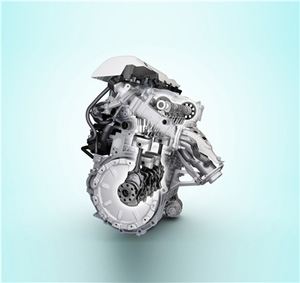
Prius 1.8-litre Atkinson Cycle engine
Because the intake valves close late in an Atkinson cycle engine, compression is delayed. This creates a high expansion ratio for less compression, reducing intake and exhaust energy losses and converting combustion energy to engine power more effectively. As a result the exhaust temperature is lower than that of conventional engines. Cooled Exhaust Gas Recirculation reintroduces the cooled gas into the intake system, further reducing engine operating temperatures.
Other models to use Atkinson Cycle engines include the Lexus CT200h, Lexus RX 450h, Mercedes S400 Blue Hybrid
Should I swap my Volvo S80 for a Mondeo or Citroen C5?
Howaya.
I have a 2007 Volvo S80 D5 and it's giving me 7 litres per 100km. I'm thinking of exchanging it for either a Ford Mondeo 1.8 TDCi or a Citroen C5 1.6 - both 2008. Which car is better from economy, reliability and safety point of view or should I change at all?
Thanks
Justin McElwee (Galway)Aug 2011 Filed under: choosing used car
Expert answer
Hi Justin,
I can't imagine why you would want to come down from a Volvo S8- into a Mondeo or Citroen C5, which are going to both feel inferior to what you have. Are you just simply bored with the car you have and want a change? Both the Mondeo and C5 are 'okay' but their diesel engines aren't as good as the Volvos.
Without fully knowing your circumstances, I would say that if you did want to get something else, then you should perhaps look at a Subaru Legacy Diesel, which for me is the best in its class around that era.
Here is one:
Otherwise, stick with what you have, because both the Mondeo and C5 will feel inferior to your S80.
I hope this helps!
How long will a 2.0-litre petrol engine last?
Hello, I would like to know how much mileage to expect from a 2.0-litre petrol engine in its lifetime. My Honda has almost 120,000 miles done in seven years and I am wondering how much more I should expect.
Thanks.
Mary Foley (Cork)Jun 2011 Filed under: reliability
Expert answer
Hi Mary,
I'm afraid there is no definitiive answer to that question. Not only is every engine different, the longevity relies on other factors such as how it is driven and maintained. Honda has a great reliability record though and its engines are some of the best. Assuming it has been well maintained there's no reason it shouldn't reach 200,000 miles without an issue - and further.
Hope that helps.