

Why is Toyota so concerned about that?
Mostly because Toyota has major manufacturing operations in both countries, but while that sounds self-serving, there’s more to it than that. As Toyota points out, it’s been building and designing cars in Europe for more than 60 years now. In fact, if you’ve bought a Corolla in the past ten years, it was almost certainly made in either Derby in the UK or in Turkey. “Toyota is not a guest in Europe. We are a European manufacturer, and we want Europe’s automotive industry to succeed,” said Toyota Europe’s president and CEO, Yoshihiro Nakata.
So what needs to be done, according to Toyota?
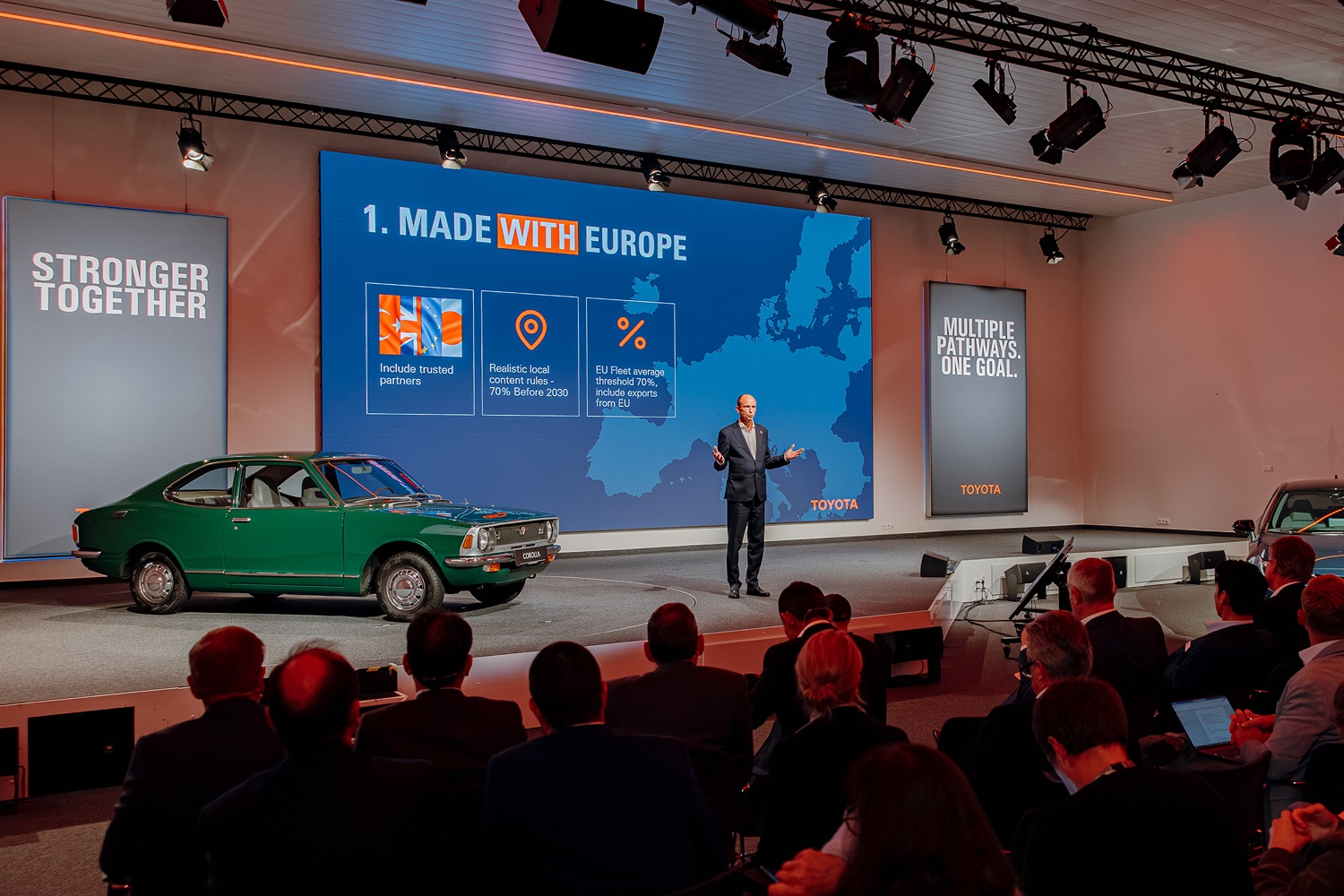
The IAA will, it seems, require parts for cars sold in Europe to be made in Europe or face higher tariffs and taxes (that’s the basic version, anyway). Toyota isn’t specifically against that, but wants to see the IAA’s rules extended from ‘made in Europe’ to ‘made with Europe’ and to allow ‘trusted partners such as the UK, Turkey and Japan’ to be included under the legislation. Do that, says Toyota, and the European car market would encompass nearly 31 million vehicles. That is the sort of critical mass Toyota reckons it needs to compete with China.
What else is Toyota proposing?
Because the IAA is also focused on reducing emissions, Toyota wants it to include ‘an openness to all technologies that reduce CO2’, which presumably means Toyota’s long-standing hybrid technology and its expertise in hydrogen power. There’s also a call to introduce a requirement for 70 per cent European-made content in cars gradually, ramping it up over three years, while allowing sufficient time for vehicle development and design. Toyota also wants to avoid introducing major new legislation before 2030. That 70 per cent ‘localisation threshold’ is lower than the 85 per cent currently proposed in the IAA draft.
What about beyond 2030?

Once we start looking further out, Toyota wants more flexibility in the EU’s electric car regulations, saying that: “The Automotive Package should keep an ambitious direction for 2035. It must also give manufacturers the flexibility to respond to the real pace of customer demand and market change. Battery-electric vehicles are forecast to make up around 45 per cent of new cars by 2030, while current rules require more than 55 per cent. For LCVs, the gap is wider. Without flexibility, manufacturers will be forced to spend on compliance rather than on the technologies Europe needs.”
In theory, the EU wants new cars to be entirely carbon-free by 2035, but Toyota proposes a five-year compliance window from 2028 to 2032 to smooth the transition through 2030 and 2031. It also wants a 90 per cent CO2 reduction target for 2035, with additional flexibility for renewable fuels and green steel to close the remaining gap.
What about the UK?
Toyota says that it has welcomed the UK government’s review of its ‘ZEV Mandate’, which sets minimum requirements for the proportion of new vehicles sold that must be zero-emission, and says that: “the move to zero-emission vehicles must stay on track, but at a pace that reflects real customer demand. With 2030 only three years away, investment decisions taken now will shape production to 2035 and beyond. Manufacturers and suppliers need a clear, realistic framework to invest with confidence.”
To help with that, Toyota is calling on the UK government to introduce new targets for zero-emission vehicles by 2030, with a maximum ZEV share of 50 per cent for cars and 40 per cent for LCVs, along with greater flexibility. The Japanese car maker is also calling on the UK to align closely with the European Union on electric car frameworks.
“Isolation makes us weaker. Europe has the capabilities, the people and the trusted partners to lead, but legislation must reflect the pace at which customers are able and willing to change. ‘Made with Europe’ is our central request – because together, we are stronger,” said Matt Harrison, Chief Corporate Officer, Toyota Motor Europe.
If there is anything about this story we have not covered, you can avail of our expert advice service via the Ask Us Anything page.