

Why are costs spiking so high now?
Fuel costs have jumped dramatically in the past few weeks, ever since Donald Trump decided to start a war with Iran. Whatever your political views on the matter, the all-but-inevitable result has been a huge increase in the wholesale costs of a barrel of crude oil.
The issue isn't just that Iran holds a huge amount of the world's oil reserves, but also that the country's position allows it to effectively close the Strait of Hormuz - a narrow sea channel between Iran and Saudi Arabia through which any oil tankers leaving the oil-rich Persian Gulf must pass.
How high have prices gone?
At the time of writing, a slight ease in the state of tension between the US and Iran had mollified oil prices a bit. Both West Texas and Brent Crude oil price indexes had fallen back from over $100 per barrel earlier this week, but Brent futures, at the time of writing, were back up to $110 per barrel with some forecasts suggesting that they could surge past $135 per barrel if the war continues much longer.
It's the Brent Crude index that effectively controls prices at Irish pumps, and the wholesale cost of crude oil is responsible for around 25 per cent of the final price that you pay. The rest is made up mostly of taxes - in Ireland around 60 per cent of the final cost per litre of petrol and diesel is made up of taxes, including excise duty, carbon tax and VAT.
There's around 5-10 per cent that goes to the refining process, and another 5-10 per cent that makes up the retailer's profits.
Are we being gouged for petrol prices?
That depends on your definition. Certainly, retailers in any given area will tend to follow the price of the next filling station over, and that can cause something of an imbalance. In general, high-traffic filling stations, whose tanks need to be topped up quickly and regularly, will see prices change more quickly than smaller stations who may receive a less regular delivery, but many retailers will simply adjust their price to more or less the local average.
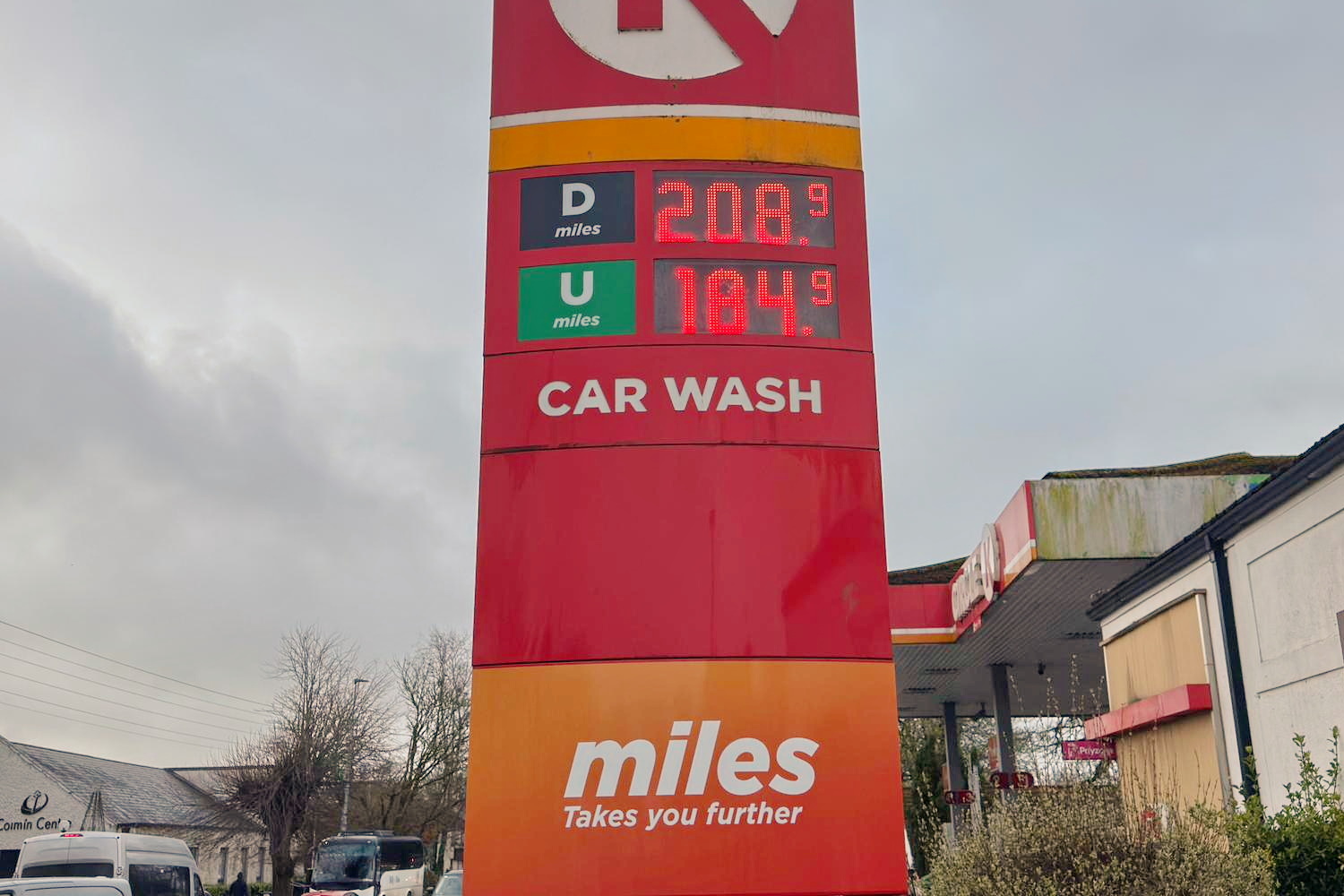
That average had hit a massive high in Ireland, with prices for petrol heading above €1.90 per litre and diesel above €2.25 per litre in some outlets before the Irish government stepped in to reduce excise duty and the NORA contribution (National Oil Reserve Agency).
So far, the Irish government is saying that the cuts in excise duty - along with some taxation changes aimed at easing the cost burden on the haulage industry - are temporary and are only supposed to be in place until the end of May. However, in spite of some hopeful signs during the week, right now there's no end in sight for this war.
Prices at my local station are still high, though. Seriously - am I being gouged?
Not necessarily. In fact, according to Kevin McPartlan, spokesperson for Fuels For Ireland (FFI - the body that represents Ireland's fuel importers and retailers) the full cost of the current fuel spike has not yet been passed on, depending on which fuel you use.
McPartlan told CompleteCar.ie: "It is important to note that wholesale market dynamics are continuing to exert upward pressure on prices in light of recent developments, including strikes on energy infrastructure and the closure of the Strait of Hormuz.
"While retail prices for motorists have risen by 25.5c per litre for unleaded and 55c per litre for diesel respectively, wholesale prices have risen by approximately 31c for unleaded, and 63.5c for diesel from 1st to 22nd March, which demonstrates that fuel retailers in Ireland have not passed on all cost increases.”
The Irish Government has now stepped in to cut excise duty and other costs that inflate the price at the pumps, much as it did in the wake of Russia's initial invasion of Ukraine, to help reduce the impact of fuel prices, especially on those who have no access to public transport, as well as for the haulage industry, whose fuel costs partly define the price we pay for groceries and household necessities.
Those changes did help, causing a fall in the price at the pumps, but the background price of crude oil is already eating into those cuts.
McPartlan urged consumers to be patient with prices at fuel retailers as tax changes are announced, because taxes are levied at the point of departure from the refineries: "Excise duty is applied at the last taxation point before fuel enters the retail supply chain. In Ireland, this is typically seen at fuel terminals, for example Dublin Port, and smaller regional ports.
"Any fuel leaving these points up to midnight on the day of the change is charged at the current (higher) excise rate, as retailers cannot retrospectively adjust the tax paid on existing stock.
"In practical terms, while policy changes may be implemented overnight, it will take some time for the full effect of those reductions to work their way through the supply chain and be visible to consumers in every forecourt nationwide. We are urging motorists who are preparing to fill up on Wednesday morning to be conscious that these changes may not be reflected immediately. Prices will fall progressively, not simultaneously.”

Will fuel prices come down?
Eventually, probably, yes. If the current war comes to some sort of end, and the crisis abates, then fuel prices will most likely relax. If Trump continues to act erratically? Who knows?
Update as of 10 April 2026
The fuel price issue remains incredibly volatile. While the government's temporary cuts to excise duty and the NORA levy have helped a little, the wildly fluctuating price of oil has erased some of those gains. Meanwhile, the nationwide fuel price protests continue to cause gridlock and shortages, while the blockading of fuel depots is causing fuel shortages across the country.
Amid all that, the Competition and Consumer Protection Commission (CCPC - Ireland's official consumer watchdog) has issued a report which found almost no evidence of any price gouging from Irish fuel retailers.
CCPC Chair, Brian McHugh, said: "The distress and concern we heard from consumers was very real. A large number of consumers suspected that recent price increases were illegal and motivated in significant part to increase profits. However, while we have identified a small number of questionable consumer protection practices, we have not seen price increases that are in breach of any law. Ireland is an open market economy where businesses are free to set their own prices for goods and services.”
Responding to the CCPC report, Kevin McPartlan, from Fuels for Ireland (FFI), said: "Fuels for Ireland welcomes the findings of the report published by the CCPC today, following its examination of fuel prices in light of recent geopolitical developments.
The CCPC's conclusions are clear. It has found no evidence of any breach of competition or consumer protection law in how fuel prices have been set in Ireland, directly addressing concerns around price gouging or anti-competitive behaviour.
The report also confirms that the recent increases in fuel prices were driven by significant rises in international wholesale costs, rather than decisions taken by companies operating in Ireland. In fact, the report makes clear that prices at Irish forecourts rose by less than the increases observed on global markets. Ireland is part of a global fuels market - we are a price taker, not a price setter. We recognise the very real pressure this has placed on households and businesses. As acknowledged by the CCPC, there is a level of distress and concern among consumers, and we absolutely recognise that. The cause of high prices is global market conditions, which are outside of the control of Irish fuel retailers.”
At the time of writing, oil prices had retreated from their initial peaks, with Brent Crude settling at around $96 per barrel, although that had yet to filter through to forecourt prices. The cost of oil remains unsteady, as the world - and global trading markets - anxiously waits to see what fresh chaos Trump, Netanyahu and Iran can unleash.
If there is anything about this story we have not covered, you can avail of our expert advice service via the Ask Us Anything page.