

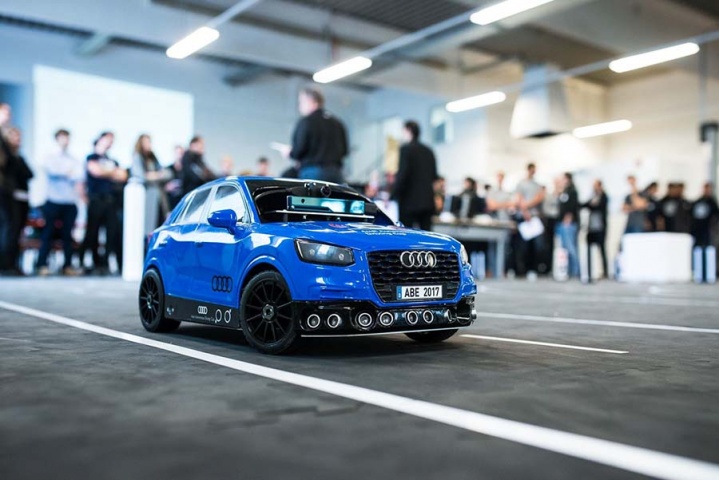
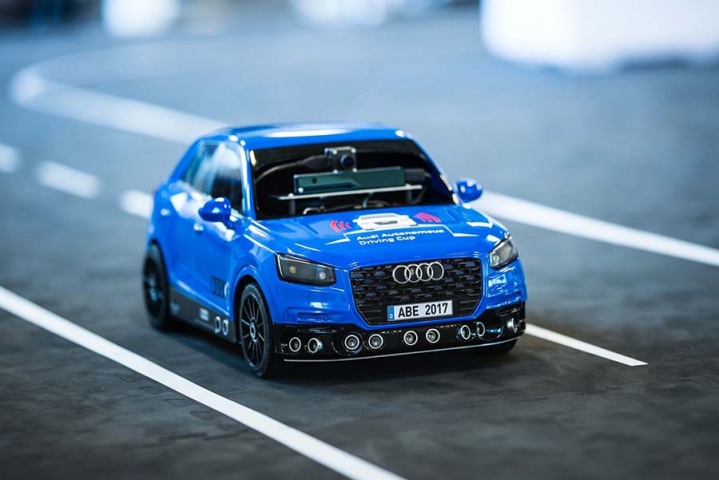
The competition has been designed to encourage young scientists and engineers to hone their skills in autonomy, but while the cars are small, they're using big-boy technology. 3D cameras, an ultra-sound scanner, a reversing camera and a high-end NVIDIA computer chip are all featured on the diminutive robots. "The setup of the sensor system and central computer beneath the model cars' bodywork is essentially the same as in a production automobile," remarked Dr. Florian Knabl, Head of Software Development Tools and Methods at Audi Electronics Venture.
The forward-looking 3D camera also incorporates a laser sensor, similar to that used on the latest generation of A8 luxury saloon, and the rear-facing one is said to be able to deliver much more precise manoeuvring data than before. The ten ultrasound sensors (five in front and five in back) have a range of between 2cm and 4 metres. Each car also gets a nine-axis acceleration sensor for very precise control of the car's movements.
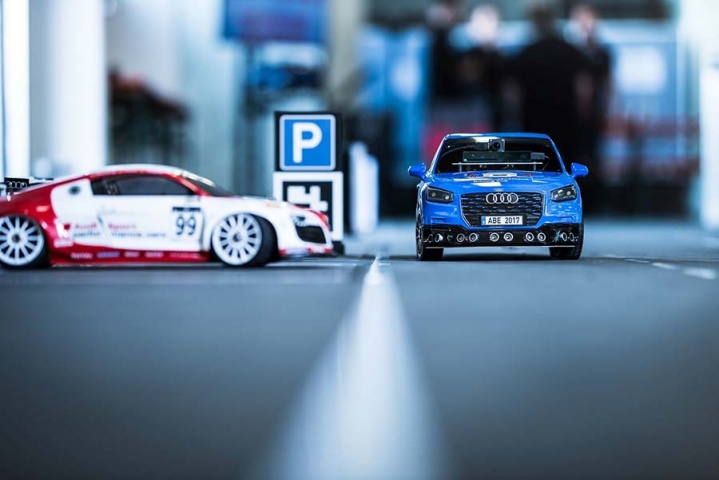
On the tiny track, each car has to negotiate its way, unaided, around obstacles, junctions, and crossing traffic, and has to be able to follow a vehicle in front at a safe distance. They must also be able to deal with temporary traffic signs, bumbling pedestrians, and more.
The university which racks up the best scores in the three-part competition (on-track, a presentation which covers the new tech and how it's been used, and a self-designed 'creative task' for the car to tackle) will get €10,000, with €5,000 and €1,000 on offer for second and third places.
If there is anything about this story we have not covered, you can avail of our expert advice service via the Ask Us Anything page.